5
Series AE1L, AE.E, AE.N, AE.H, AE.V, AED1E, AED2N
Design ID, ZD
4. Description
4.1 Structural design
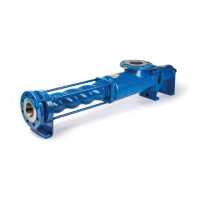
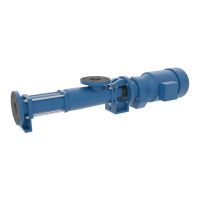
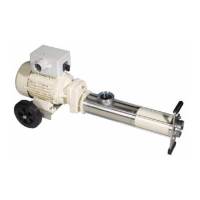
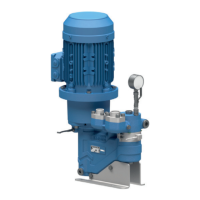
Self-priming, one or two-stage eccentric screw pump.
The conveyor elements are rotor and stator. The input
torque is transmitted via the drive shaft and the joint
shaft to the rotor.
Pressure casing, stator and suction casing are held
together by external casing connection screws (clamp
bolts).
The stuffing box or mechanical seal housing is lo-
cated between the suction casing and the bearing
bracket.
4.1.1 Bearing and lubrication
Joint shaft with liquid-proof clad bolt joints. Greasing
with joint oil.
Bearing of the drive shaft in the bearing bracket
through greased angular contact and groove ball
bearings. Bearings protected against water jets.
4.1.2 Shaft seal
Through uncooled or cooled stuffing box or cooled or
uncooled, maintenance-free, non-released, singular
or double-acting mechanical seal.
4.1.3 Dimensions/branch position/flanges
The dimensions of the pump respectively the pump
aggregate, the branch position and flange dimensions
are to be taken from the tables of dimensions.
4.2 Sound pressure level
The sound pressure level of the pump is below 70 dB
(A).
4.3 Mode of operation
Self-priming, rotating positive-displacement pump.
Conveyor elements are the rotating helical rotor and
the static stator. Both touch in transection with series
AE.E, AE.N, AE.H, AE.V in two points each and with
series AE1L, AED1E, AED2N in three points each,
which form two sealing lines seen across the length of
the conveyor elements with series AE.E, AE.N, AE.H,
AE.V and three sealing lines with series AE1L,
AED1E, AED2N. The content of the sealed chambers
that form with the rotation of the rotor is shifted axially
and totally continuously from the suction to the outlet
side of the pump. No turbulence occurs despite the
rotation of the rotor. The unvarying chamber volume
rules out crushing forces and thus guarantees very
gentle, low-pulsation conveyance.
4.4 Aggregate construction
4.4.1 Drive
By means of non-explosion-protected or explosion-
protected electric motors, geared motors or variable
speed gear motors. Other drive variants (e.g. via V-
belts) are possible.
4.4.2 Shaft coupling and protection against accidental
contact
Shaft coupling according to DIN 740.
A protection against accidental contact according to
DIN EN 809 is attached as soon as the scope of sup-
ply comprises pump, base plate, shaft coupling and
drive.
According to the rules for the prevention of acci-
dents, the pump must be started only with a pro-
tection against accidental contact according to
DIN EN 809.
If a protection against accidental contact is not sup-
plied, same is to be installed by the operator.
4.4.3 Base plate
The pumps of horizontal installation are, as a rule,
mounted with the drive on a common base plate.
Base plates are provided of the steel type of construc-
tion.
5. Installation/Mounting
5.1 Installation
The pumps can be installed horizontally or vertically
with bearing upwards.
5.2 Foundation
The foundation design depends on the size of the
pump and/or the pump aggregate and the local instal-
lation conditions.
For exact data on the pump and aggregate dimen-
sions, please refer to our tables of dimensions.
The foundation may be designed as concrete founda-
tion or load-carrying foundation frame, for example of
the steel type.
All foundation designs are subject to the following:
The foundation must be designed so that it can take
the weight of the pump aggregate on the entire sur-
face.
5.2.1 Arrangement of a steel foundation plate
A steel foundation plate must be designed in such a
way that the base plate makes full contact and can be
secured with bolts or by welding.
If only some of the areas of the
base plate are supported, the plate
sags in the center or the pump aggregate can be
twisted. This influences the alignment of the pump
aggregate can cause high noise emission and dam-
age.
5.2.2 Arrangement of concrete foundations
Concrete foundations must be horizontal, straight and
clean and must fully absorb the load exerted on the
foundations. Concrete foundations must be designed
in such a way that the base plate makes full contact
and can be secured with suitable bolts (see our ag-
gregate drawing).
If only some of the areas of the
base plate are supported, the plate
sags in the center or the pump aggregate can be
twisted. This influences the alignment of the pump
aggregate and can cause high noise emission and
damage.
5.2.3 Fastening of the pump aggregate on the concrete
foundations
After aligning the pump aggregate on the concrete
foundations the securing bolts are diagonally and
evenly tightened.
5.2.4 Arrangement of concrete foundations for poured
base plates
When shuttering the concrete foundations it must be
observed that a gap for aligning the pump aggregate
and applying the mortar compound remains between
the top of the finished foundation block and the bot-
tom of the base plate.



 To Next Page
 Loading...