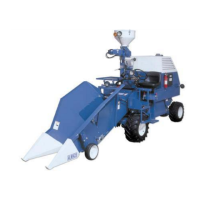
SPC 20 OPERATOR’S MANUAL
C-14 OPERATION
Header Height
Header height is a matter of preference and is dependent on the condition of the crop. In standing
corn the header only needs to be run slightly below the ears. When harvesting fallen stalks lower
the head, so that the snout lifts the stalks before they enter the rollers. When header is too low,
rocks can be picked up in the head, causing serious damage to the machine. Use header lift lever
on console to make height adjustment.
Snout Adjustment
Snout should be set so that it gently lifts fallen crop, but does not ride on the ground and push dirt
into gathering belt. In standing crops adjust the height of the snout points several inches above
the ground. In down crop conditions adjust points to lift the stalks before they enter gathering
belts. Adjustment is most easily done when head is raised.
CAUTION!
Put safety stops in header lift hydraulic cylinder.
1. Remove side access panels on outside snouts (3 quarter turn fasteners).
2. Pull chain through slot and remove hairpin.
3. Replace hairpin through chain with snout in desired position.
4. Replace side panels.
5. Unlock Cam-Loc at the top of the center snout and pivot snout up.
6. Pull chain through slot and remove hairpin.
7. Replace hairpin through chain when snout is in desired position.
8. Lock snout back down with Cam-Loc.
9. For fine adjustment: Loosen jam nut on under side of snout. Turn eye bolt to desired position.
Tighten jam nut.
Header Speed Adjustment
Header speed is very critical to reduce plants from hanging up in the head, as well as promoting
proper feeding into the threshing cylinder. Header should be set equal or slightly faster than the
ground speed. When the header speed is properly set plants will stand straight up in the
gathering belts. Adjustment to the header speed will modify threshing cylinder speed. User
border rows to practice and set header speed.
1. Engage clutch, and bring engine throttle up to maximum RPM.
2. Determine ground speed, slower in wet conditions faster in dry conditions .
3. Be sure hydraulic system is warm and running smoothly. Allow hydraulics to warm up on cold
days.
4. Adjust threshing cylinder speed using knob in control panel. (See Table C-1 Concave / Cylinder
Settings Chart.)
5. Set header speed to a mid-range speed, using dial on the console.
6. Begin harvesting. Make adjustment to the header speed and/or ground speed so that they are
equal. If header speed is too slow the plants will be pushed forward before they are cut, and will
bunch up in the head causing feeding problems. If header speed is too fast plants will be jerked
into the belts and snapping rolls possibly knocking off ears.
7. Continue to adjust threshing cylinder speed to compensate for header speed adjustment.


 To Next Page