Veb- MN (Excell-MCDSe 400)#A(15-5-2007)(in).doc
3
if used, let them evaporate before the intervention. Always remove their remaining traces from the hollow parts of the body or the
cavities (i.e. umbilicus, vagina, etc.), and from underneath the patient. Remember that during the use a spark may cause the explosion
of endogenous gases (intestine), or the fire of oxygen saturated materials (cotton, gauze, etc.);
9. Take always all the metallic objects off the patient (rings, etc.), and be sure he is not in contact with any metallic part connected to the
earth, or which may conduct electricity (table, supports, etc.). Insulate with dry towels the strongly secreting parts of the body and the
contacts skin-to-skin (i.e. between the arm and the body);
10. Place always all the monitoring electrodes, which are not specifically protected, as far away as possible from the electrodes of the
electrosurgical unit. It is not advisable to use needle type or very small monitoring electrodes;
11. Use and place the neutral electrode as follows:
- Bear in mind that, if the neutral electrodes “Split” type double section are not used, the neutral electrode safety circuit of the unit
cannot control the contact between the electrode and the patient tissues (that is, it does not grant the safety of a good contact);
- Make sure it is in perfect conditions (the worn/old neutral electrodes are extremely dangerous for the risk of the burns on the
patients), and choose an area of the body as close as possible to the intervention point (the ideal would be a soft part without hairs,
nor protuberant bones or superficial differences). Clean this area, shave it and massage it, in order to favour the circulation;
- Fix it in a reliable way, without placing anything in-between, nor pressing too much, in order to avoid ischemic zones. Establish
the best possible contact over the entire surface, and make sure it remains constant, especially if the patient is moved or when
liquids are poured. As a matter of fact, a non homogeneous and/or insufficient contact of the neutral electrode generates both an
increase of the current density in the contact points (which produces a higher temperature into the tissues, and creates burns), and a
decrease of the output power into the application point (which leads the operator to raise it, dangerously);
- Never exceed 1/3 of the max. output power for each monopolar current when using the paediatric neutral electrodes, or 1/5 when
using the electrodes for babies;
- Use the disposable neutral electrodes only once, by paying attention to the instructions on the packaging. Make sure they have the
right dimensions (standard for adults with “weight body higher than 15 Kg”: approx. 136cm
2
; standard for children with “weight
body from 5 to 15 Kg”: approx. 84cm
2
);
- As the space between the neutral electrode and the operating area represents a sort of “path” for the HF current, be sure that it is
not diagonal as regards the body, nor on the heart. Remember also that the metallic elements (prosthesis, catheters, etc.) on the
path of the current may cause accumulations of current with consequent heating/burns of the surrounding tissue;
12. Position the cables of the electrodes in a way that they do not touch the patient or any other conducting part.
During the operations, place the unused active electrodes on insulating materials, far away from the patient;
13. Always use the lowest possible power. Bear this warning in mind when intervening on patients (children or babies) for whom small
neutral electrodes are used (see also point 11);
14. Choose the bipolar technique, when operating on small portions of tissue or in cavities;
15. Try to respect as much as possible the suggested working times, and avoid useless short-circuits between the active electrode and the
neutral one;
16. Get in contact with the Technical Service for the use of the “disposable” electrodes;
17. When the device is switched on, check all the settings before using it on the patient, and remember that a failure can provoke an
undesired increase of the power;
18. Remember that also the use of too low powers, if combined with some particular electrodes or accessories, can cause side effects: for
example, when using the Argon gas, the risk of embolism raises if the power of the spray coagulation is not able to produce quickly a
rapid and impermeable eschar on the target tissues;
19. The unit must not be used for final purposes other than those listed in this manual.
THE HF LEAKAGE CURRENTS CONTROL CIRCUIT
The unit is equipped with a leakage currents to earth control circuit because these currents represent one possible source for undesired burns
on the patient or the operators (i.e. a patient who gets in touch with a metallic part of the operating table or with wet/damp towels, a patient
who is placed on a water mattress for surgical needs, an operator who gets in touch with instruments or endoscopes, etc. They all are
possible causes of the increase of such currents).
When the leakage currents to earth overcome 150mA (limit established by the rules), the circuit intervenes as follows:
- It automatically reduces the output power
, so that the currents come back within the agreed limits;
- It gives an alarm signal to the operators (red Led G-HF LEAKAGE on).
SAFETY CIRCUIT OF THE NEUTRAL ELECTRODE
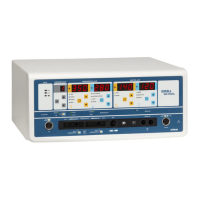
The neutral electrode connection control circuit (area A with 3 Led) operates in the three following manners:
1) With disposable/reusable electrodes with one single section (non split). The circuit controls if the neutral electrode is connected to
the cable, and if the latter is integral and correctly connected to the unit (socket N.P-7). If this is not the case, it stops the delivery of the
power and gives a luminous alarm signal (all the Led are lit, Error Code “no Np”) and a buzzer (loud, intermittent);
2) With disposable/reusable electrodes with twin section (split). The circuit works as described above at point 1, but it also checks if
the quality of the contact between the electrode and the patient tissues is good enough. It operates as follows:
a) When the contact is optimum, the circuit does not intervene;
b) When the contact is not optimum (approx. 70/80% of the surface of a standard electrode for adults is well attached), the circuit
intervenes by giving a first indication to the operators (the first small Led lights up);
c) When the contact decreases to approx. 50/60% of the surface of a standard electrode for adults well attached, the circuit intervenes
by giving a second indication to the operators (the 2 first small Led light up);
d) When the contact decreases to less than approx. 50% of the surface of a standard electrode for adults well attached, the circuit
intervenes by giving a third indication to the operators (the 2 first small Led light up, and the third bigger red Led blinks), and by
automatically reducing to max. 200W the output powers (if higher levels have been selected);
e) When the contact further decreases, the circuit completely stops the delivery of the power, by giving a luminous alarm signal (all
the Led light up, Error Code “no Np”) and also a buzzer (loud, intermittent).
3) When only the memory for the bipolar use (it does not require any neutral electrode) is selected (memory 9), the circuit does not
intervene (the 3 Led are lit, but only to show that the electrode is not connected).



 To Next Page