Veb- MN (Excell-MCDSe 400)#A(15-5-2007)(in).doc
17
TECHNICAL FEATURES
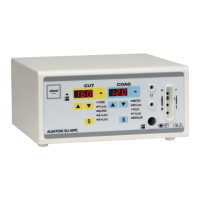
Electronic generator according to the Standards CEI EN 60601-2-2 (IEC 601-2-2 ed. 1991);
General mains switch;
Monopolar and Bipolar working frequency: 440kHz +- 10%;
Classification CEI/IEC: Class I - Type CF,
Classification 93/42 CEI/EEC: IIB;
Output circuit: “floating”, insulated from ground at high and low frequencies, and protected against the use of the defibrillator;
Mains and Absorption: 230 V ~ 50 Hz - 828 VA, Mains Fuses: T 5 A;
Monopolar mode with the possibility to connect 1 or 2 electrodes-holder handles (both of them with hand-switches, or just one with hand-switches and the
other one with pedal foot-switches);
Bipolar mode with the possibility to connect 1 electrode with pedal foot-switches;
Bipolar mode in coagulation by pedal foot-switch or (with a particular selection) by automatic start/stop system, according to the conditions of the tissue
(impedance sensing); adjustable activation delay from 0.5sec to 5sec;
Typical working values: 0-30 = non activated system; less than 900 = start; from 1000 to 1700 = stop;
Functioning memorisation system with 10 memories;
Setting: by keys buttons for the functioning and the powers (indicated on the display in centesimal scale);
Functioning control circuit: by twin microprocessor;
Self-control and self-diagnosis circuit with delivery stop system, acoustic signal, visualization of the fault code;
Neutral electrode safety circuit with acoustic signal (loud and intermittent), luminous signal (red), and visualization of the code;
Protection against liquids: standard, non protected enclosure;
Cooling system: by convection, without fan – Discontinuous functioning: max. 1 hour (10s ON/30s OFF);
Shelf-life: 5 years;
Dimensions and weight: (LxDxH) 38x35x17cm – 15Kg;
Mains cable: 3m long, section 3x1mm
2
.
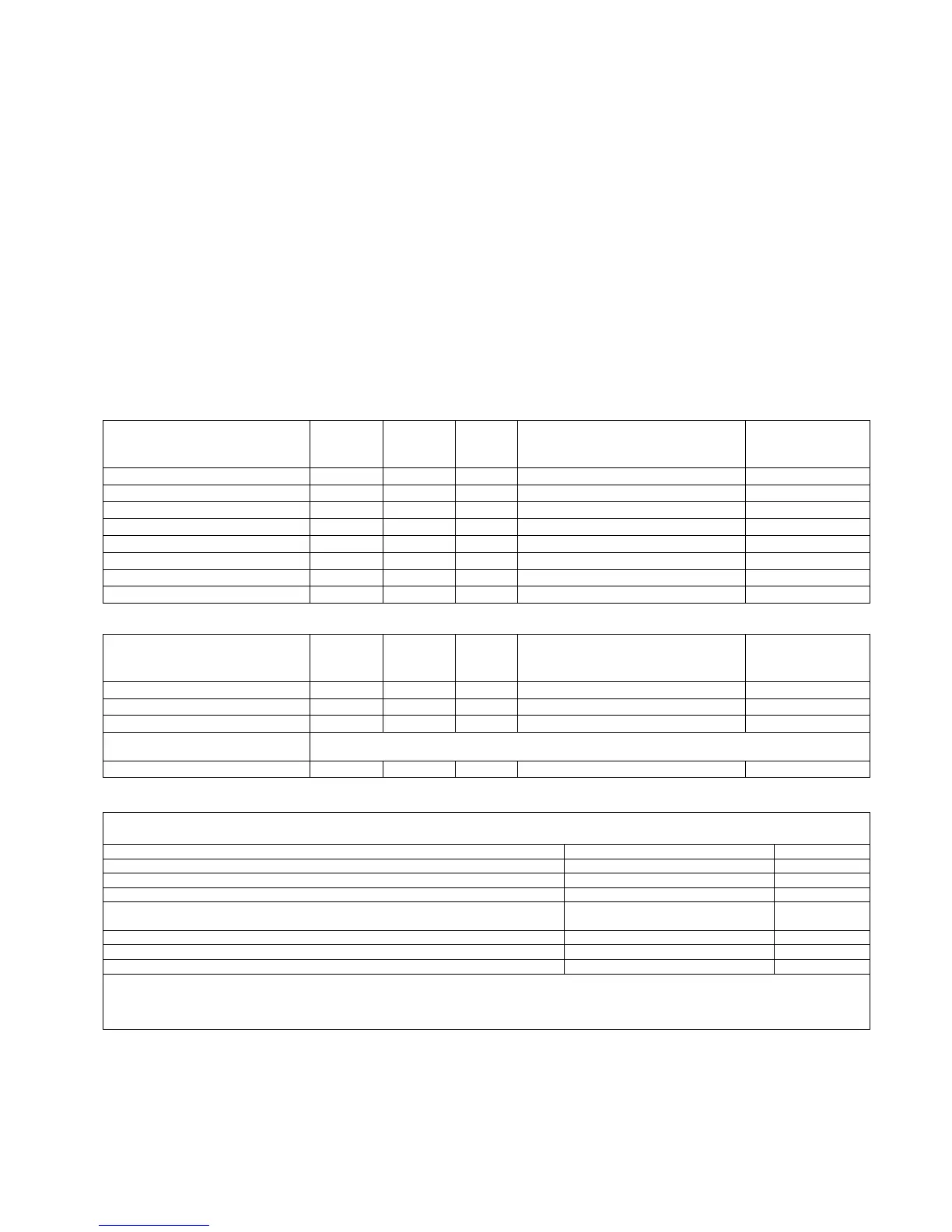
Monopolar Currents Characteristics
Function
Maximum
Power
Load Vp/p
Frequency (F) -
Crest Factor (CF) - Modulation (M) -
Duty Cycle (DT)
Acoustic and
Luminous Signals
Standard Pure Cut: Pure
400 W
350
3450 V F: 440 kHz- CF: 1.6 – M: No – DT: no
Loud tone, Yellow light
Coagulating Cut 1: Blend I
300 W
350
3600 V F: 440 kHz- CF: 2.3 – M: 29 kHz – DT: 65 %
Loud tone, Yellow light
Coagulating Cut 2: Blend II
140 W
600
7600 V F: 440 kHz- CF: 8.1 – M: 19 kHz – DT: 9 %
Loud tone, Yellow light
Coagulating Cut : Endo
250 W
350
1890 V Alternation 50% of Pure and Blend1 - CF:2.2
Loud tone, Yellow light
Fulguration Coagulation: Fulg Forced
150 W
350
4700 V F: 440 kHz- CF: 4.5 – M: 78 kHz – DT: 3.5%
High tone, Blue light
Contact Coagulation: Pin Point Contact
250 W
250
3460 V F: 440 kHz- CF: 2.6 – M: 29 kHz – DT: 50 %
High tone, Blue light
Soft Coagulation: Soft
280 W
250
3440 V F: 440 kHz- CF: 2.5 – M: 29 kHz – DT: 56 %
High tone, Blue light
Spray Coagulation: Spray
140 W
600
7600 V F: 440 kHz- CF: 8.1 – M: 19 kHz – DT: 9 %
High tone, Blue light
Bipolar Currents Characteristics
Function
Maximum
Power
Load Vp/p
Frequency (F) -
Crest Factor (CF) – Modulation (M) -
Duty Cycle (DT)
Acoustic and
Luminous Signals
Pure Cut: Pure
140 W
300
850 V F: 440 kHz- CF: 1.5 – M: No – DT: no
Loud tone, Yellow light
Coagulating Cut : Blend
120 W
300
1000 V F: 440 kHz- CF: 1.8 – M: 29 kHz – DT: 75 %
Loud tone, Yellow light
Micro Coagulation : Micro
120 W
100
450 V F: 440 kHz- CF: 1.7 – M: No – DT: no
High tone, Blue light
Micro Coagulation Automatic Start/Stop :
Micro Auto
See Micro CV
Macro Coagulation: Macro
120 W
100
760 V F: 440 kHz- CF: 1.7 – M: No – DT: no
High tone, Blue light
Conformity EMC/Directive 89/336/CEE: Category A
Suggested distances to keep from not vital devices
Source of the Current RF Typical Power (W) Distance (m)
Microcellular telephones CT1,CT2,CT3 0.01 0.4
Mobile telephones DECT, Wireless devices (modems, LANs) 0.25 2
Mobile telephones (USA) 0.6 3
Hand mobile telephones (GSM, NMT, Europe)
(DECS 1800)
2
8
6
11
Walkie-talkie (police, firemen , protection, maintenance) 5 9
Bag mobile telephones 16 16
Mobile radio (police, firemen, protection) 100 40
For broadcasting stations which use frequencies less than 800MHz, the distance can be established by using the equation: A: d = 4√P
For broadcasting stations which use frequencies between 800MHz and 2.5GHz, the distance can be established by using the equation:
B : d =2.3√P
P = Nominal power of the transmitter in watt (W), established by the manufacturer.



 To Next Page