46
J.
SOLAR PANELS (OPTIONAL)
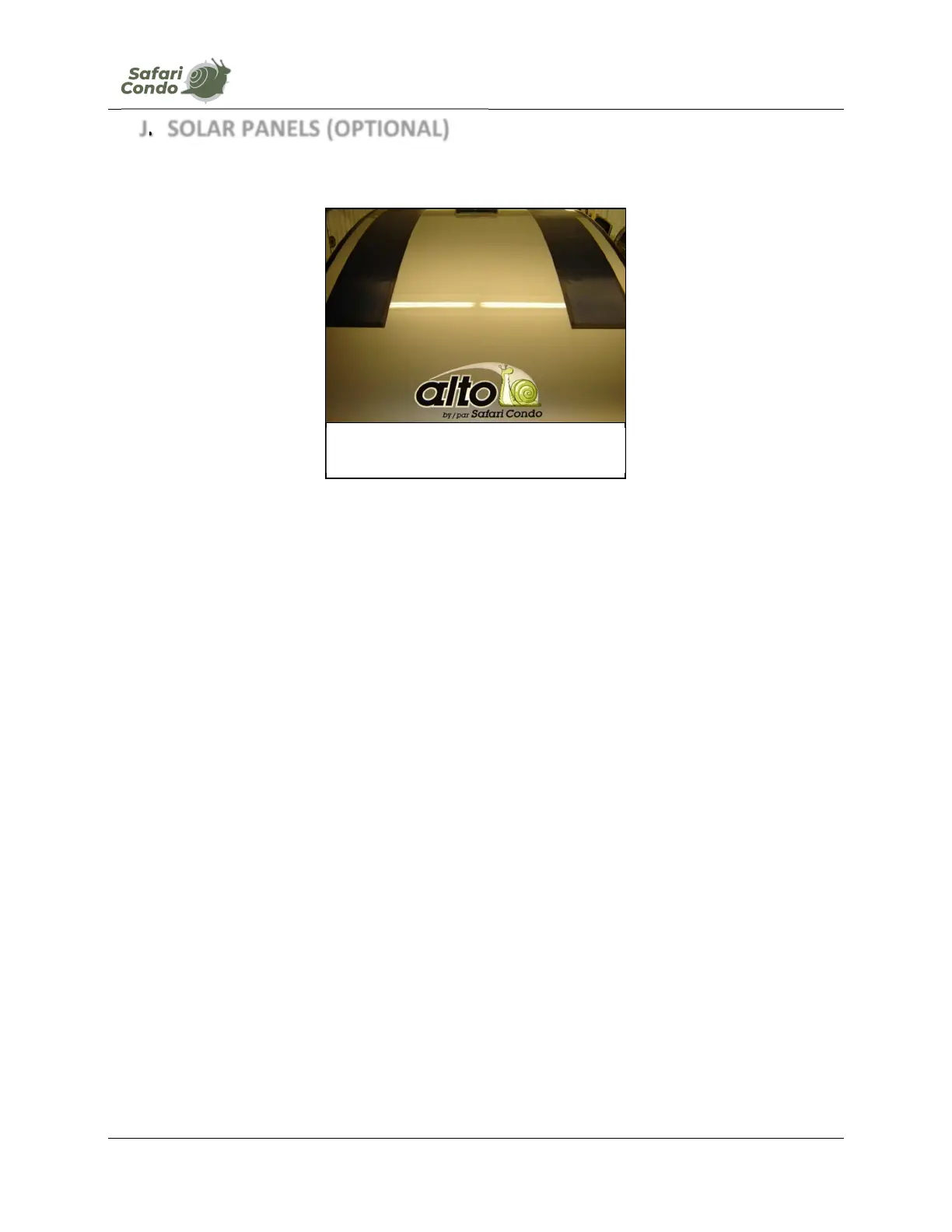
Solar panels (photo J-1) are used exclusively to recharge the battery of the trailer.
Two 110-Watt Solar Panels (220 Watts)
If trailer is equipped with two solar 110 W panels for a total of 220 Watts, they will provide energy
each day, but in variable quantity depending on the amount of sunlight. The trailer will be
completely autonomous as long as energy is managed carefully and there is a good amount of
sunlight. In this case it will be possible to use the inverter for short periods of time without limiting
endurance too severely.
Two 220-Watt Solar Panels (440 Watts)
If trailer is equipped with two solar 220 W panels for a total of 440 Watts, they will provide energy
each day, but in variable quantity depending on the amount of sunlight. The trailer will be
completely autonomous as long as energy is managed carefully and there is a good amount of
sunlight. In this case it will be possible to use the inverter for longer periods of time without
limiting endurance too severely.
Important Facts
A small shaded area on the solar panel will have an equivalent impact as a completely shaded
solar panel because all cells are connected in series. This means that the electrical output of the
solar panel will never be greater than the output of its most shaded cell.
Remember that a solar panel produces energy for only about 8 hours over a 24-hour period. The
maximum electrical output of a solar panel is about 3.3 amps/hour in full noontime summer
sunlight (6.6 a/h for 2 solar panels). On a rainy day, the electrical output will be reduced to about
0.2 to 0.4 amps/hour.
It is important to clearly understand that in order to get longer electrical endurance with solar
panels, electrical consumption inside the trailer must be reduced to a minimum. This way, the
energy provided by the solar panel will be an important share of the total daily electrical
PHOTO J-1
Solar panels



 To Next Page