80
travels 5,000 km per year will not reach such mileage for 20 years. It will need to be replaced
much before that !
It is recommended to replace a tire after eight years even if it is not worn out.
The first step is choosing a tire adequate for the load. The load rating printed on the sidewall will
show the maximum load that can be carried at a defined pressure. As the inflation pressure drops,
the load that can be carried is less. As speed increases, the amount of load that can be carried
also drops. The load rating is also affected by how the tire is used.
Lug Nut Torquing
WARNING:
IT
IS
POSSIBLE
FOR
THE
WHEEL
TO
SEPARATE
FROM
THE
TRAILER
IF
LUG
NUTS
ARE
NOT
TIGHTENED
ENOUGH.
Tighten wheel nuts after first 300 km.
Thereafter, check lug nuts:
• Before each trip.
• Following winter storage.
• Following excessive braking.
In Newton meters (pound feet):
• 13-inch wheels: 115.24 Nm (85 FT-LB)
• 15-inch wheels: 135.58 Nm (100 FT-LB)
NOTICE: Use a torque wrench to tighten lug nuts. Tightening with an
impact wrench is not recommended.
See Specification Section in this manual for wheel torque ratings.
Proper wheel nut torque is very important to safe and dependable towing of your trailer. The
wheel and axle systems used in travel trailers are similar, yet different, in many ways to those
used on cars and trucks. These differences are important and require special attention to wheel
nut torque both while the trailer is new and throughout the trailer’s life.
Trailer wheels must carry much higher loads per wheel than passenger car or truck wheels. Each
wheel may carry 1000 pounds and higher. When you go around corners, especially slow, tight
ones, the wheels on your trailer are subject to these strong side loads. This tends to flex the wheel
and gradually loosen the wheel nuts. Although the materials and manufacturing methods are
maximized for this kind of service, these extra loads can cause stress, which can result in flexing
and loosening of wheel nuts.
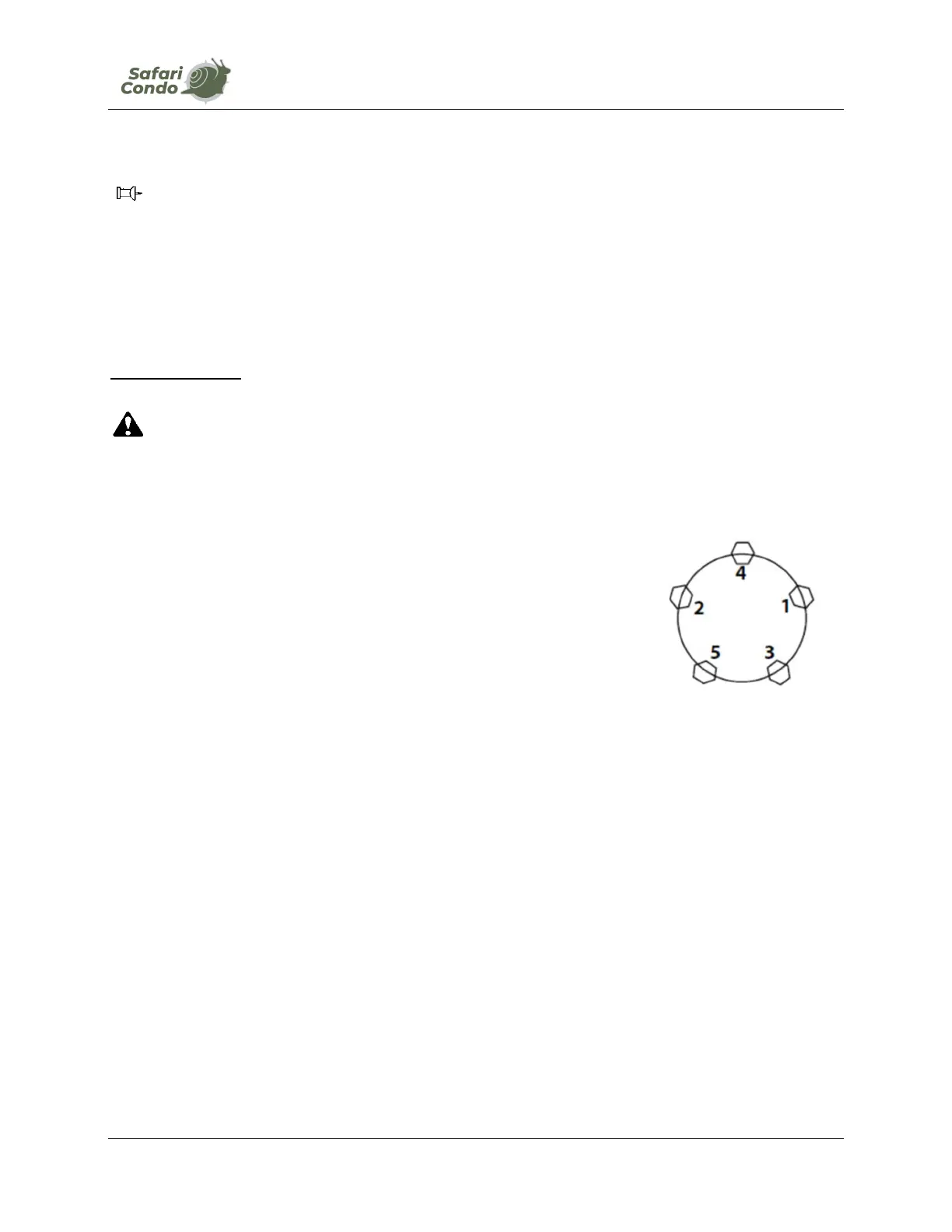
FIGURE L-1
Lug nuts



 To Next Page