PAGE 2 Pub. No. 11-AC19D1-1
INSTALLER'S GUIDE
8. Locate and install indoor coil or air handler in accordance with
instruction included with that unit.
NOTE: Refer to “Refrigerant Piping Software” Pub. No.
32-3312-0*, and “Refrigerant Piping Manual” Pub. No.
32-3009-0* (the position of the * denotes latest revision
number).
C. INSTALLING REFRIGERANT LINES
▲
A
TI
N:
If using existing refrigerant lines
make certain that all joints are brazed, not soldered.
Condensing units have provisions for braze connections.
Pressure taps are provided on the service valves of outdoor unit
for compressor suction and liquid pressures.
The indoor end of the recommended refrigerant line sets may be
straight or with a 90 degree bend, depending upon situation
requirements. This should be thoroughly checked out before
ordering refrigerant line sets.
The gas line must always be insulated.
▲
A
TI
N:
In scroll compressor applications,
dome temperatures may be hot. Do not touch top of com-
pressor, may cause minor to severe burning.
The units are factory charged with the system charge required
when using fifteen (15) feet of rated connecting line. Unit name-
plate charge is the same.
Final refrigerant charge adjustment is necessary. Use the
Charging Information on Page 6 or in the unit Service Facts.
1. Determine the most practical way to run the lines.
2. Consider types of bends to be made and space limitations.
NOTE: Large diameter tubing will be very difficult to rebend once
it has been shaped.
3. Determine the best starting point for routing the refrigerant
tubing — INSIDE OR OUTSIDE THE STRUCTURE.
4. Provide a pull-thru hole of sufficient size to allow both liquid
and gas lines.
5. Be sure the tubing is of sufficient length.
6. Uncoil the tubing — do not kink or dent.
7. Route the tubing making all required bends and properly
secure the tubing before making connections.
8. To prevent a noise within the building structure due to vibra-
tion transmission from the refrigerant lines, the following precau-
tions should be taken:
a. When the refrigerant lines have to be fastened to floor joists
or other framing in a structure, use isolation type hangers.
b. Isolation hangers should also be used when refrigerant
lines are run in stud spaces or enclosed ceilings.
c. Where the refrigerant lines run through a wall or sill, they
should be insulated and isolated.
d. Isolate the lines from all ductwork.
D. SERVICE VALVE OPERATION
BRASS LIQUID AND GAS LINE SERVICE VALVES
The Brass Liquid and Gas Line Service Valves are factory shipped
in the seated position to hold factory charge. The pressure tap
service port (when depressed) opens only to the field brazing side
of the valve when the valve is in the seated position. The liquid
line valve is not a back seating valve (see WARNING below).
▲ WARNIN
:
Extreme caution should be ex-
ercised when opening the Liquid and Gas Line Service
Valves. Turn valve stem counterclockwise only until the
stem contacts the rolled edge. (See Figures 3 and 5) No
torque is required.
BRASS GAS LINE BALL SERVICE VALVE
The Brass Gas Line Ball Service Valve is shipped in the closed
position to hold the factory refrigerant charge. The pressure tap
service port (when depressed) opens only to the field brazing side
when the valve is in the closed position.
The Gas Line Service Valve is full open with a 1/4 turn. See Figure 4.
BRAZING REFRIGERANT LINES
1. Remove lower access cover to access service valves.
2. Before brazing, remove plugs from external copper stub tubes.
Clean internal and external surfaces of stub tubes prior to
brazing.
3. Cut and fit tubing, minimizing the use of sharp 90° bends.
4. Insulate the entire gas line and its fittings.
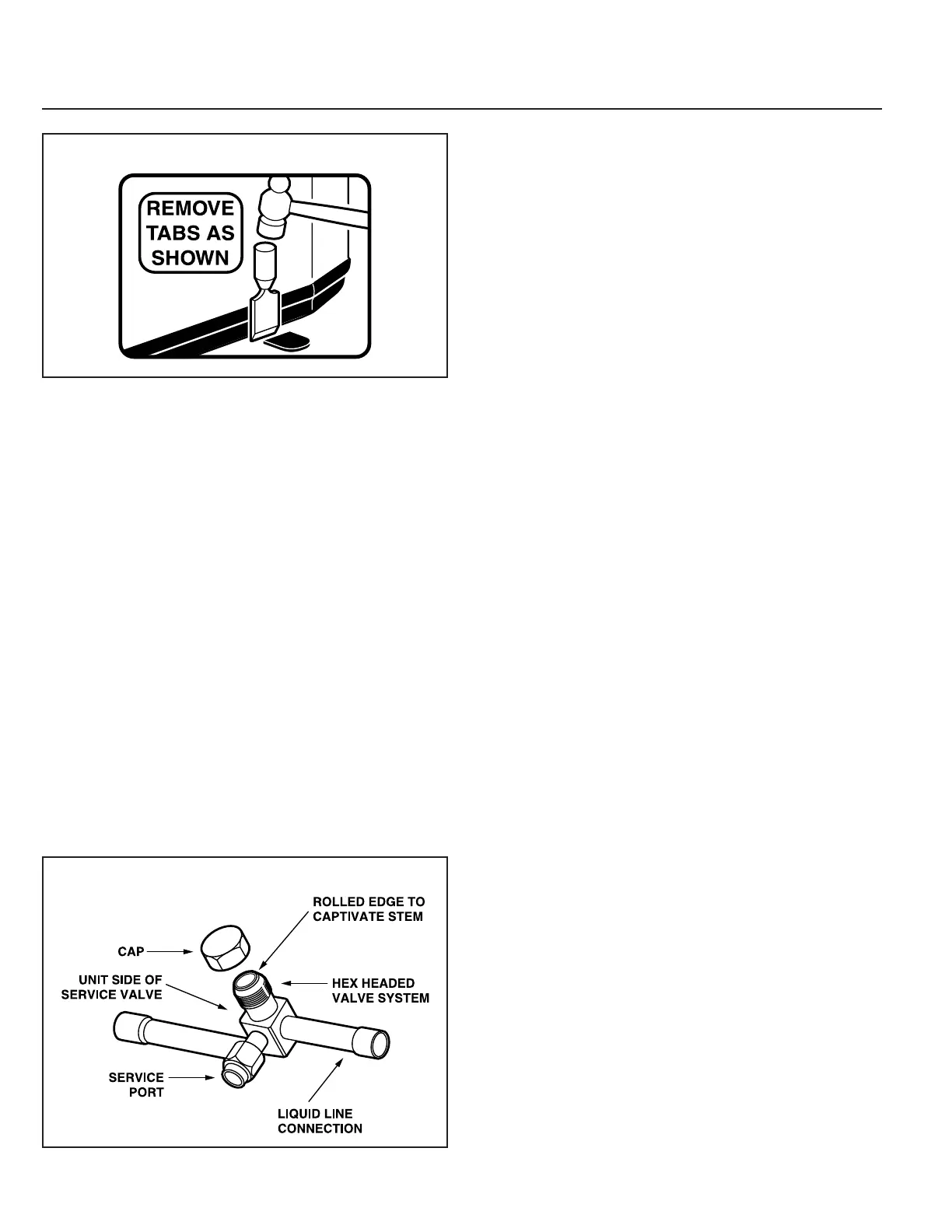
BASEPAN TAB REMOVAL
2
3
LIQUID LINE SERVICE VALVE



 To Next Page