18-CE03D1-1F-EN
27
Vent Terminations
For DIRECT VENT APPLICATION: The Furnaces must be vented to
the exterior of the house and combustion air MUST come through the
inlet air pipe from OUTSIDE AIR.
Note: BAYVENT* accessories can be used for inlet and outlet
terminals when the pipes do not exit the structure together. For
Canadian applications, venting systems must meet ULC-S636
requirements.
For NONDIRECT VENT APPLICATION: The Furnace shall be vented
to the exterior of the house, but combustion air may enter from the
surrounding area as long as combustion air requirements are met.
(See AIR FOR COMBUSTION AND VENTILATION)
Vent terminations
• BAYVENT200B
• BAYAIR30AVENTA
Vent terminations — Canadian applications. Meets ULC-S636
requirements.
• BAYVENTCN200B
• BAYAIR30CNVENT
FURNACE VENT / INLET PIPE INSTALLATION IN TWO
PRESSURE ZONE CONFIGURATIONS
There are many different variations of the vent / inlet air pipe
combination. The vent / inlet air combination used for installation of
these Furnaces depends on the needs of the location. However, these
guidelines must be followed:
1. The Furnace must vent outside the structure.
2. Furnace combustion air requirements must be met for non-direct,
single pipe applications.
3. For direct vent application of these Furnaces, the vent pipe and air
inlet pipe do not have to exit in the same air space or even on the
same surface of the structure. However, the longest individual
pipe will decide the value for the longest allowable equivalent
vent/ inlet air length as shown in the vent length table.
Note: For single pressure zone applications, see the Horizontal
Venting section.
The following are EXAMPLES ONLY.
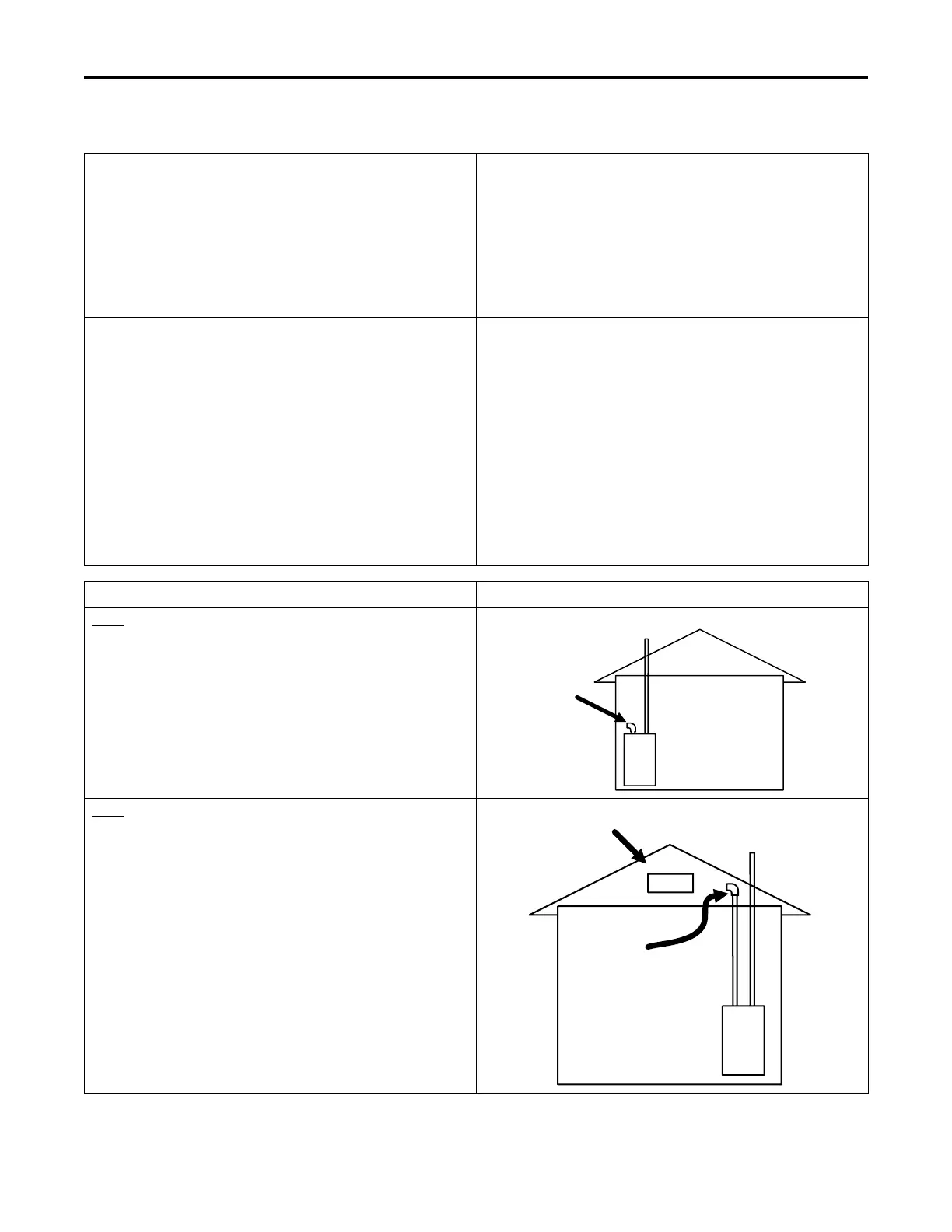
EX. 1 —
Example 1 shows the vent pipe exhausting through the roof and the
inlet air coming from the interior of the house. The inlet air coming
from the interior of the house must meet combustion requirements for
area, etc., as shown in the section AIR FOR COMBUSTION AND
VENTILATION in this Installer’s Guide.
Note: If only the flue gas pipe is to the outside of the structure, a
straight section of pipe (long enough to exit the Furnace
cabinet) must be attached to the inlet air side with an elbow
(which is 5 to 10 equiv. ft.) installed on the end to prevent dust
and debris from falling directly into the Furnace.
EX. 2 —
The inlet air does not have to come from outside the structure.
Example 2 shows the inlet air, may come from the attic if the
requirements for combustion air are met as shown in the section AIR
FOR COMBUSTION AND VENTILATION.
Note: If only the flue gas pipe is to the outside of the structure, a
straight section of pipe (long enough to exit the Furnace
cabinet) must be attached to the inlet air side with an elbow
(which is 5 to 10 equiv. ft.) installed on the end to prevent dust
and debris from falling directly into the Furnace.
Furnace
Air
Inlet
Vent
Attic
Vent
(See Note)
FFuurrnnaaccee GGeenneerraall IInnssttaallllaattiioonn



 To Next Page