EasyManua.ls Logo

AMOT B - User Manual

AMOT B
26 pages
Print Icon
To Next Page IconTo Next Page
Loading...
Doc No: OMMB00010 Revision: 7 Mar 2014
Model B Valve
Thermostatic valve for
diverting and mixing
applications
Installation, Operation
and Maintenance Manual
Question and Answer IconNeed help?

Do you have a question about the AMOT B and is the answer not in the manual?

Summary

Introduction and Safety Information

Manual Scope and Coverage

Details the manual's scope, covering installation, operation, and maintenance of the AMOT Model B Valve.

Safety Precautions and Hazard Definitions

Outlines safety hazards, precautions, and defines warning/caution terminology for safe operation.

Product Support and Service Information

Provides details on settings, alterations, and contact information for spares and service.

Document Typographical Conventions

Explains the usage and formatting of footnotes within the document for clarity.

Description of the Model B Valve

Model B Valve Overview

Describes the Model B Valve's function as an automatic 3-way fluid temperature controller.

Manual Override Functionality

Explains the optional manual override feature for emergency use and operation.

Model B Valve Features and Benefits

Lists typical applications and key advantages of the Model B Valve, including cost and robustness.

Model Number Identification System

Details the coding system for identifying specific AMOT Model B Valve configurations and options.

European Union Regulatory Compliance

Pressure Equipment Directive (PED) Compliance

Explains the applicability of the PED to the Model B Valve and its nameplate information.

ATEX Directive for Hazardous Areas

Covers ATEX Directive compliance for mechanical equipment in hazardous areas, including designation.

Machinery Directive Requirements

Addresses the Machinery Directive for assemblies and the valve's classification as Partly Completed Machinery.

Installation and Start-up Procedures

Valve Installation Guidelines

Provides essential guidelines and checks required before proceeding with valve installation.

Pre-Installation Checks and Preparation

Covers pre-installation checks, suitability assessment, and system considerations.

Valve Mounting and Pipe Alignment

Details proper mounting orientation, support, and alignment for the valve in the piping system.

System Start-up Procedures

Describes procedures for system start-up and monitoring valve performance post-installation.

Valve Operation and Control

Automatic Valve Operation Principle

Explains the automatic, power-free operation principle of the Model B valve using thermal expansion.

Diverting Application Operation

Details the valve's function and temperature control logic in diverting applications.

Mixing Application Operation

Details the valve's function and temperature control logic in mixing applications.

Manual Override Operation and Cautions

Provides instructions and cautions for using the manual override feature on the valve.

Maintenance and Servicing

Valve Dismantling Procedure

Provides a step-by-step guide for safely dismantling the valve for inspection or repair.

Valve Reassembly Instructions

Details instructions for reassembling the valve, including lubrication and component fitting.

User Maintenance Parts Identification

Lists user-replaceable parts and the number of elements for different valve sizes.

Troubleshooting Common Issues

Troubleshooting: System Temperature Too Cold

Diagnoses common causes and provides solutions for systems operating below the desired temperature.

Troubleshooting: System Temperature Too Hot

Diagnoses common causes and provides solutions for systems operating above the desired temperature.

Technical Specifications and Handling

General Valve Technical Specifications

Provides an overview of the valve's general technical specifications.

Valve Materials and Seal Options

Details the available body materials and seal options for Model B Valves.

Maximum Working Pressure Specifications

Lists maximum working pressures for various valve types and materials.

Valve Handling and Weight Information

Information on valve weights and safe handling procedures.

Valve Storage Recommendations

Provides guidelines for proper storage conditions to maintain valve integrity.

Overview

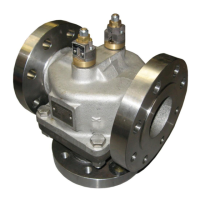
The AMOT Model B Valve is a thermostatic valve designed for fully automatic, 3-way fluid temperature control in diverting or mixing applications. It is suitable for use in engine water jackets, lubricating oil cooling systems, and various process control and industrial applications. The valve operates without an external power source, relying on the expansion of a wax/copper mixture that is highly sensitive to temperature changes to regulate flow.

Function Description:

The thermostatic element within the Model B valve is fully enclosed and factory-set, ensuring tamper-proof operation. It is available with set temperatures ranging from 13 to 116°C (55 to 240°F). The valve's operation is based on the principle that the wax/copper mixture expands when warmed, creating forces that act upon a sliding valve to regulate fluid flow.

In diverting applications (controlling outlet temperature from a load source), temperature is sensed at port A. The valve remains open to port B (bypass) until the fluid temperature reaches 3-6°C (5-10°F) below the nominal setting. At this point, the valve begins to move, progressively closing port B and opening port C (the cooler connection). If the temperature continues to rise, port B will be fully closed 4 to 6°C (8-10°F) above the set temperature.

In mixing applications (controlling inlet temperature to a load source), the hot supply is connected to port B, the cold supply to port C, and the mixed flow exits via the temperature sensor at port A. Due to the position of the controlling wax 'pill', the controlled temperature in mixing applications may be 2-3°C above the nominal setting.

Usage Features:

  • Automatic Operation: The valve is completely automatic and requires no external power source, simplifying installation and reducing costs.
  • Factory Set: No user setting is required, making it a "fit and forget" solution.
  • Manual Override (Optional): Some Model B Valves can be fitted with a manual override, allowing the operator to drive the unit towards the maximum cooling position in emergencies. On larger valves with multiple elements, each element may have its own override. This feature can also be used to partially lock an element open to prevent cooler freezing or to slightly adjust operating temperature.
  • Robust Design: Capable of handling high vibration and shock applications.
  • Versatile Applications: Suitable for lubricating oil temperature control, jacket water high temperature (HT), secondary water low temperature (LT), heat recovery, water saving applications, boiler inlet temperature control, co-generation, cooling towers, and seawater cooling.
  • Wide Range of Sizes and Materials: Available in nine sizes and various materials (Aluminium, Bronze, Cast Iron, Ductile Iron, Steel, Stainless Steel) to suit different fluids and applications.
  • Leakhole Options: Can be specified with or without leakholes of various sizes (1/8" to 1/2" Dia) and quantities (up to nine elements with leakholes for 4" size).

Important Technical Specifications:

  • Nominal Bore Sizes: Ranging from 1 1/2 inch (DN40) to 8 inch (DN200).
  • Number of Elements: Varies by valve size, from 1 element for 1 1/2" and 2" valves to 16 elements for 8" valves.
  • Control Temperature Range: Elements are available with set temperatures from 13 to 116°C (55 to 240°F). The "Crack Open" temperature is when the valve begins to open, and "Full Open" is when it is fully open.
  • Maximum Working Pressure: Varies by material and size. For example, Bronze valves typically have a maximum working pressure of 10 bar, while Steel and Stainless Steel valves can go up to 45 bar for certain sizes.
  • Materials:
    • Body: Aluminium, Bronze, Cast Iron, Ductile Iron, Steel, Stainless Steel.
    • Internal (elements): Stainless Steel and Bronze (with an option for Nickel plating).
    • Seal: Buna Nitrile, Viton, Neoprene, or Ethylene Propylene Rubber.
  • Valve Handling Weight: The mass of the units varies significantly, from 11 kg (25 lb) to 315 kg (695 lb), depending on size and material. Appropriate manual handling precautions must be applied.
  • Pressure Equipment Directive (PED) 97/23/EC: Classified as a Pressure Accessory. For Group 2 fluids (water, lubricating oil), it falls into the Sound Engineering Practice (SEP) category, not requiring CE marking. Some sizes are rated to SEP for Group 1 fluids.
  • Hazardous Area Directive (ATEX) 94/9/EC: Assessed as Group II equipment, suitable for hazardous gas environments (G). Uses constructional safety (c) as the method of protection. Not for use in mines or areas with combustible dust. Ambient temperature range for ATEX-approved valves is typically -20°C to +40°C unless otherwise specified.

Maintenance Features:

  • Minimal Maintenance: Properly applied and installed AMOT thermostatic valves require minimal maintenance.
  • Periodic Inspection: Inspection at 2 or 3-year intervals is recommended to detect normal wear.
  • Element Replacement: The thermostatic element can be changed for maintenance or to achieve a different set temperature. For the 8B valve, the element assembly can be removed without removing the valve from the piping. All other sizes require removal from the piping.
  • Seal Kits: Available for various valve sizes and materials (Nitrile, Viton, Neoprene). Note that newer 4", 5", 6", and 8" B valves use 'O' rings for sealing, and seal kits for these valves contain both original gasket types and 'O' rings.
  • Troubleshooting Guide: The manual provides a guide to identify and locate problems if the cooling system does not operate at the desired temperature, covering issues like insufficient heat, wrong element selection, oversized/undersized valve, incorrect installation, worn seals, and foreign matter.
  • Storage: Valves should be stored dry, protected from dirt, airborne contaminants, frost, and direct sunlight. Storage is permitted down to -40°C (-40°F) for Nitrile, EPDM, Neoprene 'O' rings and -26°C (-14.8°F) for Viton 'O' rings, followed by a slow temperature increase. 'O' rings should be replaced after 7 years.

AMOT B Specifications

General IconGeneral
BrandAMOT
ModelB
CategoryControl Unit
LanguageEnglish

Related product manuals