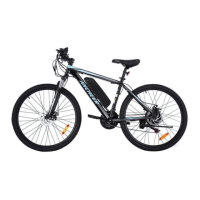
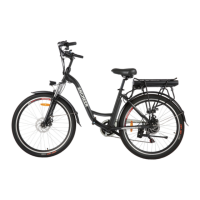
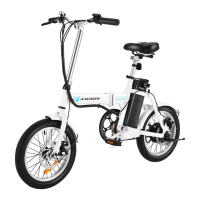
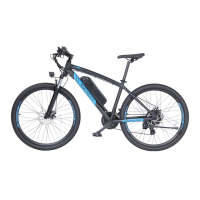
Need help?
Do you have a question about the Ancheer AMA005757 and is the answer not in the manual?
Essential pre-ride precautions and usage rules for safe operation.
Overview of the ANCHEER e-bike brand, its philosophy, and product features.
Lists all components included in the product package for unboxing and assembly.
Details the specific tools provided for bike assembly and adjustments.
Guide to selecting the appropriate frame size for rider height and comfortable riding.
Steps to perform before starting a ride, including checks of circuits and tires.
Rules and recommendations for safe riding practices while operating the e-bike.
Recommended actions after completing a ride, including cooling down and cleaning.
Step-by-step guide for adjusting the mechanical disc brakes for optimal performance.
Advice on gear selection for different riding speeds to enhance range and efficiency.
Instructions for mounting and securing the handlebar assembly to the stem.
Guide for inserting and adjusting the saddle tube and seat height correctly.
Steps to attach the front fender and connect the headlight for visibility and protection.
Detailed instructions for correctly mounting the front wheel onto the fork.
Instructions for correctly identifying and attaching the left and right pedals.
Explanation of the display layout, indicators, and button functions on the meter.
Important warnings and precautions to follow during e-bike operation.
Guide on how to access and modify system parameters on the e-bike display.
Details for cumulative mileage, auto cruise, and metric/imperial switching.
Instructions on setting the e-bike's maximum speed limit via the parameter menu.
Guidelines for battery handling, storage, temperature limits, and safety precautions.
Instructions for safe and proper charging of the e-bike battery using the provided charger.
Key reminders for initial battery charging and general battery health.
Guidelines for environmentally sound disposal and recycling of used batteries.
Details the terms and coverage of the limited hardware warranty for the e-bike.
Information on how to access customer support for product inquiries and assistance.
Comprehensive list of technical specifications for the e-bike components and performance.
Notes on factors influencing the e-bike's speed and riding range.
General warnings and guidelines for safe and intended use of the e-bike.
Restrictions on who can use the e-bike, including age and physical/mental capabilities.
Specific operational details and safety warnings related to fasteners, controls, and reflectors.
This document is an instruction manual for an ANCHEER E-Bike, model AMA005757. It provides comprehensive guidance on the safe and effective use, assembly, maintenance, and warranty information for the electric bicycle. The manual emphasizes the importance of reading and understanding the instructions thoroughly before the first ride to ensure safety and proper operation.
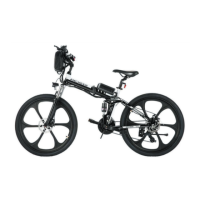
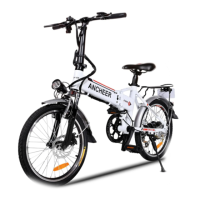
The ANCHEER E-Bike is an electric bicycle designed for recreational riding and transportation. It features a pedal-assist system and a throttle for controlling speed, offering riders various modes of operation. The e-bike is equipped with a display meter that shows current speed, pedal assist level, total mileage, and power status. It is designed to provide an efficient and enjoyable riding experience, combining traditional cycling with electric assistance. The e-bike is suitable for individuals between 16 and 45 years old, with a maximum load capacity of 120KG.
Before riding, users are instructed to perform several checks, including verifying brake functionality, handlebar and wheel fastening, reflector condition, and tire pressure (recommended 35-45 PSI). The manual highlights the importance of ensuring the power and lighting circuits are working correctly and that the battery capacity meets riding demands.
During operation, riders should wear safety helmets and protective gear, abide by traffic rules, and avoid riding on motorized lanes or roads with multiple pedestrians. The e-bike is not intended for off-road use or extreme sports. It is forbidden to ride with one hand. The manual advises against carrying people or objects beyond legal requirements and the bike's maximum load.
The e-bike features a meter operation system with a function button and a power on/off button. Users insert the key into the battery and turn on the power switch to activate the system. The throttle can be used to control speed, and the pedal assist mode offers three levels (M1, M2, M3) for varying degrees of assistance. The meter also allows for parameter settings, such as cumulative mileage (P05), auto cruise disable/enable (P08), and metric/imperial switching (P09). The maximum speed can be set (P10), with a default of 32 km/h (20 mph).
Brake adjustment is crucial for safe operation. The manual details how to adjust the barrel adjuster and positioning bolts to ensure proper brake pad gap and rotor alignment. If the rotor rubs against the brake pads or the gap is too large, the cable clamp bolts can be loosened or tightened to adjust the gap. Shifting recommendations suggest using a low-speed gear for starting and low-speed riding, and a higher gear for higher speeds to increase range.
After riding, especially after heavy use, users should avoid touching hot surfaces like the disc brake rotor. When folding the kickstand, it must be securely locked to prevent the bicycle from falling. Any moisture on the bicycle should be wiped dry promptly.
Regular maintenance is emphasized to ensure the e-bike's longevity and safe operation. Users should check the front and rear wheels to ensure they are centered in the fork or frame. After riding, the bike should be stored in a place away from direct sunlight and rain. Water showering is forbidden; instead, the car body surface should be wiped with a semi-dry cloth.
It is crucial not to touch the charging hole with metal objects to prevent short circuits. All cables and cable housings should be checked for fraying, breaks, rust, or corrosion and replaced if necessary. The motor and brake should be checked frequently, and the brake area should not be filled with oil. Brake pads need regular inspection for damage and replacement when worn.
All screws and fasteners on the e-bike should be regularly checked and reinforced to prevent injury and unnecessary wear. Recommended torque values are provided for key components: horizontal screw (60-80 kgf.cm), stem screw (175-200 kgf.cm), seat cushion screw (175-250 kgf.cm), and wheel screw (320-450 kgf.cm).
The chain tension should be checked regularly and adjusted using the chain regulator. Tires need inspection for scratches, cracks, or excessive wear, and the inner tube and valve should be perpendicular to the wheel hub. Punctured, damaged, or excessively worn inner and outer tires must be replaced immediately by professional technicians.
Modifying key structural parts such as the frame, front fork, standpipe, and electrical function parts is forbidden, as it voids the warranty and can lead to serious injury or death. Only original parts should be used for replacement.
Battery maintenance includes keeping it out of reach of children and storing it within specified temperature ranges (charging at 0°C~40°C/32°F~104°F, discharging at -5°C~40°C/23°F~104°F). The battery should be kept dry and away from acidic or alkaline liquids, rain, fire, and high temperatures. Reversing the positive and negative poles, damaging, disassembling, or short-circuiting the battery is strictly forbidden. Used batteries are hazardous chemicals and should be recycled by professionals.
For charging, only the original special charger should be used, and the charging time should not exceed 12 hours with a current not exceeding 2A. Charging should occur in a ventilated environment, not in confined or hot spaces. The battery should be inserted first, then the mains connected. After full charge, the mains should be disconnected before unplugging the battery. The charger should not be connected to AC power without a load for extended periods. Any abnormal indicator light, peculiar smell, or overheating of the charger requires immediate cessation of charging and repair or replacement. The charger should be protected from foreign objects and liquids. When transporting the charger, it should be placed in a toolbox with shock absorption. For long-term storage, the battery should be kept in a cool, dry place and charged for two hours monthly.
The manual also warns against using an incompatible battery charger, as it can lead to electrical fires, explosions, or severe burns. The battery and charger should be placed indoors in a clean, dry, well-ventilated area, free from dust, moisture, and combustibles. The battery power switch should be off before attaching the charger. Contact between battery contacts and metal objects should be avoided to prevent short circuits. Overcharging can cause electrical fires, explosions, or severe burns, so the battery should be disconnected from the charger once fully charged and the charger unplugged from the wall outlet when not in use. Damaged batteries or chargers should never be used.
 General
| Type | Electric Mountain Bike |
|---|---|
| Battery | 36V 8Ah Lithium-Ion |
| Frame Material | Aluminum Alloy |
| Wheel Size | 26 inches |
| Gears | 21-speed |
| Suspension | Front Suspension |
| Maximum Load | 150 kg |
| Motor | 250W Brushless Motor |
| Brakes | Front and rear disc brakes |

 To Next Page