Need help?
Do you have a question about the ANDELI MIG-270TPL and is the answer not in the manual?
Safety precautions against electric shock during welding operations.
Health hazards from welding smoke and gases, emphasizing ventilation.
Measures to protect eyes and skin from harmful arc rays.
Precautions to prevent fires caused by welding sparks and the need for extinguishers.
Risks of hearing damage from welding noise and use of ear protection.
Instructions for addressing machine malfunctions.
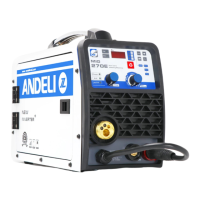
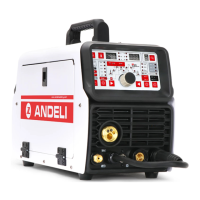
Highlights technological features and operational benefits of the welding machine.
Steps for inspecting the machine and its contents after unpacking.
Conditions for a suitable working environment, emphasizing ventilation.
Steps for connecting the machine for High-Frequency TIG welding.
Schematic illustrating the internal functional blocks of the welding machine.
Detailed table listing all technical parameters and specifications of the welder.
Explanation of welding duty cycle measurement and influencing factors.
Detailed explanation of buttons, indicators, and displays on the welder's front panel.
Identification of components and connections on the rear of the welding machine.
General setup and operational guidelines for MIG welding.
Step-by-step instructions for correctly fitting the wire spool onto the feeder.
Procedures for loading the welding wire into the wire feeder mechanism.
Specific setup steps for performing MIG welding without shielding gas.
Instructions for setting up the machine for MIG welding with shielding gas.
Guidelines for configuring the welder for MMA or STICK welding.
Safety reminder regarding protective gear for MIG welding due to its strong arc.
Explanation of the units and conventions used in the welding settings chart.
Introduction to basic MIG welding principles and techniques.
Explanation and illustration of the Gas Metal Arc Welding (GMAW) process.
Explanation and illustration of the Flux Cored Arc Welding (FCAW) process.
Important warnings regarding pulling the gun back and electrode wire energization.
Diagrams illustrating correct torch angles for various welding positions and joint types.
Explanation of how travel speed impacts weld width and penetration.
Overview of variables controlling the GMAW process for carbon steel.
Factors influencing initial welding parameter selection like material and thickness.
Key parameters that can be adjusted during welding to control bead formation.
Fine-tuning variables like stick-out and wire feed speed for optimal welds.
Guidance on setting welding current and voltage for optimal arc performance.
Factors to consider when choosing the appropriate electrode wire size.
Discusses the impact of welding speed on efficiency and weld quality.
Guidelines for optimal wire stick-out length to balance productivity and spatter.
Recommendations for setting CO2 gas flow rate for effective shielding.
Specific settings for achieving good welds on butt joints.
Recommended parameters for performing flat fillet welds.
Settings for executing fillet welds in the vertical orientation.
Guidelines for setting parameters for lap welding applications.
Precautions regarding environmental conditions for safe and effective welding.
Crucial safety advice including ventilation, over-current, over-load, and electric shock avoidance.
Steps to safely disconnect power and ensure proper grounding before maintenance.
Warning to keep body parts and tools away from moving or electrical components.
Instructions for cleaning dust and debris from the machine using compressed air.
Guidance on proper storage of the machine when not in use for extended periods.
Daily checks for the control panel, fan, power supply, and other parts.
Daily inspection points for the welding torch, including nozzle, contact tip, and wire feeding hose.
Check for proper installation and unblocking of the torch diffuser.
Daily checks for the wire feeder components like pressure adjusting handle and wire feeding wheel.
Inspection of torch, output, input, and earth cables for damage or loose connections.
 General
| Welding Process | MIG/MAG |
|---|---|
| Power Factor | 0.73 |
| Efficiency | 85% |
| Wire Diameter | 0.8-1.2 mm |
| Protection Class | IP21S |
| Insulation Class | F |
| Input Voltage | 380V ±15% 3-phase |
| Duty Cycle | 60% at 270A |
| Gas Type | CO2 or mixed gas |
| Welding Wire Diameter | 0.8-1.2 mm |

 To Next Page