Need help?
Do you have a question about the ANDELI TIG-250MGLC and is the answer not in the manual?
General safety precautions to be observed for installation, use, and repair of the welding machine.
Precautions to prevent electric shock and burns during operation and maintenance.
Guidelines for using exhaust equipment and ensuring ventilation to prevent suffocation.
Protective measures against arc light, spatter, and welding slag.
Safety measures to prevent fire, explosion, and rupture hazards.
Precautions regarding moving parts like cooling fans and wire feed wheels.
Safety measures for securing gas cylinders and handling regulators.
Safety guidelines for transporting the welding machine using forklifts or cranes.
Information on electromagnetic interference caused by welding and methods to minimize it.
Evaluating potential electromagnetic disturbances in the surrounding environment before installation.
Connecting the welding equipment to the public power supply and precautions.
Routine maintenance procedures for the welding equipment to reduce emissions.
Recommendations for welding cable length and placement to reduce interference.
Ensuring proper bonding of metal objects to prevent electric shock risk.
Guidelines and considerations for grounding the workpiece for safety.
Using selective shielding for equipment and cables to reduce interference.
Detailed technical specifications including voltage, current, and duty cycle.
Recommended environmental conditions for welding operation and storage.
Requirements for the waveform, effective value, and frequency of the supply voltage.
Details on input power, grid capacity, input protection, and cable specifications.
Steps for installing the welding machine, including power connection and grounding.
Instructions for connecting cables and operating the power switch for MMA welding.
Connecting torch, air source, and power for TIG and cold welding operations.
Connecting the cleaning gun and operating the power switch for cleaning.
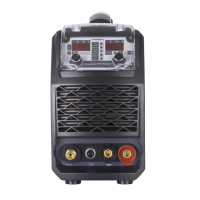
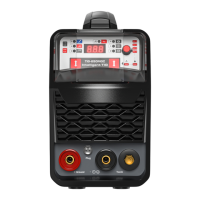
Description of the welder panel used for function selection and parameter setting.
Instructions for using buttons and knobs to select functions and set parameters.
Explanation of indicators for MMA, TIG, Cold welding, and Cleaning functions.
Understanding the indicators for current, time, and stored parameters.
Display of protection codes for overheat, overcurrent, and other faults.
Description of output sockets and connectors for various welding modes.
Steps for connecting the air pipe, gas supply, and welding torch for TIG welding.
Reference parameters for tungsten argon arc welding of titanium and its alloys.
Reference parameters for tungsten argon arc welding of stainless steel sheets.
Reference parameters for argon tungsten arc welding of aluminum and its alloys.
Instructions for connecting the cleaning gun and operating the welding machine.
Key safety considerations including ventilation, overload, and voltage.
Importance of proper ventilation for cooling and smooth operation.
Adhering to the allowable load continuity rate to prevent damage.
Warning against exceeding the allowable power supply voltage to prevent damage.
Restriction on using the welding machine for purposes other than welding.
Instructions for connecting the ground wire for static discharge and safety.
Understanding protection state activation due to exceeding load continuity rate.
Guidelines for cleaning, checking connections, and storing the welding machine.
Procedures for regular dust removal using compressed air.
Using compressed air at a reasonable pressure to avoid component damage.
Ensuring good contact of internal connections and addressing oxidation.
Preventing moisture ingress and checking insulation for safety.
Proper storage procedures for the welding machine when not in use.
 General
| Input Voltage | AC 220V ± 15% |
|---|---|
| Frequency | 50/60 Hz |
| Welding Current Range | 10-250 A |
| Duty Cycle | 60% |
| Power Factor | 0.93 |
| Insulation Grade | F |
| Protection Grade | IP21S |
| Welding Method | TIG |
| Efficiency | 85% |

 To Next Page