General Product Information
Document No. 992010. Issue 15 – 12.01.21
Page 15
20. Battery Charging and Maintenance
The battery will require recharging at regular intervals. The frequency with which the
battery requires recharging will be dependent on how often the equipment is used, and
the general condition of the battery.
The manufacturer recommends that the trolley is put on charge when not in
use, including overnight. Establishing this routine will ensure that the trolley
does not run out of charge in the course of a day.
If the trolley is going to be placed in storage the trolley must be charged for
8 hours every 2 weeks. Failure to do so will result in permanent battery
damage.
It is recommended that the battery is replaced every 3 years.
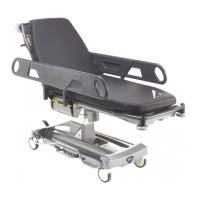
The trolley is supplied with an IEC mains power lead which is used to charge the on-
board battery (specification in ‘Electrical Specification’ on page 5). The power lead
should be plugged into a mains socket and the appliance connector end plugged into
the charging socket on the trolley (item 11, fig. 2). The socket should now be switched
on.
WARNING: Only use the lead supplied with the trolley for charging purposes.
Do not use the lead for any other purposes.
WARNING: Visually inspect the lead for damage on a daily basis. Do not use
the lead if damaged in any way.
Once the mains power lead is connected the control unit will check the charge capacity
of the battery before commencing charging, this may take up to 12 minutes. Once this
test is complete the battery will either; begin to charge and the battery status LED on
the handset will flash ‘green’, or the battery status LED will turn solid ‘green’ to indicate
that the battery is fully charged.
From flat, the battery will take approximately 8 hours to fully charge. Plugging the
trolley in for a short period of time will only partially recharge the battery.
The trolley can be left on charge permanently as there is no danger that the battery can
be over charged. The control unit manages the status of the battery charge, switching
the charging circuit off when the battery is full and back on when the charge dissipates
below a pre-set level.
When the battery charge is low the control unit will emit a continuous ‘beeping’ tone
when any one of the function buttons is being depressed, and the handset battery
status LED will turn ‘amber’. This indicates that the battery must be recharged; failure
to do so will result in the deep discharge protection being enabled.
CAUTION: Failure to charge the battery once the low battery alarm has
sounded could result in a permanent loss of maximum charge capacity.
If the battery has not been charged and the trolley is continuously used, the battery will
run flat and eventually reach a ‘deep discharge’ condition. A normal 8 hour charging
period will not be sufficient to recover the battery. The battery will need to be on
charge for approximately 72 hours to fully recover.
CAUTION:
Only batteries supplied and approved by Anetic Aid should be used.
The battery unit should not be opened.
Use the battery only for its intended purpose.
Never use a battery that is damaged.
The battery must be recycled, properly disposed of or returned to Anetic
Aid. The battery must not be discarded with Household waste.


 To Next Page