A3 PLUS - A5 - A6 PLUS - L6
SURGICAL SINGLE CART
5. DENTIST'S BOARD OPERATION
Layout of instruments.
The positions of the instruments on the board are determined by the customer at the time of order.
Enabling the instruments.
• Syringe is always on (see paragraph 5.3.).
• The curing light is turned on by the relevant button, when the instrument is extracted (see paragraph 5.7.).
• Intraoral camera turns on when the instrument is extracted (see paragraph 5.8.).
• ZEN-Xi integrated sensor is started by turning its support to the “ACTIVE” position (see paragraph 5.9 and ZEN-Xi instructions for use).
• Once picked up, all the instruments are operated with the foot control (see paragraph 5.2.).
Simultaneous use of the instruments.
An interlocking device ensures that the instruments are not used simultaneously.
The first extracted instrument is ready to be used while those extracted later are disabled by the interlocking device.
This interlocking device allows the drill to be changed in one instrument while another is used on the patient.
Positioning the dentist's board.
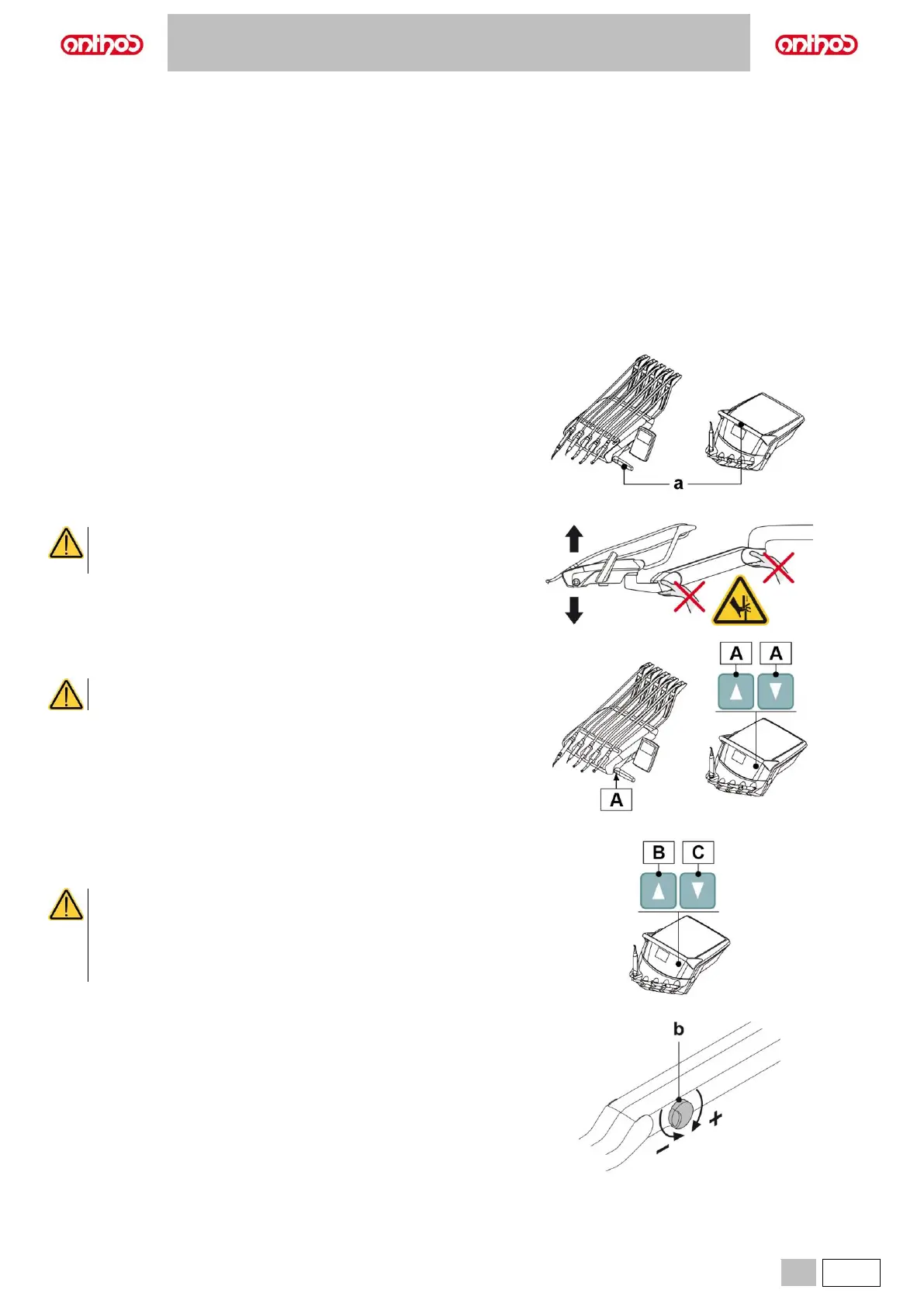
a Handle to adjust the height of the board and/or position it horizontally.
CRUSHING HAZARD
Do not grasp the arm junctions during dentist’s board
movements.
Models with pantograph arm with pneumatic brake.
A Board pantograph arm brake release button.
The release button is only active when the dental unit is
turned on.
Models with SIDE DELIVERY height-adjustable board
To adjust dentist's board height, press the special up (B) and down (C)
buttons.
• Up/down operating times for SIDE DELIVERY board:
continuous operation max. 2 min - rest 18 min.
• SIDE DELIVERY version board: make sure that the board or
the ends of handpieces are not positioned over the backrest
during the dental chair’s automatic movements, since
upholstery may tear.
Pantograph arm with manual brake adjustment
Balancing of the pantograph arm is determined at the time of installation.
Any future adjustments can be made using the knob (b) on the pantograph
arm.
Clockwise rotation: to increase clutch resistance of the pantograph arm.
Counter-clockwise rotation: to decrease clutch resistance of the pantograph
arm.



 To Next Page