Before operation of the gas detector the instruction manual must be read carefully.
In case of any questions refer to the detector manufacturer. Furthermore ensure the
detector is correctly calibrated. Instructions for calibration can be found in the instruction
manual of the detector or upon request from the manufacturer.
A possible re-calibration must be done within an area which is free of refrigerants.
In case of a positive detection by the detector any work must be stopped immediately.
Any open flames or ignition sources must be extinguished or removed. In addition to a
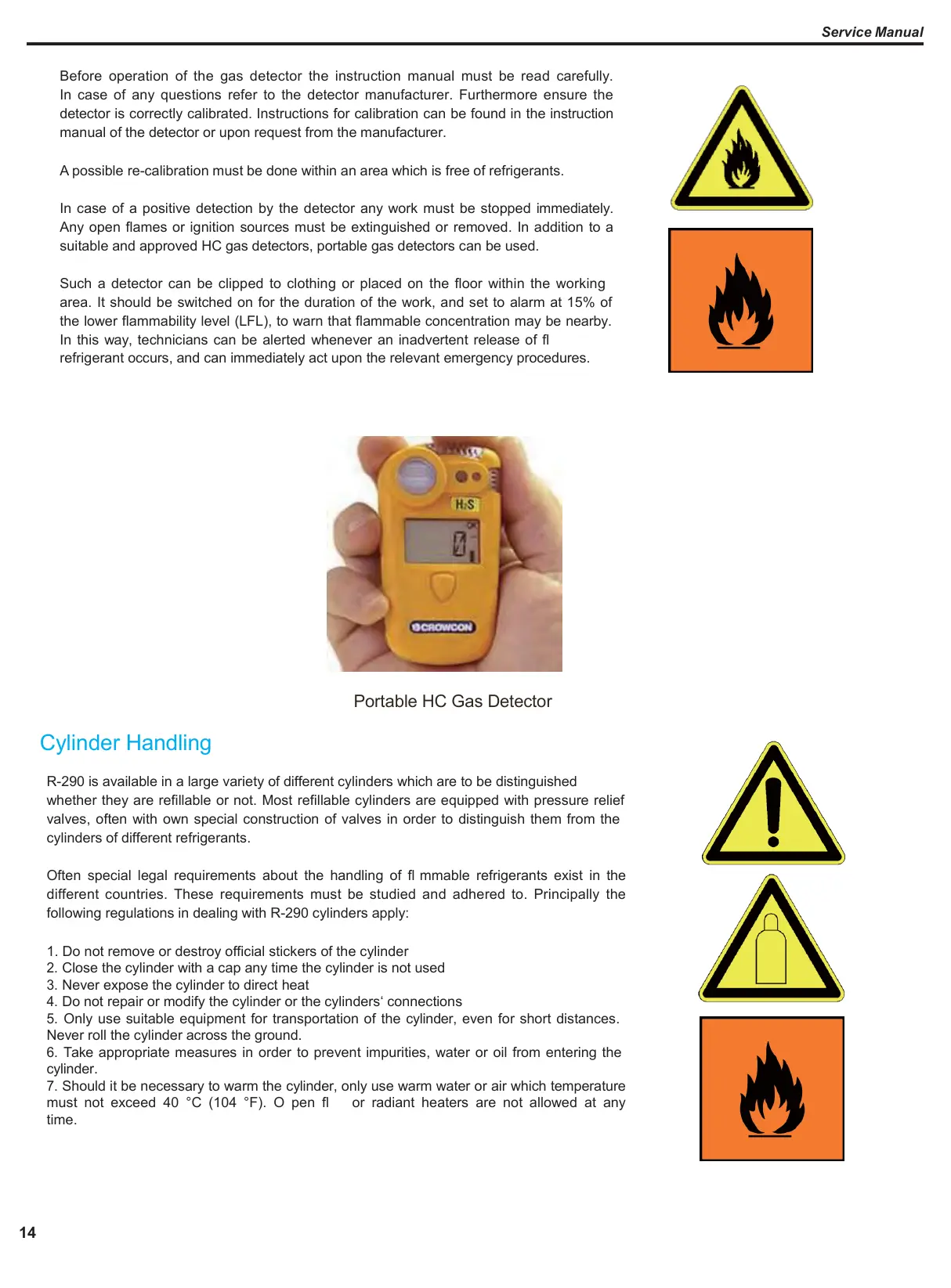
suitable and approved HC gas detectors, portable gas detectors can be used.
Such a detector can be clipped to clothing or placed on the floor within the working
area. It should be switched on for the duration of the work, and set to alarm at 15% of
the lower flammability level (LFL), to warn that flammable concentration may be nearby.
In this way, technicians can be alerted whenever an inadvertent release of fl
refrigerant occurs, and can immediately act upon the relevant emergency procedures.
Cylinder Handling
Portable HC Gas Detector
R-290 is available in a large variety of different cylinders which are to be distinguished
whether they are refillable or not. Most refillable cylinders are equipped with pressure relief
valves, often with own special construction of valves in order to distinguish them from the
cylinders of different refrigerants.
Often special legal requirements about the handling of fl mmable refrigerants exist in the
different countries. These requirements must be studied and adhered to. Principally the
following regulations in dealing with R-290 cylinders apply:
1. Do not remove or destroy official stickers of the cylinder
2.
Close the cylinder with a cap any time the cylinder is not used
3.
Never expose the cylinder to direct heat
4.
Do not repair or modify the cylinder or the cylinders‘ connections
5.
Only use suitable equipment for transportation of the cylinder, even for short distances.
Never roll the cylinder across the ground.
6.
Take appropriate measures in order to prevent impurities, water or oil from entering the
cylinder.
7.
Should it be necessary to warm the cylinder, only use warm water or air which temperature
must not exceed 40 °C (104 °F). O pen fl or radiant heaters are not allowed at any
time.







 To Next Page