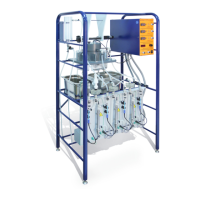
To dismantle the heat exchanger, first make sure that the electrical power is turned off
and that the unit has had an opportunity to cool and has been cleaned as efficiently as
possible.
Remove the stainless steel safety cover.
Disconnect all the tri-clamp pipeline connectors on the end plates and the
intermediate plates.
Using a suitable 17mm extended socket or spanner/wrench, remove the two nuts from
the studding at the sliding end which provide the compression force that seals the heat
exchanger. The sliding endplate can now be removed.
Remove the cooling section plate stack, first intermediate plate, interchange section
plate stack, second intermediate plate and finally the heating section plate stack.
When used at elevated temperatures (120°C to 150°C) the plates in the heating
section have a tendency to stick together which can be remedied by soaking in a
strong detergent solution overnight.
Re-assembly is the reverse of this procedure but care in ensuring correct orientation
according to the diagrams is essential.
Assembly is based upon the distance between the inside of the fixed end plate and the
inside of the sliding end plate which is set in the factory between 85.0mm and
79.0mm.
This dimension is best measured using a digital Vernier gauge and must be identical
on both sides of the heat exchanger near the studs.
As the gasket material takes a “set”, it is important to reduce this dimension slightly
after each assembly say by approximately 1.0mm to retain leak-tightness.
After several strip-downs, the gaskets will be compressed sufficiently to allow
tightening to a dimension of 79.0mm, which is the minimum. Damage to the plates
will occur if they are tightened below this dimension. It will be necessary to replace
the plates and gaskets at this point.
43



 To Next Page