Antenna Analyzer AIM4170 page 23
METHOD B:
An alternative method of transforming the data to the antenna can be used when the
properties of the transmission line (Zo, length, loss and velocity factor) are accurately
known.
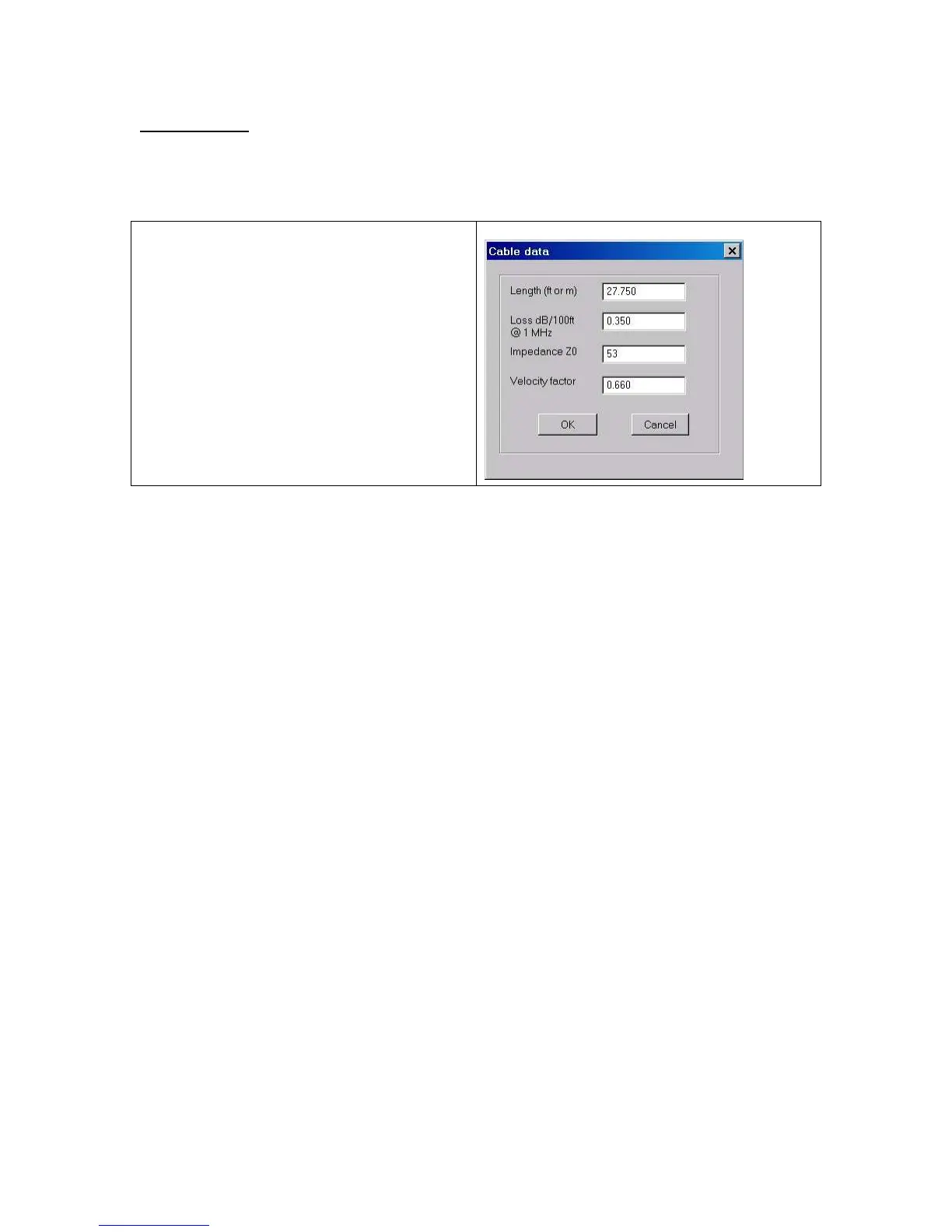
To select this feature, click Functions ->
Refer to Antenna -> B. Use cable Zo.
Then enter the transmission line data in the
dialog box.
The length and velocity factor are combined to find the effective electrical length.
Rather than trying to measure the physical length of the transmission line and estimate its
velocity factor (which may vary from one roll of coax to another), you can measure the
electrical length directly using the AIM4170. Put a short circuit across the antenna
terminals (or disconnect the coax from the antenna) and scan from 1 to 32 MHz to find
the first point where the phase angle is zero. This is listed at the top of the graph as the
first resonant freq, F1. This frequency corresponds to one-quarter of a wavelength, so
the electrical length of the line is:
Electrical_length = 0.25*(299.8/F1) meters
= 0.25*(984/F1) feet
This corresponds to the physical length of the coax divided by its velocity factor. The
electrical length is longer than the physical length since the velocity factor is less than
one. Radio waves only care about the electrical length. When entering the cable
parameters, if you know the electrical length (by measuring F1 above), the top line can be
a close “estimate” of the physical length and the velocity factor is the electrical length
that was accurately measured, divided by this “estimate”. For example, when I installed
the antenna did I use 120 feet or 125 feet of coax? Rather than trying to measure the
length of the coax again, estimate its length as 125 feet. Assuming the electrical length
was measured to be 185 feet, the velocity factor would be 125/185 = 0.6757.
Alternatively, if you know the velocity factor calculate the physical length by multiplying
the velocity factor times the electrical length.
The cable loss is usually given in terms of “dB per 100 feet” on data sheets. Enter the
value of loss for 1MHz, if it’s listed. If you’re interested in higher frequency bands and
want a bit more accuracy, pick a frequency close to your region of interest and divide the
loss at this frequency by the square root of the frequency in MHz.



 To Next Page