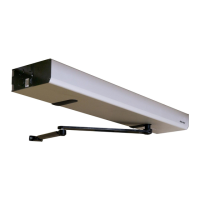
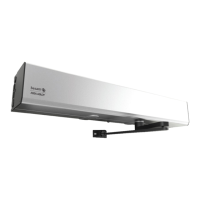
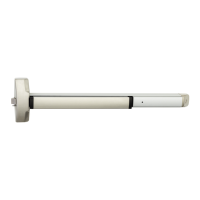
The Besam SW300/SW150 is an automatic swing door operator designed to enhance accessibility and convenience in various environments. It is suitable for both single and double pedestrian swinging or folding doors, making it versatile for applications ranging from private homes requiring handicapped access to high-traffic retail operations. The operator is engineered for indoor installation and can be used with almost all types of external and internal swing doors.
Function Description
The core function of the Besam SW300/SW150 is to automate the opening and closing of swing doors. It utilizes a DC motor and a gear-reduction system to drive an arm, which facilitates the door's movement. For the Besam SW300, closing power is provided by both the motor and a closing spring, ensuring reliable closure. The Besam SW150, however, does not include a closing spring, meaning that if it is open during a power failure, the door will not close automatically.
A sophisticated electronic control unit, incorporating a motor encoder and a microprocessor, precisely manages the door's movement. This allows for smooth and controlled operation, adapting to various conditions. The operator can be activated in several ways:
- Manual Activators: These include devices like elbow switches, allowing users to initiate the door's opening with a physical push.
- Automatic Activators: Radar devices can detect approaching individuals and automatically trigger the door to open.
- Push & Go: In situations where local standards permit, the door can be activated simply by pushing it, providing an intuitive user experience.
Once activated, the door opens and remains open for a specified "Hold Open Time" (HOT). After this time elapses, the door automatically closes. The system is designed to be self-adjusting, compensating for normal variations in weather conditions and minor friction changes caused by factors like dust and dirt, ensuring consistent performance.
The Besam SW300/SW150 offers multiple operational modes, depending on the type of program selector installed:
- AUTO (Normal position): In this mode, the door can be opened by both inner and outer manual and/or automatic activators. If an electric strike is fitted, it will be open.
- OFF: The door remains closed and cannot be opened by inner or outer activation units. If an electromechanical locking device is fitted, the door will be locked. It can, however, be opened with a key switch if one is installed.
- OPEN: The door is held permanently open by the motor, facilitating continuous passage.
- EXIT: This mode allows passage only from the inside. The door is typically locked if an electromechanical locking device is fitted. It can only be opened using the inner activation unit or a key switch (if fitted).
In the event of a power failure or during fully manual use, the Besam SW300 functions as a normal door closer, allowing for manual operation. As noted, the Besam SW150 does not have this spring-assisted closing capability. For emergency escape situations, the doorset is designed to be opened manually, ensuring safety.
Usage Features
The Besam SW300/SW150 is designed for continuous use, offering a high degree of safety and a maximum lifetime. Its self-adjusting capabilities ensure reliable operation even with minor environmental changes. The system's adaptability to various activation methods makes it suitable for diverse user needs, from those requiring assisted access to busy commercial settings. The different program modes provide flexibility in managing door access and flow, allowing operators to tailor the door's behavior to specific requirements, such as maintaining an open state during peak hours or restricting access to one direction. The inclusion of safety features, such as the ability to manually open the door in emergencies, underscores its commitment to user safety.
Maintenance Features
To ensure the safe and proper operation of the automatic door unit, regular maintenance and service are crucial. The manufacturer recommends periodic inspections by trained and qualified personnel, with the frequency of service occasions adhering to national regulations or industry standards. This is particularly important for fire-approved doors or those with emergency-opening functions. A minimum of two visits per year is recommended to extend the life of the investment and ensure safe and reliable operation, with more frequent visits depending on usage and operating conditions.
The manual provides a checklist for regular safety checks, which include:
- Daily Visual Inspection: Checking the operator, arm system, cables, hinges, door, and glass for any fastening issues or damage. Also, inspecting for sharp edges on the door leaf and frame, the condition of door seals, and finger protection. The complete door should run properly and close slowly and smoothly.
- Functional Checks:
- Setting the program selector to OFF to verify that the operator and electromechanical lock (if fitted) work together and that the lock secures the door.
- Activating manual and automatic activation units to ensure the door opens appropriately.
- Checking non-monitored safety sensors by standing in the swing path to confirm the door does not hit the user during opening or closing.
- Escape and Fire Door Tests: For escape doors, setting the program selector to AUTO mode and manually pushing the door in the escape direction to ensure nothing prevents it from opening and that the escape route is clear. For fire doors, allowing the door to close after an impulse to ensure nothing prevents closing and locking (if required by regulations). These tests must be performed regularly by trained personnel.
For cleaning, the best method to remove dust and dirt from the Besam SW300/SW150 is to use water and a soft cloth or sponge, with a gentle detergent if needed. Surfaces should be cleaned once every four months to maintain the quality of the enamel layer. Brushes and weather stripping should be vacuum-cleaned weekly to prevent damage to the profiles. Important cleaning precautions include:
- Avoiding exposure of windows, doors, or profiles to alkalis, as both aluminum and glass are sensitive to them.
- Not cleaning with high-pressure water, as this can damage the operator, program selector, sensor, and allow water to enter the profiles.
- Not using polishing detergent.
- Not scrubbing with abrasive materials like Scotch-brite, as this can cause mechanical damage.
The manual also provides a troubleshooting guide for common issues such as the door not opening, the motor not starting, the door starting but not opening, the door not closing, or the door opening and closing continuously. For persistent problems, users are advised to contact their ASSA ABLOY Entrance Systems representative. The document also includes a table of recommended replacement intervals for various parts during preventive maintenance, categorized by cycles per hour of operation and abusive environments.



 To Next Page

 General