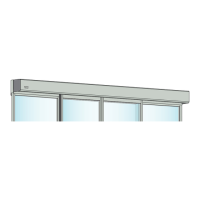
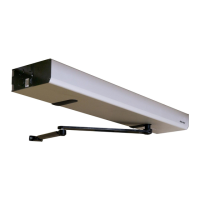
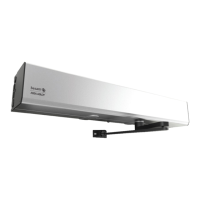
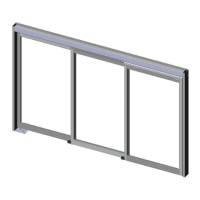
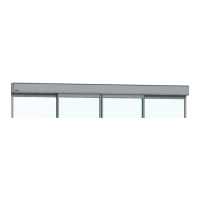
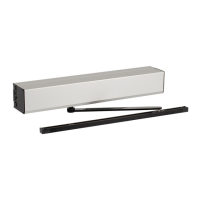
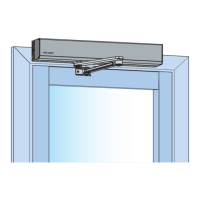
The device described in this manual is a Sliding Door Operator from ASSA ABLOY Entrance Systems, specifically the Besam SL500, SL500 T, and SL500 SL models. These operators are designed to automate sliding doors, facilitating access to and within buildings.
Function Description
The Besam SL500 series operators work electromechanically. They consist of a motor, control unit, and transmission, often housed within a support beam with an integrated cover. The motor and gearbox drive the door leaves via a tooth belt. The door leaves are attached to a door adapter/carriage wheel fitting and slide along a track, with bottom guiding provided by floor guides or side panel guides.
When an opening impulse is received by the control unit, the motor activates, moving the door leaves to the open position. The doors close automatically after a set hold-open time, provided no further opening impulse is detected.
A key feature of these operators is their integrated safety system. To ensure safe passage, the doors are designed to reverse immediately if an obstruction is detected while closing. They then resume movement at a low speed to check if the obstruction has been cleared. If an obstruction is detected between opening doors and surrounding walls or interior fittings, the doors stop immediately and then close after a time delay.
The safety system can incorporate various sensors:
- Presence sensors are typically installed above the door opening. These detect objects in the doorway during closing, causing the doors to reverse and remain open until the object is removed.
- Combined motion and presence detection sensors offer both motion activation and presence detection in a single unit. These sensors ensure the door opens when approached and remains open if an object is present in the doorway.
- Side presence detectors are used in situations requiring higher door speeds or in environments like homes for the elderly/disabled or childcare centers. These sensors protect users during the opening cycle by slowing down the door movement to a safe speed if an obstacle is detected, rather than stopping it completely.
- Photocells can also be integrated into the safety system. These units create an invisible infrared beam across the door opening. If this beam is broken during closing, the doors reverse immediately and resume movement once the obstruction is cleared.
The operator offers five different modes of operation (OPEN, AUTO PARTIAL, AUTO, ONE WAY, and OFF) which can be selected via a program selector.
- OPEN mode keeps the door permanently open, allowing manual movement for tasks like window cleaning. All activation units, except emergency push buttons, are disconnected.
- AUTO PARTIAL enables two-way traffic with partial door opening via inner/outer activation units or a key switch. Emergency push buttons open the door fully.
- AUTO mode provides normal two-way traffic, with full door opening via inner/outer activation units, key switch, or emergency push button.
- ONE WAY allows passage only from the inside. The door is normally locked if an electromechanical locking device is fitted and can only be opened from the inside or via a key switch/emergency push button.
- OFF mode is primarily for emergency escape doors, used only after ensuring all occupants have left. In this mode, inner and outer activation units are disabled, and the door is locked if an electromechanical device is present. It can be partially opened via a key switch or fully opened with an emergency push button.
For emergency escape, the operator can be fitted with different units:
- A Break-out unit (PSB) allows door leaves and side screens to be swung outwards with applied pressure, creating a wider opening for evacuation or transporting large objects.
- An Electrical emergency unit with rechargeable batteries opens the door in case of power failure and keeps it open until power is restored. This unit is monitored by the operator control unit, and any monitoring error causes the door to open and remain open until cleared. This function can also be configured to close the door during power failure, as required by fire authorities to prevent fire/smoke spread.
Additional functions and accessories include:
- Locking and Unlocking: Doors for emergency escape in certain buildings should not be locked or set to OFF mode. Mechanical locks must be unlocked before activating the operator.
- Access codes and flashing light: The operation mode selector uses access codes for security. A flashing light indicates status: red for error (solid or fast flashing for internal error), orange for a clearable status/condition (e.g., break-out door open), and yellow for maintenance needed.
- Push button: Provides an opening impulse to the door.
- Synchronization: Allows two single sliding door operators to work together for very large openings.
- Open / Close function: A single button impulse alternates between opening and closing, with an adjustable time delay for automatic closing.
- Fire alarm connection: Enables emergency opening or fire closing of the door with mains power.
- Nurse function: Often combined with a "Bed function," this opens the door to a partial open position (Nurse) or full open position (Bed) for specific needs.
- Remote Exit mode: Allows remote activation of the Exit mode via an external system.
- Emergency open impulse: Provides an opening impulse for emergency situations (e.g., fireman's opening), even during power failure with an electrical emergency unit.
- Micro switch kit: For indicating door and lock position.
- Locked door indicator: For connecting to an alarm system, indicating a locked door.
- Emergency closing with repeated closing: If the door is manually opened after an electrical emergency closing, it will close again.
- Interlocking: Used between two operators to ensure one door closes before the other opens, typically for energy efficiency.
- Convenience battery UPS: Provides standby power for continued operation during short power failures.
- External error indication: Allows connection of a lamp or buzzer for error alerts.
- Key switches: Provide an opening impulse in any operation mode, and also during power failure with an electrical emergency unit.
- Manual Opening Lock device (MOLD): For manual unlocking of electrical locks (LD type).
Usage Features
The Besam SL500 series is designed for continuous use, offering a high degree of safety and maximum lifetime. The system is self-adjusting to minor environmental variations and friction changes.
Users can select from five operation modes using the program selector, adapting the door's behavior to specific needs (e.g., permanent open, two-way traffic, one-way traffic, or locked). The program selector may have buttons or a key-operated switch. For emergency escape doors, the key on the PSK-6U mode selector must always be removed after changing settings.
The integrated safety features, including immediate reversal upon obstruction detection and slow-speed re-checking, ensure user safety during door operation. Technologically advanced sensors, approved by ASSA ABLOY Entrance Systems, further enhance obstruction detection and include built-in monitoring for error detection.
In emergency situations, the door is designed to open and remain open automatically. If equipped with a break-out function, the door leaf can be manually pushed open in the escape direction, or slid sideways to create a wider opening. The electrical emergency unit ensures the door opens during power failures, maintaining an escape route.
The system provides visual feedback through a flashing light on the operation mode selector, indicating errors, status, or maintenance needs.
Maintenance Features
Regular maintenance and service are crucial for the safe and proper operation of the automatic door unit. ASSA ABLOY Entrance Systems recommends a minimum of two service visits per year, or more depending on usage and operating conditions.
A "Service Log Book" and "Site Acceptance Test and Risk Assessment" documents (PRA-0005) should be kept available for maintenance and service records.
Regular safety checks are provided in a checklist format, including daily actions and checks for escape and fire doors. These checks involve:
- Visually inspecting the operator, cover, cables, door, glass, and operation mode selector for damage or fastening issues.
- Checking the condition of door seals, weather stripping, glazing rubbers, and finger protection.
- Verifying proper operation, including smooth and slow closing, and ensuring no ventilation is obstructed.
- Testing the electromechanical lock (if fitted) and its interaction with the program selector.
- Activating manual and automatic activation units to ensure appropriate door opening.
- Checking safety sensors for proper function.
- For escape doors with a break-out system, testing manual pushing in the escape direction to ensure nothing prevents opening and that the route is clear.
- For fire doors with automatic opening, shutting off power to ensure the door opens and remains open, then restoring power to confirm closing.
- Ensuring nothing prevents the door from closing and locking (if required by regulations).
The manual also provides a troubleshooting guide for common issues like the door not opening, not closing, or moving slowly, offering remedies such as changing program selector settings, checking for obstructions, cleaning floor guides, unlocking mechanical locks, and resetting the operator.
Cleaning the Besam SL500 series is recommended using water and a soft cloth or sponge, with a gentle detergent. Surfaces should be cleaned every one to four months, and brushes/weather stripping vacuum-cleaned weekly. Important cleaning precautions include avoiding alkalis, high-pressure water, polishing detergents, and abrasive materials.
The manual lists recommended replacement intervals for various parts during preventive maintenance, categorized by cycles per hour in operation (low, medium, high traffic) and abusive environments. These parts include the electrical emergency unit battery, floor guide shoe (standard, felt padded, break-out), door carriage components (plastic wheels, steel wheels, anti-riser device), sliding track, and tooth belt.



 To Next Page
 General