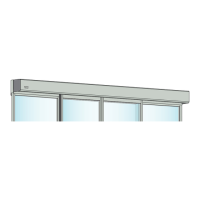
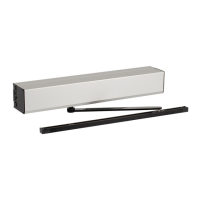
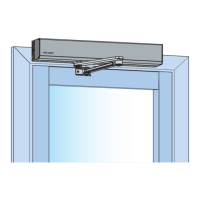
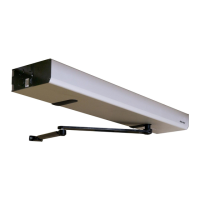
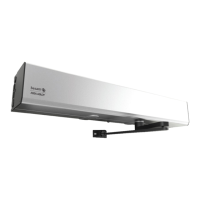
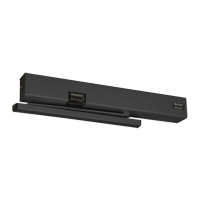
The ASSA ABLOY SL500 Resilience is an electromechanical sliding door operator designed for overhead-concealed installation between two vertical jambs. The header houses the drive and control units and supports the sliding doors and sidelites. Movement is transmitted to the door leaves by a tooth belt, with the door leaf fitted to a door adapter/carriage wheel fitting and hanging on a sliding track. Guiding at the bottom is provided by floor guides.
Function Description:
When an opening impulse is received by the control unit, the motor starts, moving the door leaves to the open position. The door begins to close when no opening impulse is received, the hold-open time has expired, and no presence impulse is activated. The operator supports five different modes of operation, selectable via an operator mode selector.
Important Technical Specifications:
- Manufacturer: ASSA ABLOY Entrance Systems Inc.
- Address: 1900 Airport Road, Monroe, NC 28110, US
- Type: ASSA ABLOY SL500 Resilience
- Mains Power Supply: 100 V AC -10% to 240 V AC +10%, 50/60 Hz, fuse 10 AT
- Power Consumption: Max. 250 W
- Standards: Complies with ANSI/BHMA.
Usage Features:
- Program Selectors: The door's functions are selected using mechanical or key program selectors, available in 5-position with key (surface or surface mounted), 5-position mechanical switch (flush or surface mounted), and 3-position mechanical switch (flush or surface mounted) variants.
- Operation Modes:
- OFF (CLOSED): Disconnects inner and outer activation units. The door is locked if an electromechanical locking device is installed. Can be opened with an emergency push-button/key switch (if installed).
- EXIT (ONE WAY TRAFFIC): Two-way traffic, AUTO PARTIAL is obtained. The door can be opened partially with inner and outer activation units and a key switch (if fitted). An emergency push-button opens the door fully. Passage from one side only. The door is locked if an electromechanical locking device is attached. Can be opened with an activation to INNER IMPULSE 2 or KEY IMPULSE 6.
- AUTO: Two-way traffic, normal operation. The door can be opened with inner and outer activation units and an emergency push-button/key switch (if installed).
- AUTO (PARTIAL): Two-way traffic. The door can be opened partially with inner and outer activation units and an emergency push-button/key switch (if installed).
- OPEN: The door is permanently held open.
- RESET: Momentarily (5 seconds) set the Program Selector to this position, then return to "AUTO" or "OFF." Clears the area for a system test and reset.
- Integrated Safety:
- Obstruction Detection (Closing): If an obstruction is detected between closing doors, they reverse immediately, then resume interrupted movement at low speed to check if the obstruction is gone.
- Obstruction Detection (Opening): If an obstruction is detected between opening doors and surrounding walls/fittings, the doors stop immediately and close after a time delay.
- Presence Sensors: Installed above the door opening, these detect objects in the doorway. If an object is detected while closing, the doors reverse immediately and resume movement once the object is removed.
- Technologically Advanced Sensors: ASSA ABLOY sensors improve obstruction detection with built-in self-monitored reverse upon obstruction force limitation. Monitored sensors have built-in error detection.
- Photocells: Alternatively, presence photocells in the door opening detect objects breaking an infrared beam during closing, causing immediate door reversal.
- Emergency Escape: The operator can be fitted with emergency escape units.
- Break-out Unit PSA: Door leaves and sidelites swing outwards when pressure is applied, creating a wider opening. From the fully swung-out position, door leaves can be manually slid sideways for transporting wide objects or making an entrance more inviting.
- Locking/Unlocking: Doors for emergency escape (hospitals, elderly homes) should not be locked or set to OFF mode. Other emergency escape doors can be locked or set to OFF mode after securing the building and ensuring all people have left. All mechanical locks must be unlocked before activating the operator.
- I/O Functions (with I/O unit P/N: 1007779):
- Fire Alarm Connection: Used for emergency open/fire close with mains power.
- External Error Indication: Provided if a lamp or buzzer is connected.
- Open/Close Function: A single impulse alternates between open and close. The door can stay open until the next impulse or close automatically after an adjustable time delay.
- Nurse Function: Partial pedestrian opening in Exit, Auto, and Auto Partial modes. Adjustable hold-open time.
- Night Mode: Remotely sets the door to exit-only via an automated system (requires a NO contact).
- Bottom Guide Systems: Full Break Out (FBO) pin guide offers recessed or surface threshold options.
- Optional Accessories: Combined motion and presence sensors, separate presence sensors, flush or surface-mounted operation mode selectors (master and slave), electrical locks (LDP Fail Safe P/N: 1008354, LD Fail Secure P/N: 1008167).
Maintenance Features:
- Regular Safety Checks: Essential for safety and compliance. Do not use if repair is needed. Disconnect power for cleaning/maintenance.
- Daily Action:
- Visually check operator and program selector(s) fastening, door and glass stability.
- Inspect door seals, weather stripping, glazing vinyl, finger protection.
- Ensure proper operation (smooth opening/closing, no obstruction).
- Set program selector to OFF; check operator and electromechanical lock function.
- Activate knowing act devices and automatic activation units; check appropriate door opening.
- Check safety sensors (if any).
- For escape doors with break-out system, set to AUTO, manually push door in escape direction to ensure it opens freely, and verify escape route is clear.
- Cleaning:
- Use water and a soft cloth/sponge with gentle detergent to remove dust/dirt.
- Clean surfaces once every four months to maintain enamel quality.
- Vacuum brushes/weather stripping weekly.
- Avoid alkalis on windows, doors, or profiles.
- Do not use high-pressure water (can damage operator, program selector, sensor).
- Do not use polishing detergent or abrasive materials like Scotch-Brite.
- Troubleshooting: A table is provided to identify common problems (door not opening/closing, motor stops, door moves slowly) and their remedies (change mode selector, check break-out unit, check mains switch, unlock mechanical locks, clean floor guide, remove obstructions, reset operator).
- Planned Maintenance Checklist: Includes checks for functioning of mats, sensors, push plates, signage, door hinging/mechanical soundness, finger guards, glass, trip hazards, rails, sharp edges, emergency egress, lock assembly, weather stripping, and overall cleanliness.
- Housekeeping: Keep floor guides clean and free of debris. Check for tripping/slipping hazards. Inspect door panels for damage. Ensure hardware and overhead covers are secured. Remove dust/dirt from operator and sliding track (use methylated spirits). Check for lubrication needs.
- Traffic Patterns: Observe and plan traffic routing for straight approach to the door center.
- Signage: Ensure "AUTOMATIC DOOR," "IN EMERGENCY PUSH TO OPEN," and "STAND CLEAR" decals are properly displayed and visible. An AAADM safety information label should be affixed to the door frame.
- Closing Speed: Verify closing time meets minimum requirements based on nominal door opening (e.g., 36" single slide door: 3 seconds minimum).
- Activating Switch (Knowing Act): If equipped, the door should hold open for a minimum of five seconds after releasing the switch.
- Emergency Breakout: Manually push the door at the lock area in the emergency exit direction. The door should stop operation or spring to closed position, and panels should re-latch. If breakaway sidelites are present, door operation should stop when they are broken out.
ASSA ABLOY recommends a minimum of two service visits per year, or more depending on usage, to extend product life and ensure safe operation. Non-compliance with maintenance recommendations may void the warranty.


 To Next Page
 General