Serviceanleitung_US2000V5_EN_V0.0.docx
2.10.2. Adjusting the driving shaft (clutch/ brake)
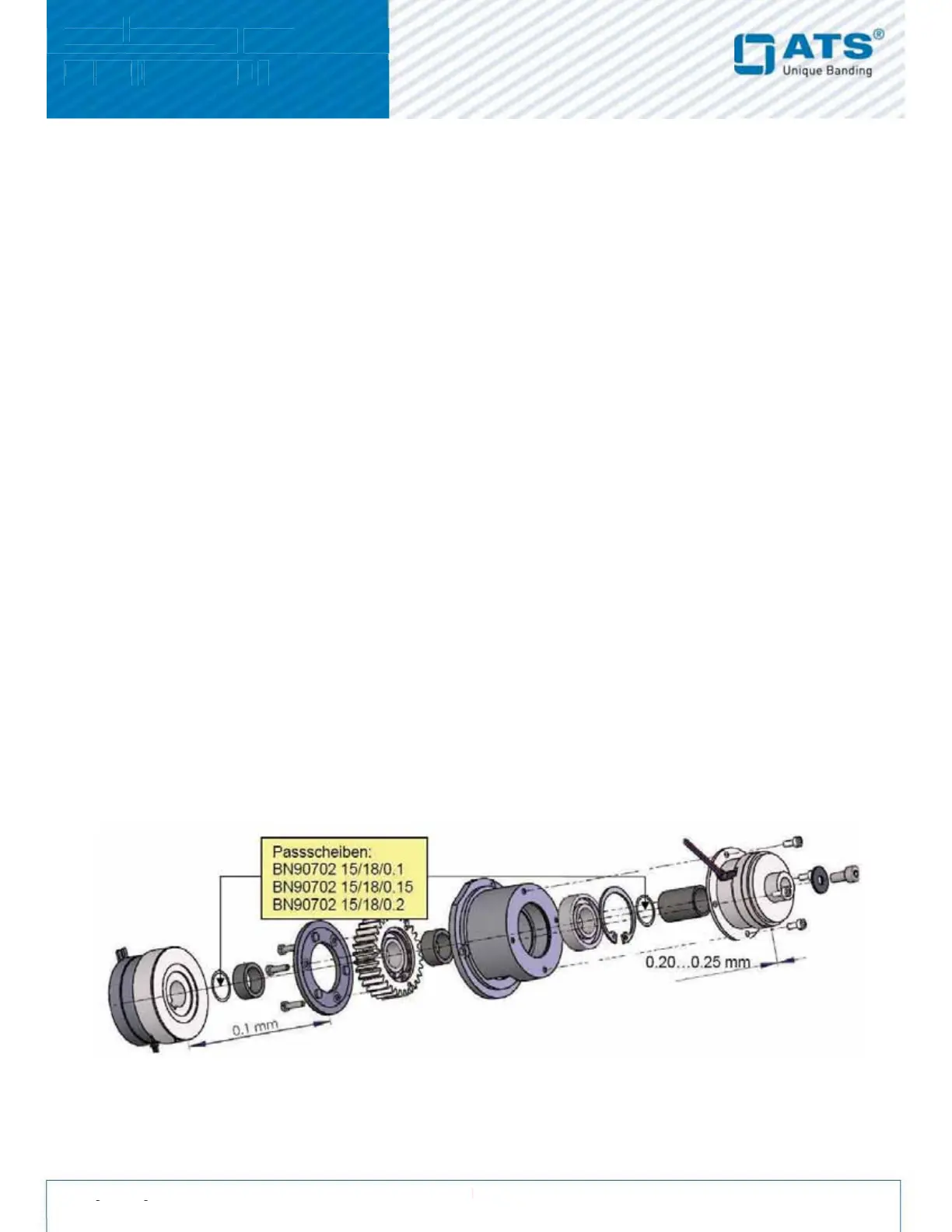
To achieve a good range in the tension setting (Soft tension and Band tension) the gap between the rotor and
stator of the clutch and brake has to be set to desired value. To adjust the gap, only use precise (grounded)
shims.
Disassembling the driving shaft:
1. Remove the fixing screw on the brake disc and take off the disc.
2. Remove all four fixing screws of the brake housing and remove the brake.
3. Take off the spacer bushing and any other spacers/ shims if necessary.
4. Remove the bearing housing.
5. Take off the spacer bushing and the clutch gear wheel.
6. Remove the spacer bushing and any other spacers/ shims if necessary.
7. Pull the clutch plate off the shaft and remove the key.
8. If necessary replace brake and/ or the clutch.
9. To mount the driving shaft, follow the same procedure but in reverse order. Pay attention to the gap setting
of the clutch and brake.
Brake:
The brake needs a minmum gap of 0.20 mm. The feeler gauge of 0.20 mm should not be clamped by stator and
rotor but should slightly touch it on each side.
If the gap is too small, it can happen that the brake does not disengage anymore. This causes inconsistent
overlapping and will wear the brake quicker.
Clutch:
The clutch needs a gap of 0.10mm (stator and rotor should not touch). Only with a precise gap setting of the
clutch, will make it possible to have low soft tension.


 To Next Page