..,.
,
I1
Dipper Switch.
The dipper switch has two functions-one to give the normal driving
light, and one to dip the near side head lamp beam and at the same time
switch off the offside headlamp.
If the headlights are on full, a touch of the foot on the switch
alters the lights to the "dip and switch" position, and they remain so
until another touch returns them to the "full on" position.
The second fuse protects the dynamo. and is connected in the dynamo
field circuit. The indication of a blown dynamo fuse is that the dynamo
will fail to charge, no charge reading being given on the ammeter under
normal daytime running conditions.
Spare fuses are provided for use in cases of emergency. Before
fitting a replacement fuse, examine the wiring of the equipment the fuse
protects for loose connections or short circuits, and remedy. If the new
fuse blows and the cause cannot be found, we advise the owner to have
his equipment examined at a Lucas Service Depot.
'I
Ammeter.
II
i'lil
The centre zero ammeter indicates the rate at which the battery is
being charged or discharged under all conditions. For instance suppose
2 amperes are consumed when the side and tail lamps are switched on,
and that the ignition coil takes 2 amperes, then if the dynamo is generating
7 amperes the meter will show 3 amperes on the charge side of the scale.
This is the current in e~cess of the lamp and ignition load that is available
for charging purposes.
The ammeter gives an indication that the system is' functioning
satisfactorily. .For example if no reading is given on the charge side of
the scale when the ignition and charging switch is in tbe "High Charge"
position and the car is running at say 20 m.p.h. with no lights on, then
a fault in the dynamo charging circuit is indicated.
To determine the output of the dynamo, switch off all the lights
and add the amount of current used for ignition (about 2 amperes at
normal speeds) to the reading given on the ammeter.
The amount of current used for ignition may be somewhat higher
than the above figure when starting. The ammeter does not indicate
the amount of current used by the starter.
A
D
F
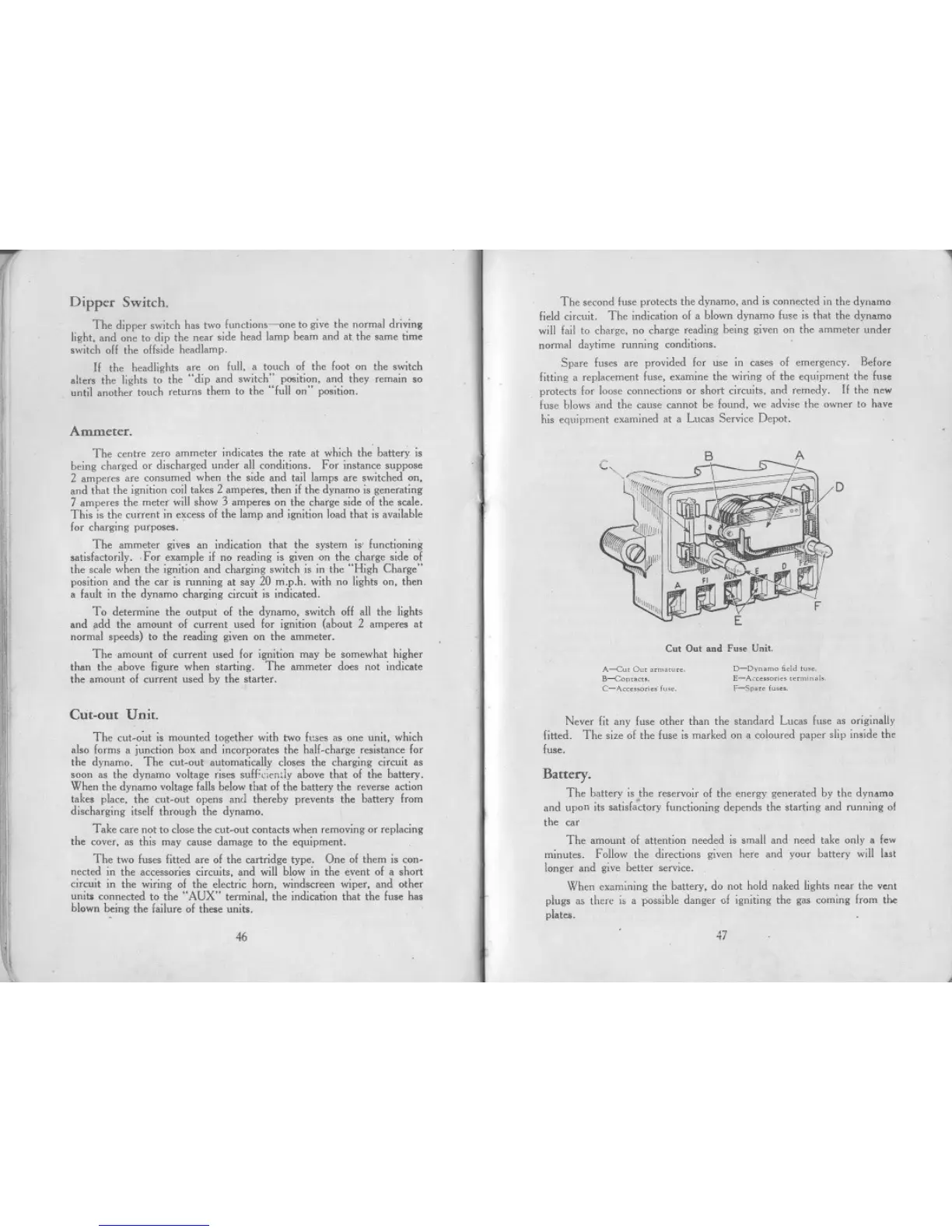
Cut Out and Fus. Unit.
A-Co< 00< "mow".
6-Coo,"",.
C-A"",o,'" fm,.
o-o,o,mo fioldto".
R-A"",o<'" mm",!.
F-S,mfo'...
Cut-ont Unit.
The cut-o;'t is mounted together with two fuses as one unit, which
also forms a junction box and incorporates the half-charge resistance for
the dynamo. The cut-out automatically closes the charging circuit as
soon as the dynamo voltage rises sufficien,ly above that of the battery.
When the dynamo voltage falls below that of the battery the reverse action
take, place, the cut-out opens ami thereby prevents the battery from
discharging itself through the dynamo.
Take care not to close the cut-out contacts when removing or replacing
the cover, as this may cause damage to the equipment.
The two fuses fitted are of the cartridge type. One of them is con-
nected in the accessories circuits, and will blow in the event of a short
circuit in the wiring of the electric horn, windscreen wiper, and other
units connected to the "AUX" terminal, the indication that the fuse has
blown being the failure of these units.
Never fit any fuse other than the standard Lucas fuse as originally
fitted. The size of the fuse is marked on a coloured paper slip inside the
fuse.
Battery.
The battery is the reservoirof the energy generatedby the dynamo
.
and upon its satisfactory functioning depends the starting and running of
the car
The amount of attention needed is small and need take only a few
minutes. Follow the directions given here and your battery will last
longer and give belter service.
When examining the battery, do not hold naked lights near the venl
plugs as lhere is a possible danger of igniting the gas coming from the
plates.
tl
46
47
,


 To Next Page