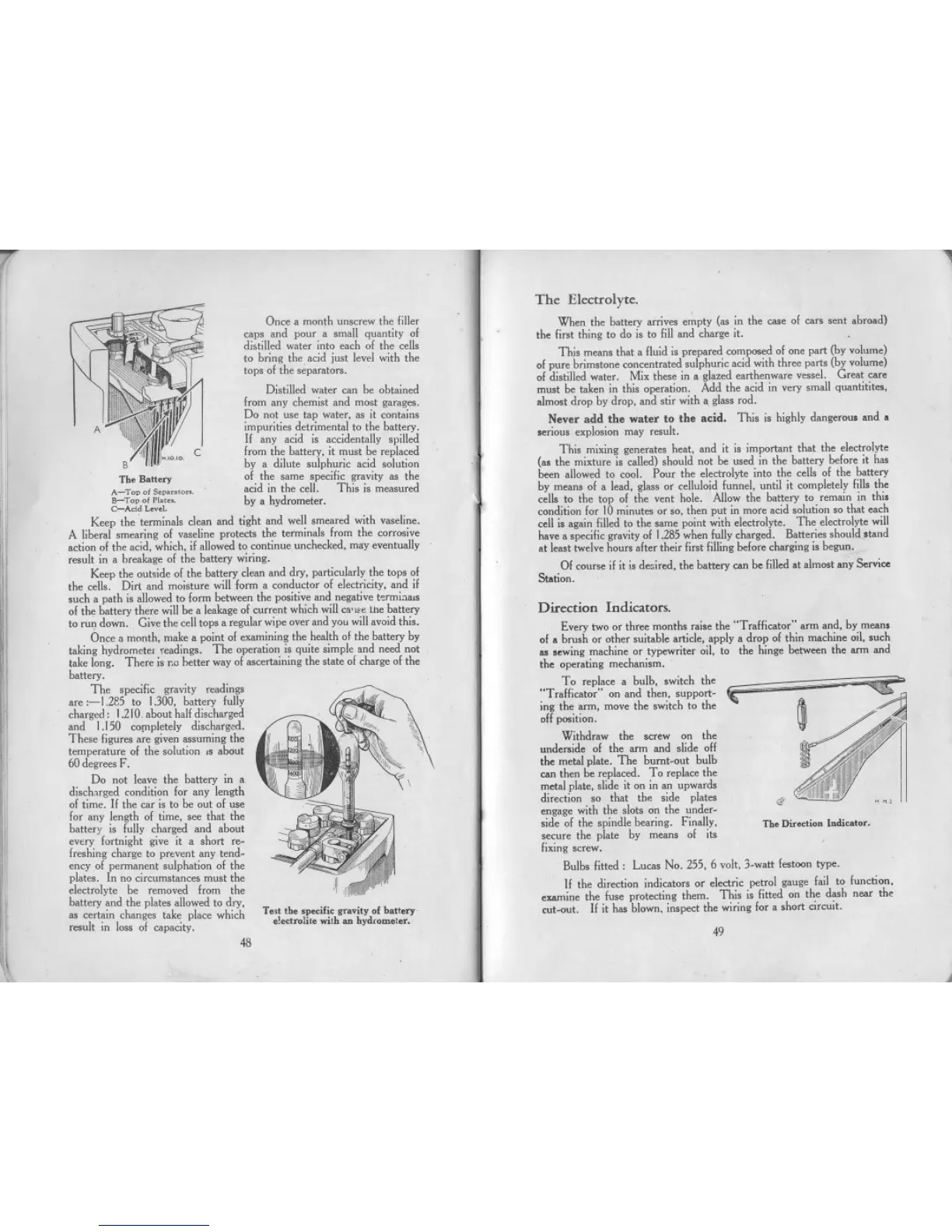
Once a month unscrew the filler
caps and pour a small quantity 01
di.tilled water into each01 the cells
to bring the acid just level with the
tops of the separators.
Distilled water can be obtained
Irom any chemist and most garages.
Do not use tap water, as it contains
impurities detrimental to the battery.
If any acid is accidentally spilled
from the battery, it must be replaced
B' by a dilute sulphuric acid solution
The Battery of the same specific gravity as the
A-Top ofS,p.,,<on. acid in the cell. This is measured
B-Top ofPI"" by a hydromeier.
C-Add Lml.
Keeptheterminals clean and tight and well smeared with vaseline.
A liberal smearing 01 vaseline protects the terminals Irom the corrosive
action 01the acid, which, if allowed to continue. unchecked, mgy eventually
result in a breakage 01 the battery wiring.
Keep the outside 01 the battery clean and dry, particularly the tops 01
the cells. Dirl and moisture will form a conductor of electricity, and il
such a path is allowed to lorm between the positive and negative t"mic,als
01the battery there will be a leakage 01current which will ca"'e the battery
to run down. Give the cell tops a regular wipe over and you will avoid this.
Once a month, make a point 01examining the health of the battery by
taking hydrometer readings. The operation is quite simple and need not
take long. There is r.o better way of ascertaining the state of charge of the
battery .
The specific gravity readings
are :-1.285 to 1.300, battery lully
charged: 1.210.about hall discharged
and 1.150 cOJ1lpletely discharged.
These figures are given assuming the
temperature 01 the solution ISabout
60 degrees F.
Do not leave the battery in a.
discharged condition for any length
of time. If the car is to be out 01 use
lor any length of time, see that the
battery is fully charged and about
every lortnight give it a short re-
Ireshing charge to prevent any tend-
ency 01 permanent sulphation of the
plates. In no circumstances must the
electrolyte be removed Irom the
battery and the plates allowed to dry,
as certain changes take place which Test the specif~cgravity of hattery
result "n I
I
.
t
e!ectroh'e wJlh an hydrometer..
oss 0 capaCI y.
48
..,..
I
i
,I
I
!I.
III
H
1
1
il
('I
"
The Electrolyte.
When the battery arrives e~pty (as in the case 01 cars sent abroad)
the lirst thing to do is to fill and charge it.
This means that a fluid is prepared composed of one part (by volume)
of pure brimstone concentrated sulphuric acid with three parts (by volume)
01 distilled water. Mix these in a glazed earthenware vessel. Great care
must be taken in this operation. Add the acid in very small quantitites,
almost drop by drop, and stir with a glass rod.
Never add the water to the acid. This is highly dangerous and a
serious explosion may result.
This mixing generates heat, and it is importgnt that the electrolyte
(as the mixture is called) should not be used in the battery before it has
been allowed to cool. Pour the electrolyte into the cells 01 the battery
by means of a lead, glass or celluloid funnel, until it completely fills the
cells to the top 01 the vent hole. Allow the battery to remain in this
condition for 10 minutes or so, then put in more acid solution so that each
cell is again lilled to the same point with electrolyte. The electrolyte will
have a specilic gravity 011.285 when lully charged. Batteries should stand
at least twelve hours alter their first filling belore charging is begun.
01 course if it is de:;ired. the battery can be filled at almost any Service
Station.
Direction Indicators.
Every two or three months raise the uTrafficatorU arm and, by means
01a brush or other suitable article, apply a drop 01 thin machine oil, such
as sewing machine or typewriter oil, to the hinge between the arm and
the operating mechanism.
To replace a bulb, switch the
uT rafficator" on and then, support-
ing the arm, move the switch to the
off position.
Withdraw the screw on the
underside of the arm and slide 011
the metal plate. The burnt-out bulb
can then be replaced. To replace the
metalplate, slide it on in an upwards
direction so that the side plates
engage with the slots on the under-
side of the spindle bearing. Finally,
secure the plate by means of its
lixing screw.
Bulbs fitted: Lucas No. 255, 6 volt, 3-watt festoon type.
If the direction indicators or electric petrol gauge lail to function,
examine the fuse protecting them. This is litted on the dash near the
cut-out. If it has blown, inspect the wiring for a short circuit.
\ ~ <:
c?
""'
The Direction Indicator.
49
..j


 To Next Page
 Loading...