QUALIFICATIONS FOR AND CONDUCT OF OPERATORS
AND OPERATING PRACTICES
2-9.0.0
05/23/2003
MISCELLANEOUS
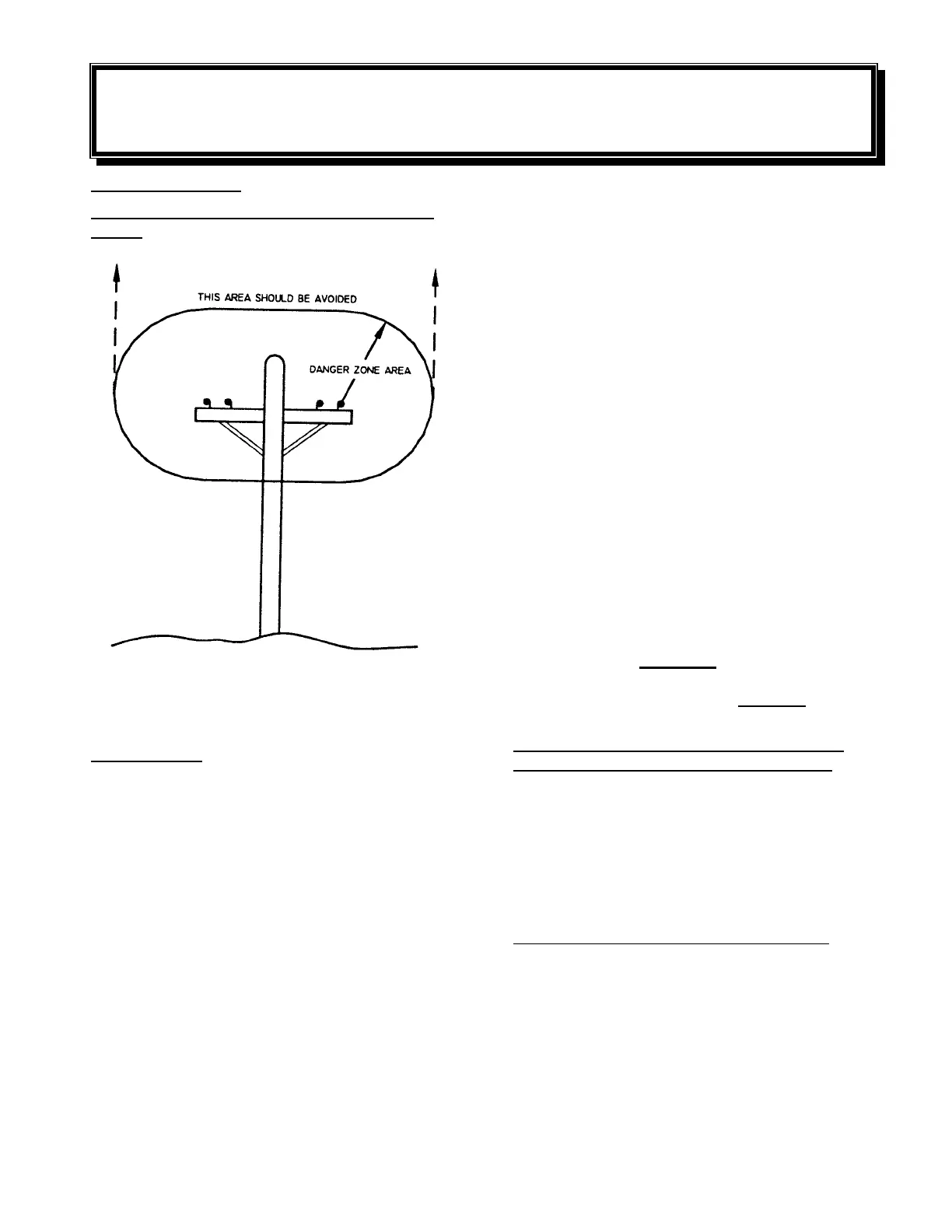
OPERATING NEAR ELECTRICAL POWER
LINES
22. Cranes shall be operated so that no part of the
crane or load enters into the danger zone shown
above.
EXCEPTIONS
A. The danger zone may be entered after confirmation
by an appointed person that the electrical distribution
and transmission lines have been de-energized and
visibly grounded at the point of work; or
B. The danger zone may be entered if insulating
barriers (not a part of nor an attachment to the crane)
have been erected to prevent physical contact with
the lines.
23. For lines rated 50 kV or below, minimum
clearance between the lines and any part of the
crane or load (including handling appendages)
shall be 10-ft. (3m). For higher voltages, see
Table1.
24. Caution shall be exercised when working near
overhead lines, because they can move
horizontally or vertically due to wind, moving the
danger zone to new positions.
25. In transit with no load and boom lowered the
clearance shall be specified in Table 1.
26. A qualified signalperson shall be assigned to
observe the clearance and give warning before
approaching the above limits.
A. Any overhead wire shall be considered to be an
energized line unless and until the person
owning such line or the electrical utility
authorities verify that it is not an energized line.
B. Exceptions to this procedure, if approved by the
administrative or regulatory authority if the
alternate procedure provides equivalent
protection and set forth in writing.
C. Durable signs shall be installed at the operator's
station and on the outside of the crane, warning
that electrocution or serious bodily injury may
occur unless a minimum clearance of 10 ft.
(3.0m) between the crane or the load being
handled and energized power lines. Greater
clearances are required because of higher
voltage as stated above. These signs shall be
revised but not removed when local jurisdiction
requires greater clearances.
normal voltage, kV
(phase to phase) ft (m)
over to 50 10 (3.50)
over 50 to 200 15 (4.6)
over 200 to 350 20 (6.1)
over 350 to 500 25 (7.62)
over 500 to 750 35 (10.67)
over 750 to 1000 45 (13.72)
over to 0.75 4 (1.22)
over 0.75 to 50 6 (1.83)
over 50 to 345 10 (3.83)
over 345 to 750 16 (4.87)
over 750 to 1000 20 (6.1)
while in transit with no load and boom lowered
TABLE 1
minimum required
____clearance
____
when operatin
near hi
h volta
e poower lines



 To Next Page