Need help?
Do you have a question about the Avidyne DFC90 and is the answer not in the manual?
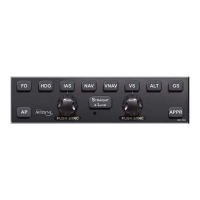
Overview of the DFC90 autopilot's supported functions and features.
Details on how the DFC90 autopilot operates, including engagement and mode logic.
Specifies where to set airspeed, VS, heading, and altitude targets.
Describes audible warnings provided by the autopilot for various conditions.
Explains how armed and engaged autopilot modes are visually indicated.
Describes visual cues for automatic transitions between armed and engaged states.
Explains the effect of manual electric trim inputs on autopilot operation.
Details the speed-based envelope protection for underspeed and overspeed conditions.
Describes full-time envelope alerting for various flight envelope exceedances.
Explains how barometric altimeter setting changes affect autopilot altitude hold.
Defines the maximum limits for autopilot mode engagement and parameter holding.
Describes the autopilot's internal comparators and their indications.
Details the procedures and methods for engaging and disengaging the autopilot.
Compares and contrasts Flight Director (FD) and Autopilot (AP) modes.
Explains operations when the aircraft is equipped with dual PFDs.
Lists and explains all possible annunciations on the Primary Flight Display.
Details the power consumption of the DFC90 autopilot.
Describes the autopilot's self-test and ADAHRS alignment process.
Explains how to adjust the lighting for the autopilot control head.
Step-by-step guide for performing the pre-flight test of the autopilot.
Recommended techniques for setting up the autopilot before takeoff.
Details the standard modes of operation for the DFC90 autopilot.
Explains the Pitch Hold mode for maintaining a constant pitch.
Explains the Roll Hold mode for maintaining a constant bank angle.
Describes how to use the Heading mode to control aircraft heading.
Explains the Navigation mode for tracking lateral guidance from a nav source.
Details the GPSS mode for GPS-driven lateral steering.
Explains how to use Altitude Hold mode to maintain a specific altitude.
Describes how to use Indicated Airspeed Hold mode.
Explains the Vertical Speed Hold mode for controlling climb/descent rate.
Details how to capture a target altitude using IAS or VS.
Describes the Straight and Level mode for rapid aircraft attitude recovery.
How to set pilot-selectable intercept angles for NAV and GPSS modes.
Explains the Control Wheel Steering (CWS) mode for temporary manual control.
General system behavior during approach procedures.
Overview of various autopilot modes used for approaches.
Details on performing WAAS approaches with the DFC90.
Describes LNAV approach procedures and autopilot coupling.
Explains LNAV+V approaches and autopilot coupling.
Details LNAV/VNAV approaches and autopilot coupling.
Describes LPV approaches, precision guidance, and autopilot coupling.
Procedures for non-WAAS GPS approaches.
Steps for flying VOR approaches with the autopilot.
Procedures for localizer approaches and autopilot interaction.
Guidance for ILS approaches with glideslope intercept.
Procedure for ILS/Localizer approaches involving procedure turns.
Instructions for flying back course approaches.
Procedures for executing a missed approach.
General information on failure modes and their impact.
Procedure for loss of PFD display with AHRS still functional.
Handling loss of PFD bezel buttons and knobs.
Procedure for total loss of PFD display and buttons.
Handling failure of the Turn Coordinator system.
Procedure for AHRS loss on single PFD aircraft.
Procedure for AHRS loss on dual PFD aircraft.
Handling loss of the aircraft's air data system.
Procedure for total PFD failure on single PFD aircraft.
Procedure for total PFD failure on dual PFD aircraft.
Using the autopilot during loss of engine scenarios.
Covers various other error modes and annunciations.
Troubleshooting general or unknown autopilot failures.
Handling AHRS-TC miscompare issues during ground operations.
Procedure for handling a Built-in Test (BIT) failure.
Information on AHRS alignment status and its effect on autopilot.
Troubleshooting loss of communication between PFD and autopilot.
Handling messages related to excessive trim activity.
Troubleshooting GPSS Invalid message.
Handling NAV Invalid messages.
Troubleshooting Glide Slope Invalid messages.
Handling Turn Coordinator (TC) Fail messages.
Handling AHRS Miscompare messages.
Troubleshooting 'No PFD Comm' alerts.
Handling Maintenance and Safety Recorder (MSR) Failures.
Handling Audio Failures.
Procedure for servo limit warnings.
Handling bank limit alerts.
General limitations and POH supplements for autopilot operations.
Authorized PFD/autopilot combinations and operational notes.
Performance specifics for Cirrus aircraft.
Performance considerations for pitch trim-only aircraft.
Performance considerations for non-Cirrus aircraft.
 General
| Type | Digital Flight Control System |
|---|---|
| Autoland Capability | No |
| Straight and Level Button | Yes |
| Envelope Protection | Yes |
| Power Requirements | 28 VDC |
| Compatibility | General aviation aircraft |
| Modes | Altitude Hold, Heading Hold, Vertical Speed |
| Control Modes | Manual |
| Display Integration | Integrated with Avidyne PFD |
| Approvals | FAA approved |
| Warranty | 2 years |

 To Next Page