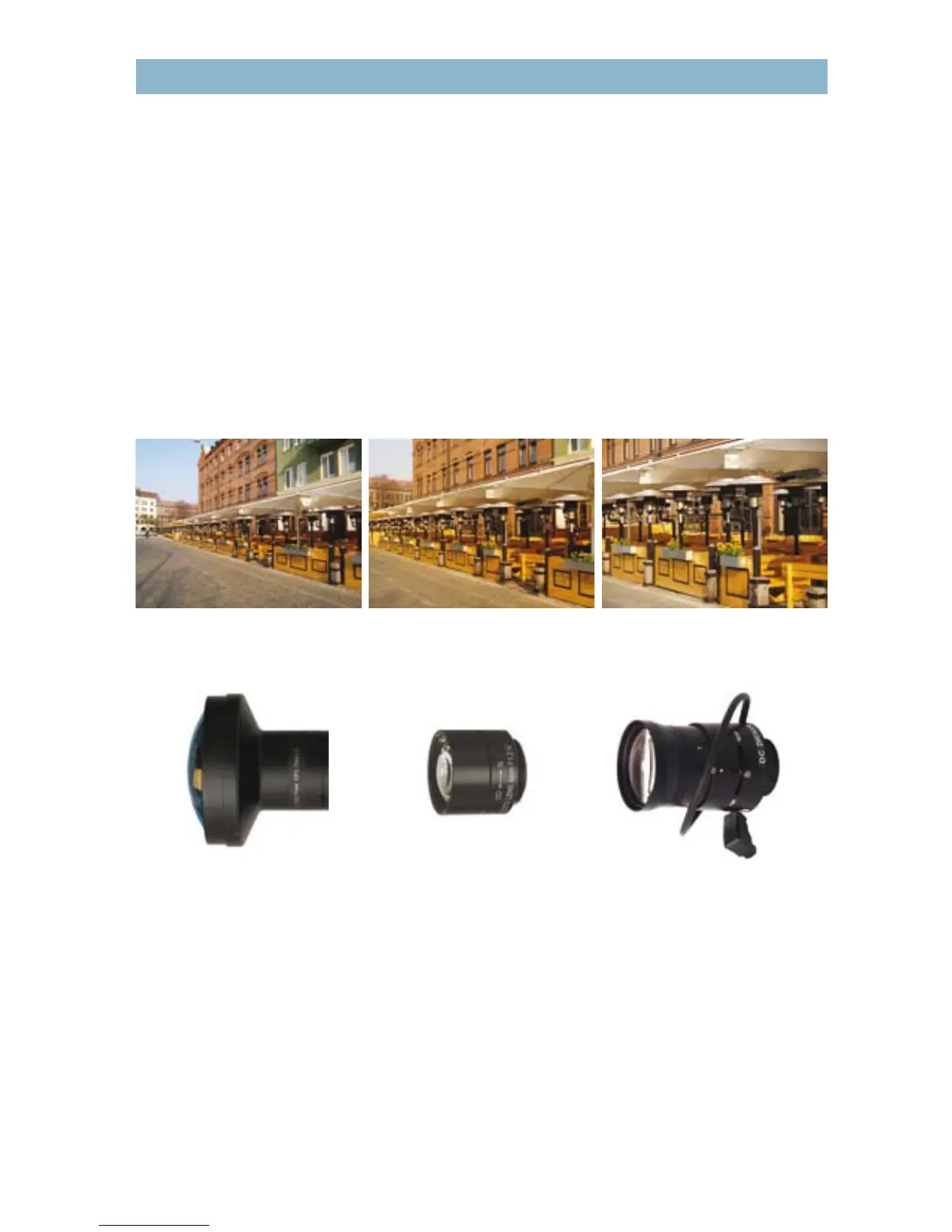
The eld of view can be classied into three types:
> Normal view: oering the same eld of view as the human eye.
> Telephoto: a narrower eld of view, providing, in general, ner details than a human eye can
deliver. A telephoto lens is used when the surveillance object is either small or located far
away from the camera. A telephoto lens generally has less light gathering capability than a
normal lens.
> Wide angle: a larger eld of view with less detail than in normal view. A wide-angle lens
generally provides good depth of eld and fair, low-light performance. Wide-angle lenses
sometimes produce geometrical distortions such as the “sh-eye” eect.
Figure 3.2a Dierent elds of view: wide-angle view (at left); normal view (middle); telephoto (at right).
Figure 3.2b Network camera lenses with dierent focal lengths: wide-angle (at left); normal (middle); telephoto (at
right).
There are three main types of lenses:
> Fixed lens: Such a lens oers a focal length that is xed; that is, only one eld of view
(either normal, telephoto or wide angle). A common focal length of a xed network camera
lens is 4 mm.
CAMERA ELEMENTS - CHAPTER 3



 To Next Page