Video encoders
Video encoders, also known as video servers, enable an existing analog CCTV video
surveillance system to be integrated with a network video system. Video encoders
play a signicant role in installations where many analog cameras are to be main-
tained. This chapter describes what a video encoder is and its benets, and provides
an overview of its components and the dierent types of video encoders available.
A brief discussion on deinterlacing techniques is also included, in addition to a section
on video decoders.
5.1 What is a video encoder?
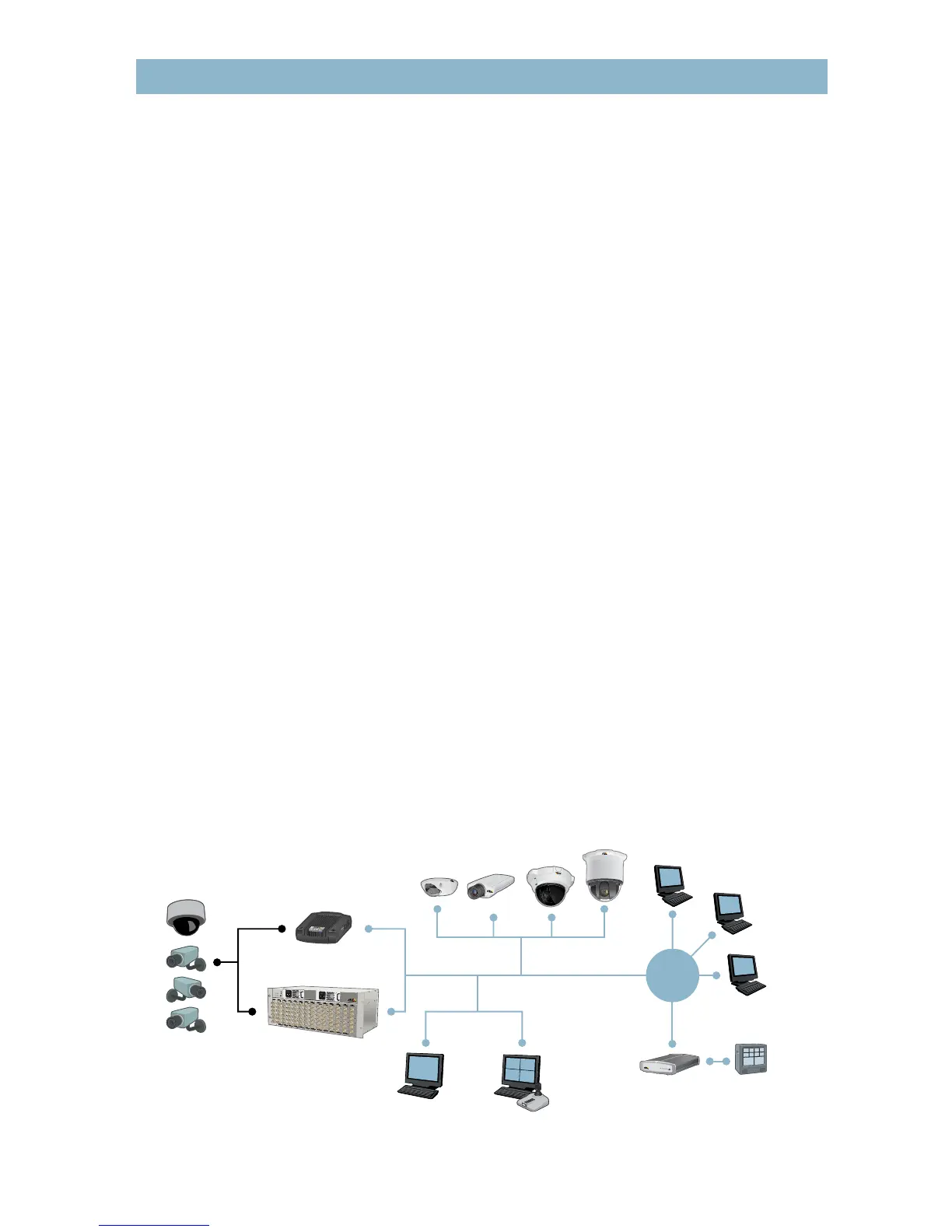
A video encoder makes it possible for an analog CCTV system to migrate to a network video sys-
tem. It enables users to gain the benets of network video without having to discard existing
analog equipment such as analog CCTV cameras and coaxial cabling.
A video encoder connects to an analog video camera via a coaxial cable and converts analog
video signals into digital video streams that are then sent over a wired or wireless IP-based net-
work (e.g., LAN, WLAN or Internet). To view and/or record the digital video, computer monitors
and PCs can be used instead of DVRs or VCRs and analog monitors.
Figure 5.1a An illustration of how analog video cameras and analog monitors can be integrated with a network
video system using video encoders and decoders.
VIDEO ENCODERS - CHAPTER 5



 To Next Page