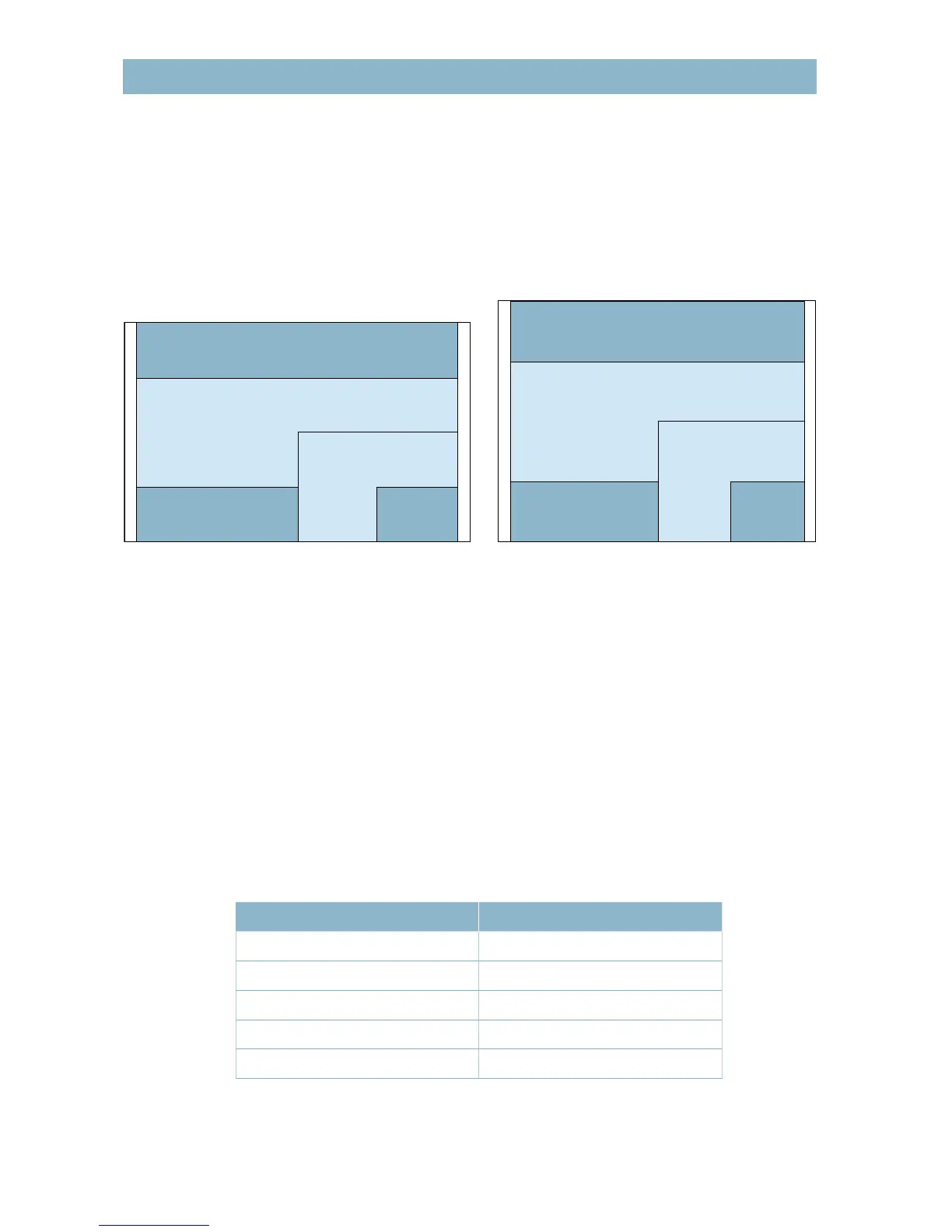
When shown on a computer screen, digitized analog video may show interlacing eects such as
tearing and shapes may be o slightly since the pixels generated may not conform to the square
pixels on the computer screen. Interlacing eects can be reduced using deinterlacing techniques
(see Chapter 5), while aspect ratio correction can be applied to video before it is displayed to
ensure, for instance, that a circle in an analog video remains a circle when shown on a com-
puter screen.
Figure 6.1a At left, dierent NTSC image resolutions. At right, dierent PAL image resolutions.
6.2 VGA resolutions
With 100% digital systems based on network cameras, resolutions that are derived from the
computer industry and that are standardized worldwide can be provided, allowing for better
exibility. The limitations of NTSC and PAL become irrelevant.
VGA (Video Graphics Array) is a graphics display system for PCs originally developed by IBM. The
resolution is dened as 640x480 pixels, which is a common format used by non-megapixel
network cameras. The VGA resolution is normally better suited for network cameras since VGA-
based video produces square pixels that match with those on computer screens. Computer
monitors can handle resolutions in VGA or multiples of VGA.
Table 6.2 VGA resolutions.



 To Next Page