(3) Wheel hub
The rear wheel hubs are fitted to the knuckle shafts through two tapered roller
bearings, the wheels with rims are bolted on the hubs. There are oil seals keeping the
grease in the hubs and the chambers of the knuckles between the inside of the two
tapered roller bearings. The degree of the bearing tightness is adjusted by the nut.
3.2 Adjustment and maintenance
3.2.1 Rear wheel bearing pre-load adjustment
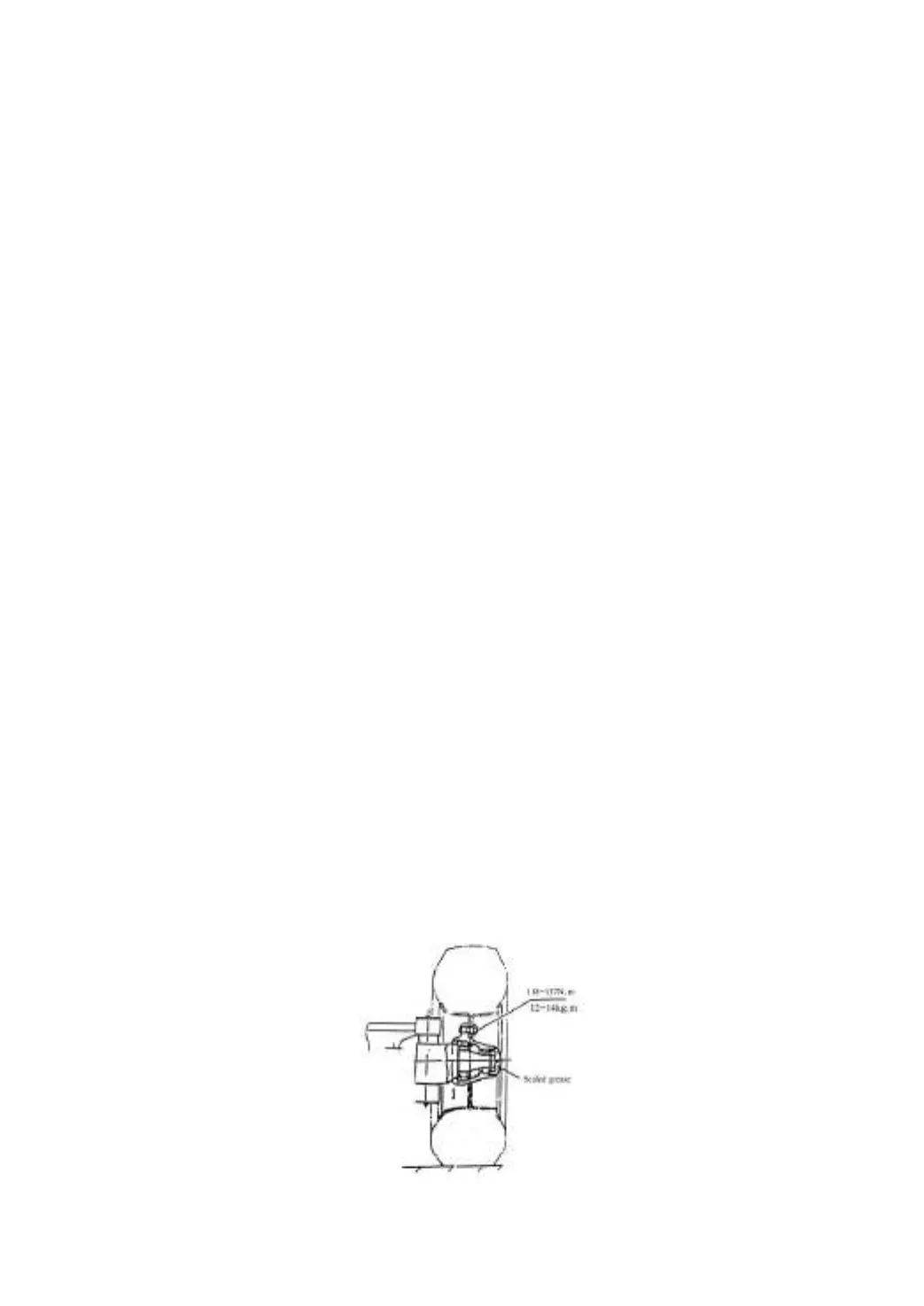
(1) As shown in Fig.3-6, fill up the chamber formed by wheel hubs, wheel hub bearing and
wheel hub covers with lubricating grease. Coat the lips of the oil seal with lubricating
grease.
(2) Press the hub bearing into the hub and fit the hub on the knuckle shaft.
(3) Fit a flat washer and tighten a castle nut with torque of 206-235N.m (21-24kg.m) and
loosen it, and then tighten it again with torque of 9.8N.m (1kg.m).
(4) To ensure firm installation of the hub, slightly knock at it with a wooden hammer and in
the meantime, rotate the hub for 3-4 turns.
(5) Tighten the castle nut and align one of its notches with a cotter pin hole drilled in the
steering knuckle.
(6) Again slightly knock at the hub with a wooden hammer and in this time, rotate
manually the hub for 3-4 turns to ensure its smooth rotation with a specified torque of
2.94-7.8N.m (0.3-0.8kg.m).
(7) If the torque value necessary to rotate the hub is more than the specified
above-mentioned, screw out the castle nut for 1/6 turn and then measure the torque
value.
(8) When the torque value measured is up to the specified one, lock the castle nut with a
cotter pin.
Fig. 3-6 Pre-load adjustment


 To Next Page