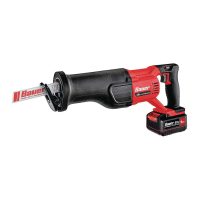
Page 11For technical questions, please call 1-888-866-5797.Item 59281
SAFETYOPERATIONMAINTENANCE SETUP
Maintenance and Servicing
Procedures not specifically explained in this manual must
be performed only by a qualified technician.
TO PREVENT SERIOUS INJURY FROM ACCIDENTAL OPERATION:
Make sure that the Trigger is in the off-position and remove its Battery
Pack before performing any procedure in this section.
TO PREVENT SERIOUS INJURY FROM TOOL FAILURE:
Do not use damaged equipment. If abnormal noise or vibration
occurs, have the problem corrected before further use.
Cleaning, Maintenance, and Lubrication
1. BEFORE EACH USE, inspect the general
condition of the tool. Check for:
• leaking, swollen, or cracked battery pack,
• loose hardware,
• misalignment or binding of moving parts,
• cracked or broken parts, and
• any other condition that may
affect its safe operation.
2. AFTER USE, wipe external surfaces
of the tool with clean cloth.
3. For blade changing instructions
see Tool Set Up on page 9.
4. Disconnect battery pack and store battery pack,
charger, and tool in dry, indoor area out of
reach of children and away from metal objects
(i.e., paperclips, coins) to prevent shorting.
Troubleshooting
Problem Possible Causes Likely Solutions
Tool will not start. 1. Battery Pack not properly
connected.
2. Battery Pack not properly charged.
3. Battery Pack worn out.
4. Internal damage or wear.
(Trigger, for example.)
1. Remove Battery Pack, make sure there are no
obstructions, reinsert the Battery Pack according
to its shape (it should only fit one way), and press
firmly until the Battery Pack locks in place.
2. Make sure Charger is connected and
operating properly. Give enough time for
Battery Pack to recharge properly.
3. Dispose of old Battery Pack
properly or recycle. Replace Battery Pack.
4. Have technician service tool.
Tool operates slowly. 1. Forcing tool to work too fast.
2. Battery Pack wearing out.
1. Allow tool to work at its own rate.
2. Dispose of old Battery Pack
properly or recycle. Replace Battery Pack.
Performance
decreases over time.
Blade dull or damaged. Keep blades sharp. Replace as needed.
Excessive noise
or rattling.
Internal damage or wear.
(Bearings, for example.)
Have technician service tool.
Overheating. 1. Forcing tool to work too fast.
2. Blade misaligned.
3. Blade dull or damaged.
4. Blocked motor housing vents.
1. Allow tool to work at its own rate.
2. Check and correct blade to fence alignment.
3. Keep blades sharp. Replace as needed.
4. Wear ANSI-approved safety goggles and
NIOSH-approved dust mask/respirator while
blowing dust out of motor using compressed air.
Follow all safety precautions whenever diagnosing or servicing the tool.
Disconnect Battery Pack and Charger power supply before service.


 To Previous Page
 Loading...