GENERAL DESCRIPTION
SAFETY INSTRUCTIONS
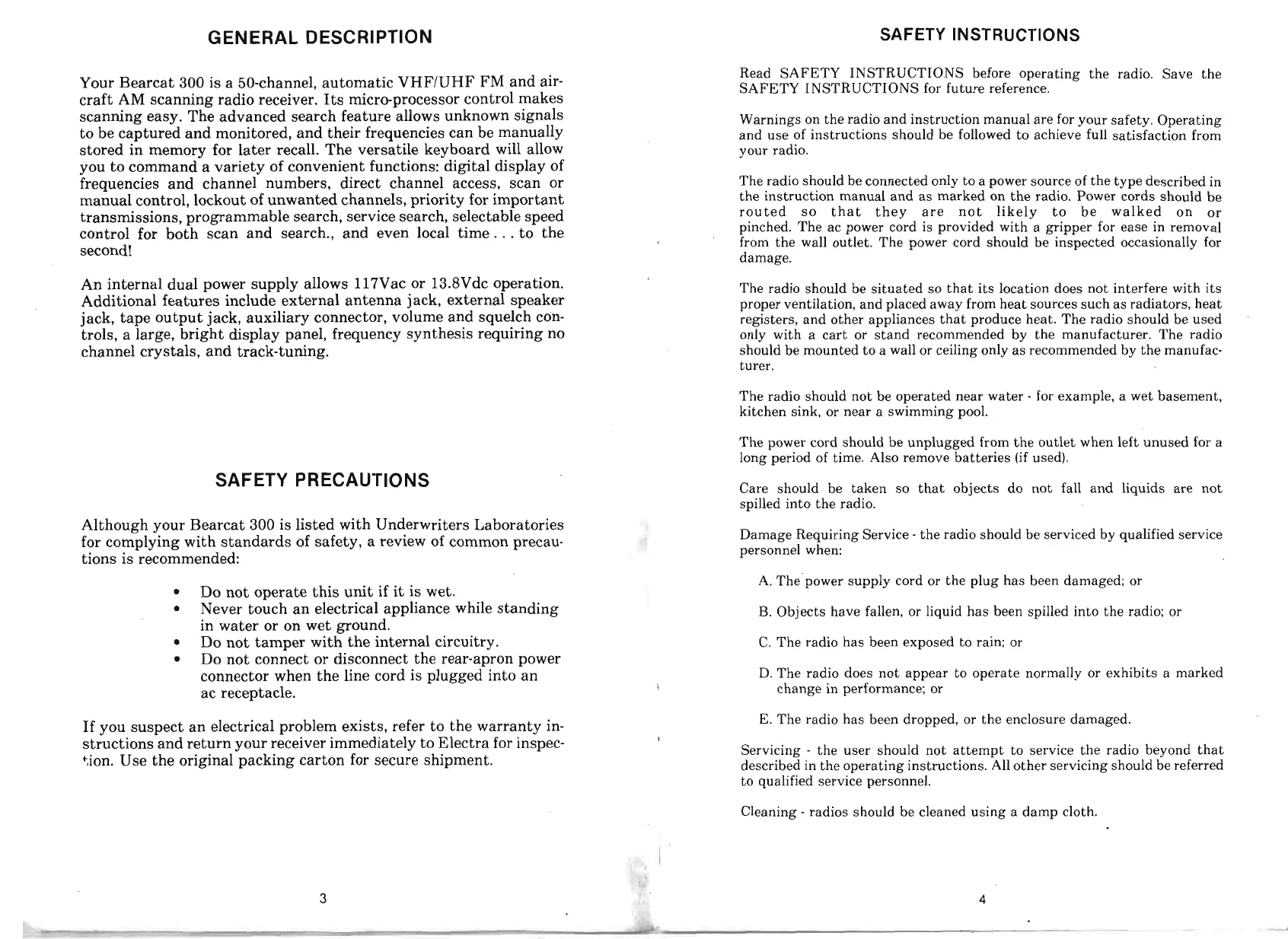
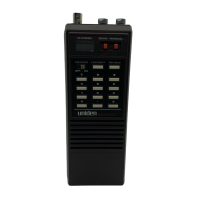
Your Bearcat 300 is a 50-channel, automatic VHFlUHF
FM
and air-
craft AM scanning radio receiver. Its micro-processor control makes
scanning easy. The advanced search feature allows unknown signals
to be captured and monitored, and their frequencies can be manually
stored in memory for later recall. The versatile keyboard will allow
you to command a variety of convenient functions: digital display of
frequencies and channel numbers, direct channel access, scan or
manual control, lockout of unwanted channels, priority for important
transmissions, programmable search, service search, selectable speed
control for both scan and search., and even local time..
.
to the
second!
An internal dual power supply allows
ll7Vac or 13.8Vdc operation.
Additional features include external antenna jack, external speaker
jack, tape output jack, auxiliary connector, volume and squelch con-
trols, a large, bright display panel, frequency synthesis requiring no
channel crystals, and track-tuning.
SAFETY PRECAUTIONS
Although your Bearcat 300 is listed with Underwriters Laboratories
for complying with standards of safety, a review of common precau-
tions is recommended:
Do not operate this unit if it
is
wet.
Never touch an electrical appliance while standing
in water or on wet ground.
Do not tamper with the internal circuitry.
Do not connect or disconnect the rear-apron power
connector when the line cord is plugged into an
ac receptacle.
If you suspect an electrical problem exists, refer to the warranty in-
structions and return your receiver immediately to Electra for inspec-
tion. Use the original packing carton for secure shipment.
Read SAFETY INSTRUCTIONS before operating the radio. Save the
SAFETY INSTRUCTIONS for future reference.
Warnings on the radio and instruction manual are for your safety. Operating
and use of instructions should be followed to achieve full satisfaction from
your radio.
The radio should be connected only to a power source of the type described in
the instruction manual and as marked on the radio. Power cords should be
routed so that they are not likely to be walked on or
pinched. The ac power cord is provided with a gripper for ease in removal
from the wall outlet. The power cord should be inspected occasionally for
damage.
The radio should be situated so that its location does not interfere with its
proper ventilation, and placed away from heat sources such as radiators, heat
registers, and other appliances that produce heat. The radio should be used
only with a cart or stand recommended by the manufacturer. The radio
should be mounted to a wall or ceiling only as recommended by the manufac-
turer.
The radio should not be operated near water
-
for example, a wet basement,
kitchen sink, or near a swimming pool.
The power cord should be unplugged from the outlet when left unused for a
long period of time. Also remove batteries (if used).
Care should be taken so that objects do not fall and liquids are not
spilled into the radio.
Damage Requiring Service
-
the radio should be serviced by qualified service
personnel when:
A.
The power supply cord or the plug has been damaged; or
B.
Objects have fallen, or liquid has been spilled into the radio; or
C.
The radio has been exposed to rain; or
D.
The radio does not appear to operate normally or exhibits a marked
change in performance; or
E. The radio has been dropped, or the enclosure damaged.
I
Servicing
-
the user should not attempt to service the radio beyond that
described in the operating instructions. All other servicing should be referred
to qualified service personnel.
Cleaning
-
radios should be cleaned using a damp cloth.


 To Next Page