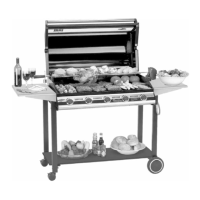
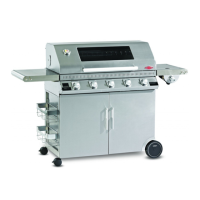
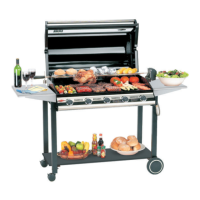
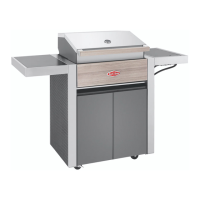
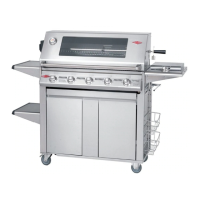
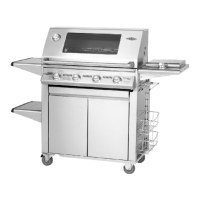
This document serves as the Assembly and Operating Instructions for the BeefEater Signature Barbecue, an outdoor cooking appliance designed for various grilling and roasting applications. It emphasizes safety, proper installation, and effective use to ensure a satisfying barbecuing experience.
Function Description
The BeefEater Signature Barbecue is an outdoor cooking appliance that utilizes LPG (liquefied petroleum gas) or propane as its fuel source. It features multiple burners, cooking plates, and grills, allowing for both direct and indirect cooking methods. The barbecue is equipped with vaporizers designed to atomize fats and juices from food, reducing flare-ups and enhancing flavor. A roasting hood is included for indirect cooking, transforming the barbecue into an "outdoor oven" for items like roasts, poultry, and casseroles. The appliance incorporates a safety feature that requires the control knobs to be pushed in before turning, preventing accidental ignition. It also includes a grease tray for collecting drippings, which aids in cleanup and reduces the risk of grease fires.
Usage Features
The barbecue is designed for outdoor use only and must be placed on a firm, level surface with adequate clearance from combustible materials. Proper ventilation is crucial for both the barbecue and the gas cylinder.
For lighting, users must push in and hold the far-right control knob while turning it counter-clockwise to engage the starter mechanism. Once the main burner lights, other burners can be lit successively. If a burner fails to light, users are instructed to return the knob to the Off position, wait five minutes for gas to disperse, and then retry. Manual lighting is also possible by igniting the burner through the gap between the drip tray and the barbecue body.
Burner operation can be adjusted using the control knobs, which offer Low, Medium, and High heat settings. The document advises checking for a clear blue flame with only a yellow tip, and provides instructions for adjusting the flame if excessive yellow tipping occurs.
The cooking surfaces, including porcelain enamel coated grills, do not require seasoning and should be washed with soapy water before first use. The solid plate is typically placed on the left, and grills over the vaporizers on the right. It is explicitly stated that additional cooking plates should not be fitted to the top of the barbecue, as this obstructs ventilation and can cause damage.
Two primary cooking methods are outlined:
- Direct Cooking: Food is placed directly over the lit grill section, suitable for steaks, chops, sausages, and hamburgers. Users are advised to monitor for excess flaring.
- Indirect Cooking: This method is used when the roasting hood is closed. Burners directly beneath the food are turned off, and burners on either side are used. Heat circulates by convection, creating an "outdoor oven" effect that cooks food more evenly and keeps it moist. This is recommended for rotisserie cooking, roasts, poultry, casseroles, vegetables, and whole fish. When roasting, using a roast holder and a baking dish with a depth greater than 35mm is recommended to prevent fat fires.
The manual also provides guidelines for preheating the barbecue with the hood down and maintaining the correct cooking temperature using a temperature gauge. It includes charts detailing approximate cooking times and recommended burner settings for various types of meat. Users are warned not to exceed the temperature warning on the gauge, as overheating can damage components.
Maintenance Features
Regular maintenance is essential for safe and efficient operation. The document provides a checklist for maintenance tasks, categorized by frequency (each use, every 6 months, and every 2 years by an authorized service agent).
Key maintenance activities include:
- Gas Connections: Checking all hoses for cracks and leaks, and ensuring all gas connections are tight. A leak test using soapy water is recommended every time the gas cylinder is refilled or reconnected, or after any new gas connection.
- Cleaning: The entire barbecue should be cleaned thoroughly. Stainless steel surfaces should be washed with hot soapy water, cleaning along the grain to avoid scratching. Discoloration caused by heat can often be removed with a stainless steel polish. Porcelain enamel coated cooking surfaces should be cleaned with a brass bristle wire brush and soapy water, avoiding harsh chemical cleaners.
- Grease Tray: The grease tray should be regularly emptied and cleaned to prevent grease build-up and potential fires. Lining the tray with aluminum foil and a 6mm layer of dry sand or other non-combustible absorbent material is recommended. The tray should only be removed when the barbecue is cool.
- Burners: Burners, their main opening, throat, and venturi should be regularly checked for insect nests (e.g., wasp, ants, or spiders), which must be thoroughly cleaned out. Periodically, burners should be removed, scrubbed clean with soapy water, and reinstalled correctly, ensuring ports are free of obstructions.
- Vaporizers: These should be cleaned and inspected regularly.
- Ignition System: The working of the ignition system should be checked.
- Storage: When storing the barbecue for extended periods, all controls and cylinder valves must be turned off. If stored indoors, the gas cylinder must be removed and stored outdoors in a ventilated area, out of reach of children. The barbecue should be covered when not in use to protect it from the elements. All nuts and bolts should be frequently checked and tightened.
The manual also includes a troubleshooting guide for common issues such as burners not lighting, going out after starting, or having low flame levels, providing potential causes and solutions. It emphasizes that the appliance should be checked and serviced by an authorized service person every two years.


 To Next Page
 General