
 Need help?
Do you have a question about the Behringer K-2 and is the answer not in the manual?
Explains that the unit is factory calibrated but may require recalibration due to environmental changes.
Outlines the initial preparation and control setting steps for general unit calibration.
Instructions on how to enter the testing mode by holding TRIG SW during power-up.
Details on holding TRIG SW and setting the FILTER1/2 switch to start VCO calibration.
Explains the meaning of the ON LED color (green for success, red for failure) during calibration.
The final step to restart the unit after the calibration process is complete.
The Behringer K-2 is an analog and semi-modular synthesizer designed for musicians and sound designers seeking a versatile and powerful instrument. It features a dual VCO (Voltage Controlled Oscillator) architecture, a ring modulator, and an external signal processor, making it capable of producing a wide range of sounds from classic analog tones to complex experimental textures. The synthesizer also boasts a 16-voice poly chain capability, allowing users to link multiple K-2 units for expanded polyphony, and is designed in a Eurorack format, ensuring compatibility with other modular synthesis systems.
The K-2's core sound generation revolves around its two voltage-controlled oscillators. These VCOs are the primary source of the synthesizer's sound, offering a foundation for various waveforms and timbres. The semi-modular design means that while the K-2 has a default signal path, users can re-route signals using patch cables to create custom signal flows and unique sounds. This flexibility is a hallmark of modular synthesizers, empowering users to experiment beyond conventional synthesis structures.
The inclusion of a ring modulator allows for the creation of metallic, bell-like, and dissonant sounds by multiplying the frequencies of two input signals. This effect is particularly useful for crafting industrial textures, percussive elements, or evolving soundscapes. An external signal processor further enhances the K-2's utility, enabling users to process external audio sources through the synthesizer's filters, envelopes, and other modules. This transforms the K-2 into a powerful effects unit, capable of imparting its distinct analog character onto guitars, drums, or other electronic instruments.
The 16-voice poly chain feature is a significant advantage for users who require more than monophonic operation. By connecting multiple K-2 units, the synthesizer can achieve up to 16 voices of polyphony, making it suitable for playing chords, pads, and more complex musical arrangements. This scalability allows the K-2 to grow with a user's needs, from a single monophonic unit to a powerful polyphonic instrument.
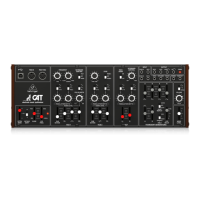
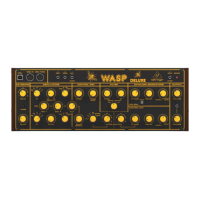
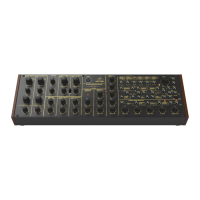
While specific technical specifications like frequency ranges, filter types, and modulation capabilities are not explicitly detailed in the provided document, the mention of "Dual VCOs," "Ring Modulator," "External Signal Processor," and "16-Voice Poly Chain" highlights key architectural components. The "Eurorack Format" indicates that the K-2 adheres to the mechanical and electrical standards of the Eurorack modular synthesis system, typically implying 3.5mm jack connections for patching and standard power requirements within a Eurorack case. The front panel layout, visible in the image, suggests a comprehensive set of controls for each module, including knobs for parameters like frequency, resonance, modulation depth, and envelope stages, along with switches for waveform selection and routing.
The semi-modular nature of the K-2 is its primary usage feature, offering both immediate playability and deep sound design potential. For beginners, the default signal path allows for quick sound creation without the need for extensive patching. For experienced users, the patch points open up a world of sonic exploration, enabling complex modulation routings, feedback loops, and unique signal processing chains. The front panel is laid out with clearly labeled sections for VCOs, VCFs (Voltage Controlled Filters), VCAs (Voltage Controlled Amplifiers), and Envelope Generators, facilitating intuitive control over sound parameters. The 16-voice poly chain feature expands the K-2's musical applications beyond typical monophonic synthesizers, allowing for rich harmonic textures.
The K-2 includes user-accessible calibration procedures to ensure optimal performance over time. This is a crucial maintenance feature for analog synthesizers, as their components can drift due to environmental changes or aging. The calibration process involves two main steps:
General Setup:
VCO PITCH Calibration:
These calibration procedures empower users to maintain the K-2's factory-level performance, ensuring accurate pitch tracking and consistent sound quality throughout its lifespan. This self-maintenance capability reduces the need for professional servicing for common performance drifts, making the K-2 a more user-friendly and reliable instrument.
 General
| Brand | Behringer |
|---|---|
| Model | K-2 |
| Category | Synthesizer |
| Language | English |








 To Next Page