
 Need help?
Do you have a question about the Beltone LND664-DRW and is the answer not in the manual?
Specifications for the BERLIN RIE C5.0 platform, including models, colors, and power levels.
Specifications for the BERLIN RIE C4.5 platform, including models, colors, and power levels.
Part numbers for programmed service modules and ASM frame components.
Catalog of part numbers for essential test equipment.
Part numbers for Housing (HSG) components and replacement packs.
Part numbers for SUREFIT 2 C receiver tubes and standard/power domes.
Part numbers for SUREFIT 2 B receiver tubes and associated domes.
Part numbers for SUREFIT 2 B & C accessories, including fitting kits and sport locks.
Part numbers for optional N-Cased earmoulds for specific receiver tubes.
Part numbers for custom insert option components like mandrels and rubber.
Step-by-step guide for safely disassembling the hearing instrument.
Step-by-step guide for correctly reassembling the hearing instrument.
Procedure for replacing the wax guard/filter in the 3-pin receiver tube.
Visual guide and descriptions of essential test equipment for hearing instruments.
Instructions on attaching and using the programming adaptor clip.
Steps to prepare the hearing instrument for Hearing Instrument (HI) testing.
Detailed procedure for performing Hearing Instrument (HI) tests.
Guide for conducting wireless range tests using DSA6000 and Noahlink.
This document provides a comprehensive technical manual for the Beltone BERLIN RIE Platform, encompassing various models under the RELY, AMAZE, TRUST, and LEGEND series. The manual details the form-factor matrix, product information, part lists, and procedures for disassembly, reassembly, filter replacement, and testing.
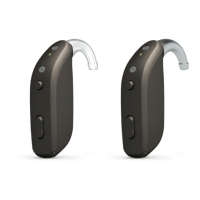
The Beltone BERLIN RIE Platform offers a range of Receiver-In-Ear (RIE) hearing instruments designed for discreet wear and advanced hearing support. These devices are available with different battery types, including size 13 zinc-air batteries, and feature wireless connectivity. Some models, like the Cloud Key (CK) C5.0, support Made for iPhone (MFi), iPad, and iPod compatibility, while others, such as the RLY264-DRW, do not include MFi functionality. Additionally, certain models are compatible with Android devices, enhancing their versatility across different smartphone ecosystems.
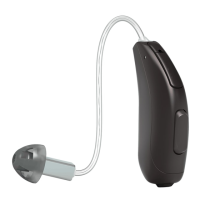
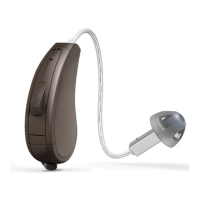
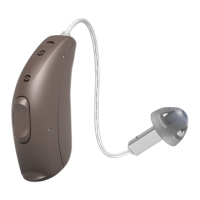
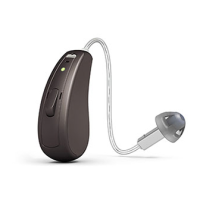
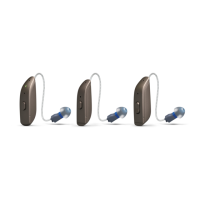
The core function of the Beltone BERLIN RIE hearing instruments is to amplify sound and deliver it directly into the ear canal, compensating for various degrees of hearing loss. These devices utilize advanced digital signal processing to provide clear and natural sound quality. The RIE design places the receiver (speaker) directly in the ear canal, connected by a thin wire to the main body of the hearing aid, which sits behind the ear. This configuration minimizes feedback and offers a more open fit compared to traditional behind-the-ear (BTE) models.
The hearing instruments are available with four selectable receiver power levels: Low (LP), Medium (MP), High (HP), and Ultra (UP), allowing for customization based on the user's specific hearing loss profile. The hearing instruments fit SureFit (SF) 3-pin receiver tubes, ensuring a secure and reliable connection.
Some models, particularly within the AMAZE series, offer "Dual mic, RIE, Wireless" (DRW) functionality, indicating the presence of two microphones for improved sound localization and noise reduction, along with RIE and wireless capabilities. Certain AMAZE models also include "Telecoil" (DRWT) functionality, which allows the hearing aid to pick up electromagnetic signals from compatible loop systems in public venues, enhancing listening in challenging environments.
The Beltone BERLIN RIE devices are designed for user-friendliness and adaptability. They come in a variety of colors, including Grey (GRY), Brown (BRN), Beige (BGE), Charcoal (CHAR), Sterling Grey (STG), Light Grey (LGR), Black (BLK), and White (WHT), allowing users to choose a color that blends with their hair or skin tone. The Legend (LND) models also offer a unique Blue (BLU) option.
The SureFit 2 C and SureFit 2 B Rec Tubes are available in various sizes (0L, 0R, 1L, 1R, 2L, 2R, 3L, 3R, 4L, 4R) and power levels (LP, MP, HP) to ensure an optimal fit and sound delivery for different ear canal anatomies and hearing needs. These tubes are designed to be easily mounted with a variety of domes, including standard, open, closed, and power domes, which are supplied in bags of 10 pieces. The manual provides clear instructions on how to mount the domes to the receiver tube, emphasizing the correct orientation for tulip domes.
For active users, Sport Locks are available in LP, MP, and HP variants. These accessories help secure the hearing instrument in place during physical activities, preventing accidental dislodgement. The manual illustrates how to choose and mount the appropriate sport lock.
Optional N-Cased Earmoulds are also available for users requiring a more custom and secure fit, particularly for higher power receivers like the UP (Ultra Power) receiver. These earmoulds are designed to encase the receiver, providing enhanced acoustic seal and stability. The manual references a separate document, "N-Cased Earmould Process, RIE," for detailed instructions on this option. Custom insert options are also available, with specific mandrels for LP, MP, and HP receivers, and a silicone rubber vent for optimal comfort and acoustic performance.
The manual provides detailed, step-by-step instructions for the maintenance and repair of the Beltone BERLIN RIE devices, enabling technicians to perform necessary services.
The disassembly procedure begins with unlocking the connector lock that secures the receiver, followed by carefully pulling out the receiver. Two pins are then pushed out using a pin removal tool, allowing the top housing (HSG) to be separated from the bottom housing. The battery door is gently pulled upwards to avoid damaging the black plastic battery click in the top HSG. Finally, the module/ASM FRAME is lifted and slid out from the bottom HSG, and the pin for the battery door is pushed out.
Reassembly is the reverse process, with careful attention to alignment and secure fastening. The battery door is mounted, and its pin is pushed in to fix it to the module. The module is then slid into the bottom HSG, ensuring alignment with the pinholes. If the connector lock is damaged, a new one can be mounted into the top HSG, ensuring it is correctly oriented and pressed firmly into place. The top HSG is slid towards the battery door end, taking care not to damage the HSG taps, and the two pins are mounted. Finally, the receiver is mounted, and the connector lock is pressed down to secure it.
The manual includes a clear guide for replacing the filter in the 3-pin receiver tube, specifically for SureFit 2 B models. Before starting, any dome mounted on the receiver must be removed. The wax guard tool, which has both a removal tip and a replacement tip with a new white filter, is used for this process. The removal tip is inserted into the used filter until the shaft touches the rim, and the filter is slowly pulled straight out. To insert the new filter, the replacement tip is gently pressed into the sound outlet until the outer ring is flush. The tool is then pulled straight out, leaving the new filter in place, and a new or fresh dome can be reattached.
The manual outlines the necessary test equipment and procedures for comprehensive device evaluation. This includes:
The manual also lists various CROS/BICROS SureFit audio shoes and Europlugs, indicating compatibility with different accessories for specific hearing needs. The importance of nano-coating on all HSG parts is highlighted, contributing to the durability and longevity of the hearing instruments.
 General
| Brand | Beltone |
|---|---|
| Model | LND664-DRW |
| Category | Hearing Aid |
| Language | English |


 To Next Page