07/ 2018
BENNING ST 725
36
9.5 Testing of 30 mA RCDs
The BENNING ST 725 allows measuring the tripping time of permanently installed RCDs and of
portable RCDs (PRCDs) with a nominal fault current of 30 mA. In the automatic test sequence,
thetrippingtimeoftheone-foldnominalfaultcurrent(initialpolarityof0°/180°)andoftheve-
fold nominal fault current (initial polarity of 0°/ 180°) is measured.
By generating a fault current of 30 mA, it is proven that the RCD will trip when the nominal fault
current is reached. If the limiting value of the maximum contact voltage of 50 V is exceeded, the
"UB > 50 V" symbol will be shown on the display and the testing will be stopped.
Before testing an RCD, the 4 mm safety plug of the test cable must be
disconnected from the test socket
9
.
Measurement might be influenced by:
- a possibly existing voltage between the protective conductor of the
shockproof socket and earth
- leakage currents in the circuit behind the RCD
- further earthing equipment
- equipment which is connected behind the RCD and which will cause a
longer tripping time, e.g. capacitors or rotating machines
9.5.1 Testing of permanently installed RCDs
- Connect the IEC power cord to the IEC connector J of the BENNING ST 725.
- Connect the shock-proof plug to a shock-proof socket which is protected by the RCD to be
tested and switch on the RCD.
-
The RCD can only be tested with the mains voltage being applied correctly (see chapter 8.3).
- Press the -key
6
to start the RCD test.
- If the "rESET" symbol is still shown on the display and the "LN" and "LE" symbols are
flashing, turn the shock-proof plug in the shock-proof socket by 180° and press the -key
6
again to start the test.
- Whenever the "rESEt" symbol appears on the display, switch the RCD on again.
- The BENNING ST 725 generates a fault current of 30 mA with positive (0°) or negative
(180°) initial polarity. The RCD trips and the tripping times of the one-fold nominal fault
current are measured.
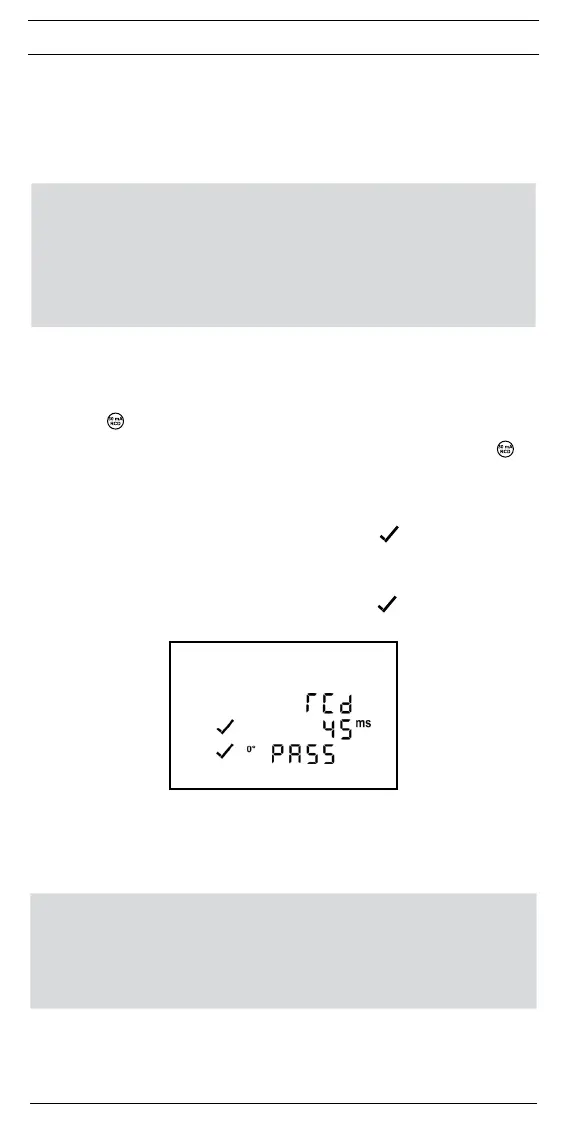
- If the tripping time is less than the limiting value (200 ms), a will be shown next to the
tripping time.
- Subsequently, the BENNING ST 725 generates a fault current of 150 mA with positive (0°) or
negative (180°) initial polarity. The RCD trips and the tripping times of the five-fold nominal
fault current are measured.
- If the tripping time is less than the limiting value (40 ms), a will be shown next to the
tripping time.
- The test is considered to be passed, if "PASS" is shown on the display.
Seegure8a: TestingofpermanentlyinstalledRCDs(I
ΔN
=30mA)
Note:
- By generating a fault current of 30 mA, it is proven that the RCD will trip when the nominal
fault current is reached. If the limiting value of the maximum contact voltage of 50 V is
exceeded, the "UB > 50 V" symbol will be shown on the display and the testing will be
stopped.
Measurement might be influenced by:
- a possibly existing voltage between the protective conductor of the
shockproof socket and earth
- leakage currents in the circuit behind the RCD
- further earthing equipment
- equipment which is connected behind the RCD and which will cause a
longer tripping time, e.g. capacitors or rotating machines
9.5.2 Testing of portable RCDs (PRCDs)
- Connect the plug of the mains connection cable to the jack K of the BENNING ST 725.
- Connect the shock-proof plug to a 230 V shock-proof socket. With the mains voltage being
applied, the voltage measurement will start automatically.
-
The RCD can only be tested with the mains voltage being applied correctly (see chapter 8.3).



 To Next Page