Need help?
Do you have a question about the BenQ LU960ST2 and is the answer not in the manual?
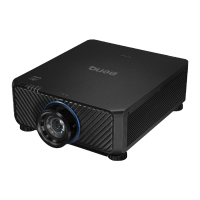
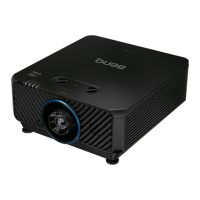
The BenQ LU960ST2 Projector RS232 Command Control Installation Guide details how to control a BenQ projector via RS232 from a computer. This document serves as a comprehensive guide for establishing connections, configuring settings, and utilizing a command table for various RS232 commands.
The projector offers flexible connectivity options, allowing control through an RS232 serial port with a crossover cable, via LAN, or through HDBaseT. Each method requires specific setup procedures to ensure proper communication between the computer and the projector.
For RS232 serial port control with a crossover cable, the guide provides a detailed wire arrangement and RS232 pin assignment. The wire arrangement specifies the color coding for each pin (P1 to P2), such as black for pin 1, brown for pin 2, red for pin 3, orange for pin 4, yellow for pin 5, green for pin 6, blue for pin 7, purple for pin 8, and gray for pin 9, with a drain wire for the case. The pin assignment clarifies the function of each pin on the D-Sub 9 connector: pin 1 is NC (No Connection), pin 2 is RXD (Receive Data), pin 3 is TXD (Transmit Data), pin 4 is NC, pin 5 is GND (Ground), pin 6 is NC, pin 7 is RTS (Request To Send), pin 8 is CTS (Clear To Send), and pin 9 is NC. To set up this connection, users must first identify the COM Port name in Device Manager, then select "Serial" and the corresponding COM port (e.g., COM6) in the communication software (like Tera Term), and finally configure serial port settings such as baud rate, data length, parity, stop bit, and flow control. The baud rate can be set to 9600, 14400, 19200, 38400, 57600, or 115200 bps, with the recommendation to check the projector's OSD menu for the correct baud rate. Data length is typically 8 bits, parity is none, stop bit is 1 bit, and flow control is none.
When controlling the projector via LAN, the connection involves an RJ45 port on the projector and a LAN cable connecting to a PC or laptop. The setup requires finding the wired LAN IP address of the projector from its OSD menu and ensuring both the projector and computer are on the same network. Additionally, users need to input "8000" in the TCP port # field within the communication software.
For HDBaseT control, the setup involves an HDBaseT compatible device, which includes a D-Sub 9 pin and an RJ45 port, connected to the projector's RJ45 port via a LAN cable. A PC or laptop connects to the D-Sub 9 pin of the HDBaseT device. Similar to the serial port setup, users must determine the COM Port name in Device Manager, choose "Serial" and the appropriate COM port, and then configure the serial port settings (baud rate, data length, parity, stop bit, and flow control) to match the projector's OSD menu.
The command table is a central feature, listing various functions, their types (Write/Read), operations, corresponding ASCII commands, and whether they are supported. This table allows users to send specific commands to control different aspects of the projector.
The projector can be powered on or off using the commands <CR>*pow=on#<CR> and <CR>*pow=off#<CR>, respectively. The power status can be read with <CR>*pow=?#<CR>. Source selection is extensive, covering inputs like COMPUTER/YPbPr (<CR>*sour=RGB#<CR>), HDMI (<CR>*sour=hdmi#<CR>), DisplayPort (<CR>*sour=dp#<CR>), and HDBaseT (<CR>*sour=hdbaset#<CR>). The current source can be queried using <CR>*sour=?#<CR>.
Audio control includes muting and unmuting the audio (<CR>*mute=on#<CR>, <CR>*mute=off#<CR>) and checking the mute status (<CR>*mute=?#<CR>). Volume can be adjusted up (<CR>*vol=+#<CR>) or down (<CR>*vol=-#<CR>), set to a specific value (<CR>*vol=value#<CR>), and its status read (<CR>*vol=?#<CR>). Microphone volume can also be controlled. Audio pass-through can be turned off (<CR>*audiosour=off#<CR>), and the status read (<CR>*audiosour=?#<CR>). Specific audio sources like Audio-Computer1, Audio-HDMI, and Audio-DisplayPort can be selected.
Picture mode settings offer a variety of options such as Dynamic, Presentation, sRGB, Bright, Living Room, Game, Cinema (Rec.709), Standard/Vivid, Football, Football Bright, DICOM, THX, Silence mode, DCI-P3 mode (D. Cinema), Vivid, Infographic, User1, User2, User3, ISF Day, ISF Night, 3D, Sport, HDR10, HLG, and Spreadsheet. Each mode has a corresponding command (e.g., <CR>*appmod=dynamic#<CR>). The current picture mode can be read with <CR>*appmod=?#<CR>.
Picture settings allow for fine-tuning of Contrast, Brightness, Color, and Sharpness. Each of these can be increased (<CR>*con=+#<CR>), decreased (<CR>*con=-#<CR>), set to a specific value (<CR>*con=value#<CR>), and their current value read (<CR>*con=?#<CR>). Flesh Tone can also be adjusted. Color Temperature offers options like Warmer, Warm, Normal, Cool, Cooler, and Lamp Native, with commands like <CR>*ct=warmer#<CR>. The color temperature status can be read using <CR>*ct=?#<CR>.
Aspect ratio settings include 4:3, 16:6, 16:9, 16:10, 2.35:1, Auto, Real, Letterbox, Wide, Anamorphic, Anamorphic 2.35, Anamorphic 16:9, and 2.4:1. Commands like <CR>*asp=4:3#<CR> are used for selection, and <CR>*asp=?#<CR> for status.
Keystone correction, both vertical and horizontal, can be adjusted incrementally (<CR>*vkeystone=+#<CR>), decremented (<CR>*vkeystone=-#<CR>), set to a specific value (<CR>*vkeystone=value#<CR>), and their status read (<CR>*vkeystone=?#<CR>). Rotate Keystone also offers similar adjustments. Overscan adjustment can be increased, decreased, and its value read.
Four Corners adjustment allows for precise geometric correction of the image. Each corner (Top-Left-X, Top-Left-Y, Top-Right-X, Top-Right-Y, Bottom-Left-X, Bottom-Left-Y, Bottom-Right-X, Bottom-Right-Y) can be decreased (<CR>*cornerfittlx=-#<CR>) or increased (<CR>*cornerfittlx=+#<CR>), and their status read.
Digital Zoom In (<CR>*zooml#<CR>) and Digital Zoom Out (<CR>*zoomO#<CR>) are available, along with an Auto zoom function (<CR>*auto#<CR>). Brilliant Color can be turned on or off, increased, decreased, or set to a specific value, and its status read. HDR settings include Auto, SDR, HDR10, and HLG, with status reading capability.
Operation settings cover various projector behaviors. Picture settings can be reset to current (<CR>*rstcurpicsetting#<CR>) or all (<CR>*rstallpicsetting#<CR>). Projector position (Front Table, Rear Table, Rear Ceiling, Front Ceiling) can be set and its status read. Quick cooling can be turned on or off, and its status checked. Quick auto search for inputs can also be enabled or disabled, and its status read. Menu position can be set to Center, Top-Left, Top-Right, Bottom-Right, or Bottom-Left, with status reading. Direct Power On and Signal Power On features can be enabled or disabled, and their status checked. Standby settings for Network and Microphone can be configured.
The projector supports various baud rates for serial communication, including 2400, 4800, 9600, 14400, 19200, 38400, 57600, and 115200 bps. The current baud rate can be read.
Lamp control features include reading lamp hours (Lamp Hour, Lamp2 Hour), setting lamp modes (Normal, Eco, SmartEco, SmartEco mode 2, SmartEco mode 3, Dimming, Custom), and adjusting the light level for custom mode. The lamp mode status can be read.
Miscellaneous commands allow reading the Model Name, System F/W Version, Scaler F/W Version, Format F/W Version, Lan F/W Version, MCU F/W Version, and Ballast F/W Version.
Blank On (<CR>*blank=on#<CR>) and Blank Off (<CR>*blank=off#<CR>) commands are available, with status reading. Freeze On (<CR>*freeze=on#<CR>) and Freeze Off (<CR>*freeze=off#<CR>) commands are also supported, with status reading.
Menu navigation can be controlled with Menu On (<CR>*menu=on#<CR>), Menu Off (<CR>*menu=off#<CR>), and status reading. Directional commands (Up, Down, Right, Left), Enter, and Back are also provided for menu interaction. Source Menu can be turned on or off, and its status read.
3D synchronization settings include 3D Sync Off, 3D Auto, 3D Sync Top Bottom, 3D Sync Frame Sequential, 3D Frame packing, 3D Side by side, 3D inverter disable, 3D inverter, 2D to 3D, and 3D nVIDIA. The 3D Sync Status can be read.
Remote Receiver settings allow turning the receiver on or off, and configuring its position (front+rear, front, rear, top, top+front). The remote receiver status can be read.
Instant On can be enabled or disabled, and its status checked. Lamp Saver Mode can be turned on or off, and its status checked. Projection Log In Code can be enabled or disabled, and its status checked. Broadcasting can be turned on or off, and its status checked. AMX Device Discovery can be enabled or disabled, and its status checked.
The guide provides commands to read the Mac Address and Serial Number of the projector. High Altitude mode can be turned on or off, and its status checked.
Lens memory functions allow users to load and save up to 10 different lens memory positions. Commands like <CR>*lensload=ml#<CR> are used to load a specific memory, and <CR>*lenssave=ml#<CR> to save. The status of loaded lens memory can be read. There is also a command to reset the lens to center (<CR>*lensreset=center#<CR>).
The document emphasizes that available functions and commands may vary by model, advising users to check the specifications and user manual of their specific projector. It also notes that commands work if the standby power is 0.5W or a supported baud rate is set. Uppercase, lowercase, and mixed-case characters are accepted for commands. The system provides feedback for illegal command formats ("Illegal format"), unsupported items ("Unsupported item"), or blocked commands ("Block item") due to certain conditions. When RS232 control is performed via LAN, commands work whether they start and end with <CR>, and all commands and behaviors are identical to serial port control.
 General
| Display Technology | DLP |
|---|---|
| Native Resolution | WUXGA (1920 x 1200) |
| Light Source | Laser |
| Zoom Ratio | 1.2x |
| Lens Shift | Vertical: ±60%, Horizontal: ±23% |
| Keystone Correction | Vertical: ±30°, Horizontal: ±30° |
| Speaker | 10W |
| Outputs | HDMI, VGA, Audio Out |
| Contrast Ratio | 100, 000:1 |
| Light Source Life | 20, 000 hours |
| Interface | HDMI, VGA, USB, RS-232 |
| Projection Size | 30" ~ 300" |
| Input Lag | 16.7 ms (1080p@60Hz) |

 To Next Page