INSTALLATION FOR SURFACE WATER
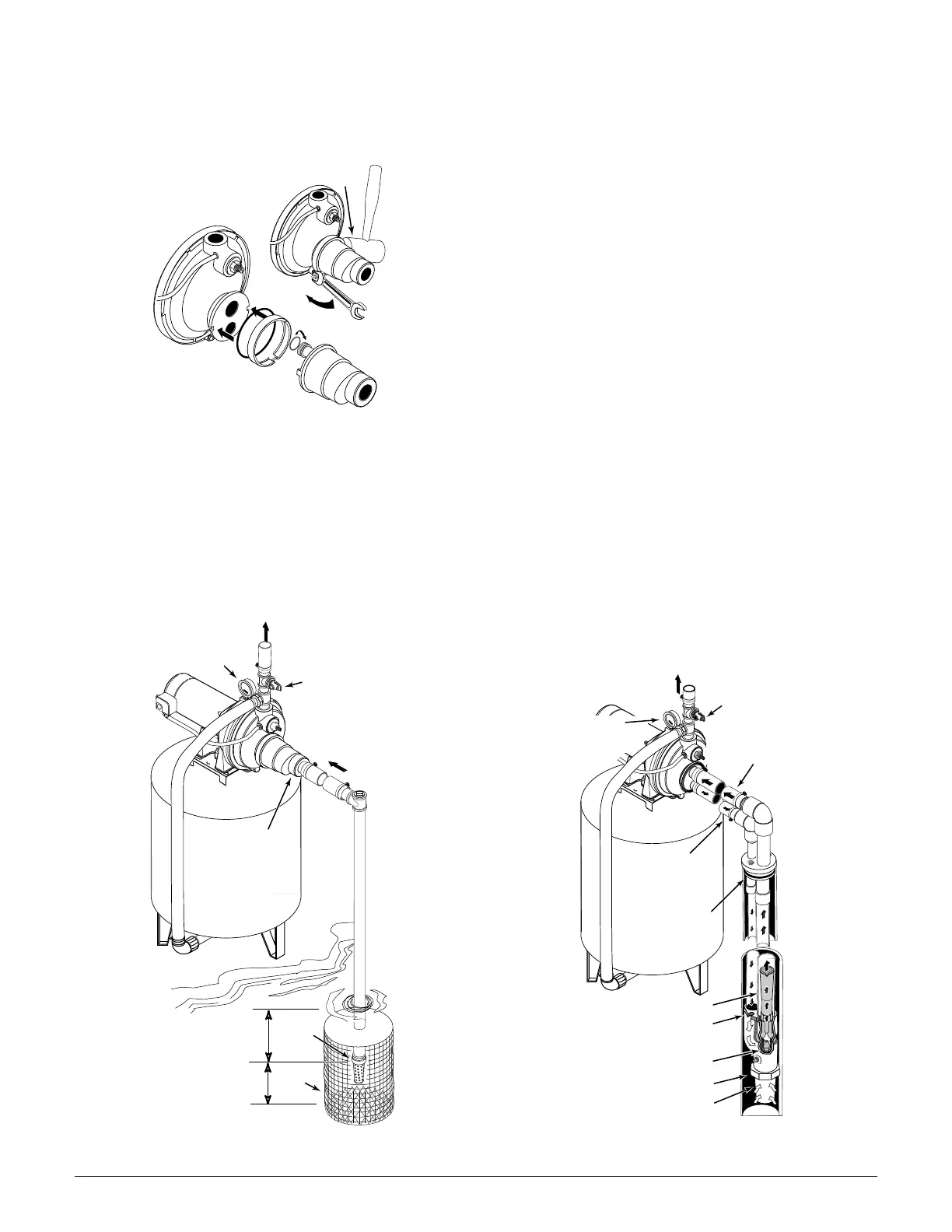
1. Install Berkeley ejector kit BK4875 (sold separately).
Follow the instructions provided with the kit. Align the
venturi with the top hole on the front of the pump (See
Figure 6).
2. The pump should be installed as close to the water as
possible, with the fewest possible fittings (especially
elbows) in the suction pipe. The suction pipe should be
at least as large as the suction port on the pump.
3. Assemble a foot valve and suction pipe (See Figure 7).
Make sure that the foot valve works freely. Use teflon
tape or a teflon-based pipe joint compound on threaded
pipe joints. Protect the foot valve assembly from fish,
trash, etc, by installing a screen around it (See Figure 7).
4. Lower the pipe into the water until the strainer is five feet
above the bottom. It should also be at least 10 feet
below the water level while the pump is running in order
to prevent the pump from sucking air.
5. Install a priming tee, priming plug, and suction pipe to the
pump (See Figure 7). Support the pipe so that there are
no dips or sags in the pipe, so it doesn’t strain the pump
body, and so that it slopes slightly upward from the well
to the pump (high spots can cause air pockets which can
air lock the pump). Seal the suction pipe joints with teflon
tape or a teflon-based pipe joint compound. Joints must
be air and water-tight. If the suction pipe can suck air,
the pump cannot pull water from the well.
New Deep Well
4” Or Larger Well (Figure 8)
1. Assemble Berkeley ejector kit BK4800 (sold separately).
Follow the instructions included with the kit in order to
match the nozzle and venturi to your well conditions.
2. Mount the pump as close to the well as possible.
3. Connect two pipes (1” drive, 1-1⁄4” suction) to the ejector
and lower the ejector into the well until it is five feet from
the bottom. It should also be at least 10 feet below the
well’s water level while the pump is running in order to
prevent the pump from sucking air.
4. Install a sanitary well seal and connect the ejector piping
to the pump. Flexible poly pipe is recommended for ease
of installation. However, use steel nipples through the
well seal as tightening the well seal on plastic pipe can
crush the pipe.
5. Support the pipe so that there are no dips or sags in the
pipe, so it doesn’t strain the pump body, and so that it
slopes slightly upward from the well to the pump (high
spots can cause air pockets which can air lock the
pump). Seal the suction pipe joints with teflon tape or a
teflon-based pipe joint compound. Joints must be air and
water-tight. If the suction pipe can suck air, the pump
cannot pull water from the well.
6


 To Next Page