I. PATIENT SAFETY, WARNINGS, AND CAUTIONS
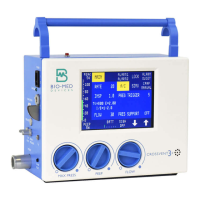
The Crossvent-2i+ ventilator is intended for use only by a qualified practitioner, under the direction of a qualified physician.
All personnel operating the ventilator must be completely familiar with the warnings and operating procedures in this manual
prior to using the Crossvent-2i+ with patients. As with any life support device, competent personnel should visually monitor
the patients on the Crossvent-2i+ at all times since life-threatening conditions may arise that may not be detected by the
alarms. It is essential to test all life-support devices for proper function prior to each use on patients.
A- WARNINGS, CAUTIONS, AND NOTES
The following terms are used throughout this manual:
WARNING - INDICATES A PROCEDURE OR CONDITION THAT COULD
CAUSE BODILY INJURY.
CAUTION - Signifies a procedure or condition that could damage the equipment.
NOTE - Refers to a procedure or condition that requires special attention.
WARNINGS
• Whenever the Crossvent-2i+ is connected to a patient, a skilled operator should always be present at all times at
the ventilator or within visual or hearing range of the ventilator’s alarm system.
• High oxygen concentrations may be hazardous to the patient.
• If the gas supply fails or there is a total electrical power failure, the patient may breathe atmospheric gas through
the failsafe valve. This is, however, only a temporary emergency measure, which requires elevated inspiratory
effort and it should be corrected immediately.
• Always operate the CV-2i+ on battery prior to use to confirm that the battery is functioning.
• In the event of an AC power failure, the Crossvent-2i+ will automatically switch over to battery operation and
sound an alarm. The audible alarm may be silenced by pressing the POWER SOURCE window. On a fully
charged battery, there will be approximately 2 ¾ hours of autonomous operation. No further alarm will be
sounded until the battery is low. It is imperative to restore AC power at this time to assure continued safe
operation of the ventilator.
• A patient filter should always be used in the patient breathing circuit to prevent cross contamination. Breathing
through the negative pressure relief valve in a contaminated environment can be hazardous.
• Extreme care should be taken to assure that the patient circuit components are connected correctly. Improper
connection can cause malfunction.
• A test lung should be ventilated prior to each use to insure that all modes are functioning correctly. An external
spirometer should be used to verify correct volumes and flow rates.
• The patient should never be left unattended after the ALARM QUIET key is depressed since this is followed by a
period when the audible alarms are deactivated.
• An audible alarm always indicates an anomalous state that should always be rectified.
• While the oxygen alarm may be turned off to permit use of the Crossvent-2i+ without this sensor, it is
recommended that it be used at all times.
• Always be certain that the PIP Limit is set correctly and is operative even when volume limiting, to prevent
possible inadvertent administration of high pressure. Increased pressure can be caused by blocked tubes, changes
in patient compliance or resistance, or system malfunction.
• If it is desired to temporarily disconnect the patient for clinical interventions such as suctioning, the alarms
should be silenced by pressing the ALARM QUIET key. Pressing once will give a 60 second period and pressing
twice a 2 minute period, during which time the alarms are silenced. If more time is needed, the ALARM QUIET
key may be pressed again after the alarm sounds. Never turn the power switch off in order to silence the alarms,
since this permanently deactivates all alarms.


 To Next Page