4 5
SAFETY GUIDELINES /
DEFINITIONS
DANGER: Indicates an imminently hazardous situation which, if not
avoided, will result in death or serious injury.
WARNING: Indicates a potentially hazardous situation which, if not
avoided, could result in death or serious injury.
CAUTION: Indicates a potentially hazardous situation which, if not
avoided, may result in minor or moderate injury.
CAUTION: Used without the safety alert symbol indicates potentially
hazardous situation which, if not avoided, may result in property damage.
RISK OF UNSAFE OPERATION. When using tools or equipment,
basic safety precautions should always be followed to reduce the risk of
personal injury. Improper operation, maintenance or modification of tools
or equipment could result in serious injury and property damage. There
are certain applications for which tools and equipment are designed.
Manufacturer strongly recommends that this product NOT be modified and/
or used for any application other than for which it was designed. Read and
understand all warnings and operating instructions before using any tool
or equipment.
READ ALL INSTRUCTIONS
WARNING: Read all instructions before operating this product. Failure
to follow all instructions listed below may result in electric shock, fire and/or
serious injury.
IMPORTANT SAFETY
INSTRUCTIONS
GENERAL SAFETY WARNINGS AND
INSTRUCTIONS
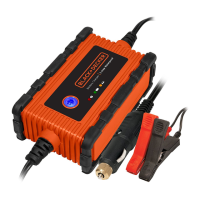
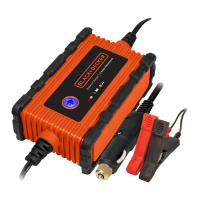
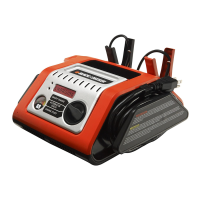
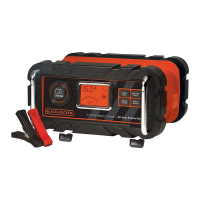
• The BC15BDCA was designed for household use only. The BC25BDCA
and BC40BDCA were designed for both household and commercial use.
• Avoid dangerous environments. Don’t use the battery charger in damp
or wet locations. Do not expose the clamps or cords to rain or snow.
• Keep children away. Keep away from children. This is not a toy!
• Store indoors. When not in use, battery chargers should be stored
indoors in dry, and high or locked-up places – out of reach of children.
• Unplug the battery charger when not in use.
SPECIFIC SAFETY INSTRUCTIONS FOR POWER
CORDS
• Don’t abuse cord. Never carry appliance by cord or yank it to disconnect
from receptacle. Keep cord from heat, oil, and sharp edges. Pull by plug
rather than cord when unplugging the unit.
• Ground Fault Circuit Interrupter (GFCI) protection should be provided on
the circuits or outlets to be used. Receptacles are available having built in
GFCI protection and may be used for this measure of safety.
Extension cords
• An extension cord should not be used unless absolutely necessary.
Use of improper extension cord could result in a risk of fire and electric
shock. If an extension cord is used, make sure that the pins of the
extension cord are the same number, size and shape as those in the
charger.
• Make sure your extension cord is in good condition. When using an
extension cord, be sure to use one heavy enough to carry the current
your product will draw. An undersized cord will cause a drop in line
voltage resulting in loss of power and overheating. The following table
shows the correct size to use depending on cord length and nameplate
ampere rating. If in doubt, use the next heavier gauge. The smaller the
gauge number, the heavier the cord.
Recommended Minimum AWG Size for Extension Cords
for Battery Chargers
AC Input Rating American Wire Gauge (AWG) Size of Cord
Amperes Length of Cord, feet (m)
Equal to or But less
25 (7.6) 50 (15.2) 100 (30.5) 150 (45.6)
greater than than
0 2 18 18 18 16
2 3 18 18 16 14
3 4 18 18 16 14
4 5 18 18 14 12
5 6 18 16 14 12
6 8 18 16 12 10
8 10 18 14 12 10
10 12 16 14 10 8
12 14 16 12 10 8
14 16 16 12 10 8
16 18 14 12 8 8
18 20 14 12 8 6
Power Cord Safety
The BC15BD and BC25BD have polarized plugs (one blade is wider than
the other) as a safety feature. This plug will fit into a polarized outlet only
one way. If the plug does not fit fully into the outlet, reverse the plug. If it
still does not fit, contact a qualified electrician. Do not attempt to defeat this
safety feature.
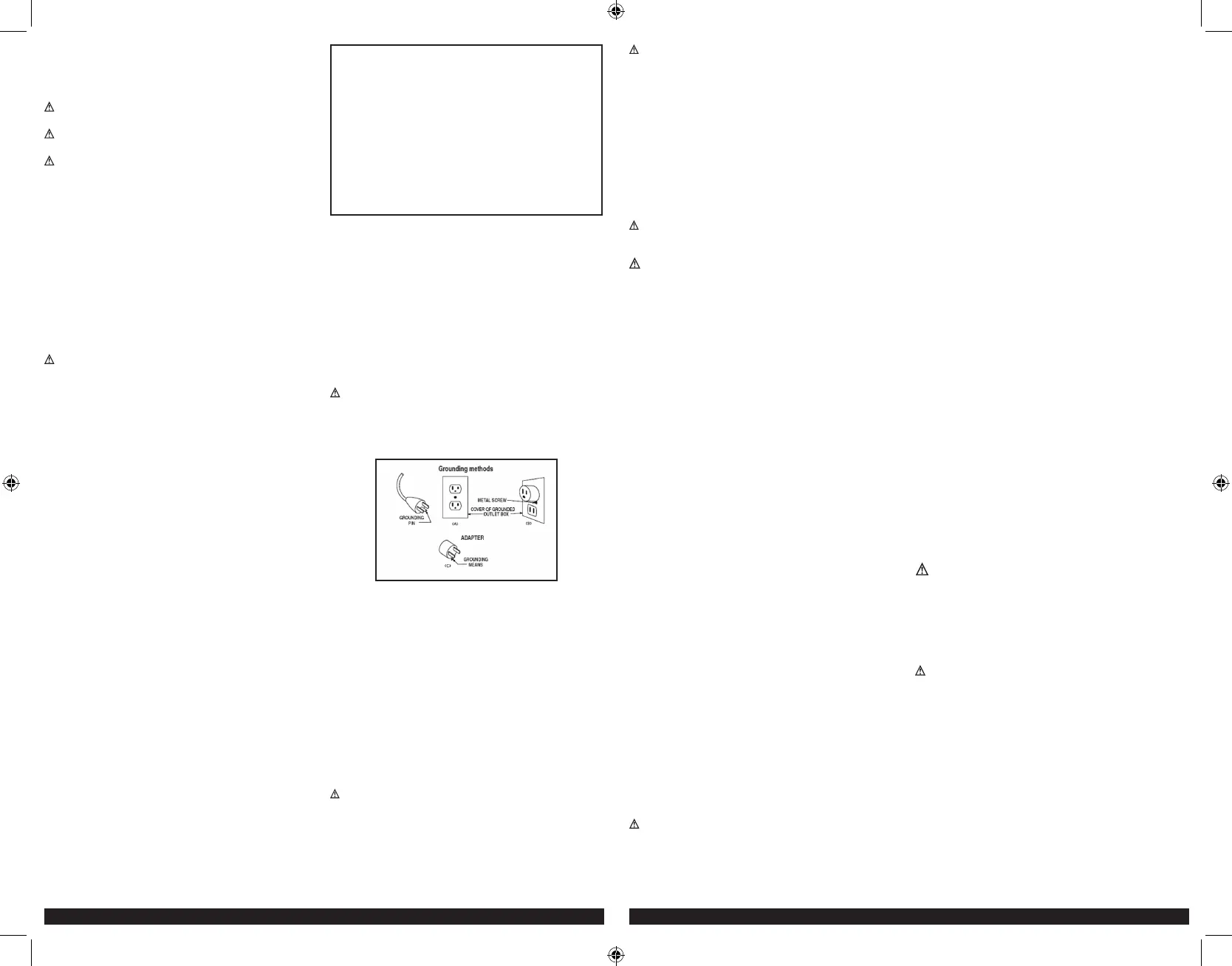
The BC40BD battery charger is for use on a nominal 120-volt circuit, and
has a grounding plug that looks like the plug illustrated in the sketch A
in the illustration that follows. A temporary adapter, which looks like the
adapter illustrated in sketches B and C, may be used to connect this plug
to a two-pole receptacle as shown in sketch B if a properly grounded outlet
is not available. The temporary adapter should be used only until a properly
grounded outlet can be installed by a qualified electrician.
DANGER: Before using adapter as illustrated, be certain that center
screw of outlet plate is grounded. The green-colored rigid ear or lug
extending from adapter must be connected to a properly grounded outlet–
make certain it is grounded. If necessary, replace original outlet cover plate
screw with a longer screw that will secure adapter ear or lug to outlet cover
plate and make ground connection to grounded outlet.
SPECIFIC SAFETY INSTRUCTIONS FOR BATTERY
CHARGERS
• Use of accessories and attachments: The use of any accessory or
attachment not recommended by manufacturer for use with this battery
charger could be hazardous.
• Stay alert. Use common sense. Do not operate this equipment when you
are tired or impaired.
• Check for damaged parts. A part that is damaged should be properly
repaired or replaced by manufacturer before further use unless otherwise
indicated elsewhere in this instruction manual.
• Do not operate the battery charger near flammable liquids or in gaseous
or explosive atmospheres. Motors may spark, and the sparks might ignite
fumes.
• Do not operate the battery charger if it has received a sharp blow,
been dropped, or has been otherwise damaged in any way. Return it to
the manufacturer for repair.
WARNING – BURST HAZARD:
• Do not use the unit for charging dry-cell batteries that are commonly
used with home appliances. These batteries may burst and cause injury
to persons and damage property. Use the unit for charging/boosting a
12V LEAD-ACID battery only. It is not intended to supply power to a low-
voltage electrical system other than in a starter-motor application.
• Never attempt to charge non-rechargeable batteries.
WARNING – RISK OF EXPLOSIVE GASES:
• WORKING IN THE VICINITY OF A LEAD ACID BATTERY IS DANGEROUS.
BATTERIES GENERATE EXPLOSIVE GASES DURING NORMAL BATTERY
OPERATION. FOR THIS REASON, IT IS OF THE UTMOST IMPORTANCE
THAT EACH TIME BEFORE USING THE BATTERY CHARGER YOU READ THIS
MANUAL AND FOLLOW INSTRUCTIONS EXACTLY.
• To reduce the risk of battery explosion, follow these instructions and
those published by the battery manufacturer and manufacturer of
any equipment you intend to use in the vicinity of the battery. Review
cautionary markings on these products and on the engine.
• This equipment employs parts (switches, relays, etc.) that produce arcs or
sparks. Therefore, if used in a garage or enclosed area, the unit MUST be
placed not less than 18 inches above the floor.
• THIS UNIT IS NOT FOR USE BY CHILDREN AND SHOULD ONLY BE
OPERATED BY ADULTS.
WARNING – TO REDUCE THE RISK OF FIRE:
• Do not operate near flammable materials, fumes or gases.
• Do not expose to extreme heat or flames.
CAUTION – TO REDUCE THE RISK OF INJURY OR PROPERTY
DAMAGE:
• This charger is not designed for use with every make, manufacture or
model of engine. Use only with 12 volt systems.
• NEVER ATTEMPT CHARGE A FROZEN BATTERY.
• Do not charge the battery while the engine is operating.
• Never smoke or allow a spark or flame in vicinity of vehicle battery,
engine or battery maintainer.
• Be extra cautious to avoid dropping a metal tool onto the battery. It might
spark or short-circuit the battery or another electrical part, and that may
cause an explosion.
• Never allow battery acid to come in contact with this unit.
• Do not operate this unit in a closed area or restrict ventilation in any way.
• Always turn the battery charger off by unplugging it when not in use.
• Do not open the battery charger – there are no user-serviceable parts
inside. Opening the battery charger will void manufacturer’s warranty.
• Operate battery charger only as described in this Instruction Manual.
• Check battery charger and components periodically for wear and tear.
Return to manufacturer for replacement of worn or defective parts
immediately.
PERSONAL SAFETY
Stay clear of fan blades, belts, pulleys, and other parts that can cause injury
to persons.
Always have protective eyewear when using this product: contact with
battery acid may cause blindness and/or severe burns. Be aware of first aid
procedures in case of accidental contact with battery acid.
Have plenty of fresh water and soap nearby in case battery acid contacts skin.
If battery acid contacts skin or clothing, wash immediately with soap and
water for at least 10 minutes and get medical attention immediately.
Remove personal metal items such as rings, bracelets, necklaces and
watches when working with a lead acid battery. A lead acid battery can
produce a short circuit current high enough to weld a ring, or similar metal
object, to skin causing a severe burn.
• SKIN: If battery acid comes in contact with skin, rinse immediately with
water, then wash thoroughly with soap and water. If redness, pain, or
irritation occurs, seek immediate medical attention.
• EYES: If battery acid comes in contact with eyes, flush eyes
immediately, for a minimum of 15 minutes and seek immediate medical
attention.
• LCD liquid crystal display: If liquid crystal comes in contact
with your skin: Wash area off completely with plenty of water. Remove
contaminated clothing. If liquid crystal gets into your eye: Flush the
affected eye with clean water and then seek medical attention. If liquid
crystal is swallowed: Flush your mouth thoroughly with water. Drink large
quantities of water and induce vomiting. Then seek medical attention.
WARNING – TO REDUCE THE RISK OF INJURY OR PROPERTY
DAMAGE: Follow these instructions and those published by the
manufacturer of any engine you intend to use with this battery charger.
Review cautionary markings on the battery charger and engine.
SAVE THESE
INSTRUCTIONS
INTRODUCTION
Congratulations on purchasing your new Black + Decker
®
Automatic
Battery Charger. Read this Instruction Manual and follow the
instructions carefully before using your new battery charger.
PREPARING TO CHARGE
1. Be sure area around battery is well ventilated while battery is being
charged.
2. Remove battery completely from boat/airplane or any confined area
before charging.
3. If it is necessary to remove battery from a vehicle to charge, or to clean
terminals, always remove the grounded terminal from the battery first.
Make sure all accessories in the vehicle are turned off, so as not to
cause an electrical arc.
4. Clean the battery terminals, taking care to avoid getting corrosive
material in your eyes.
5. Add distilled water in each cell until battery acid reaches level specified
by battery manufacturer. This helps purge excessive gas from cells. Do
not overfill. For a battery without cell caps (maintenance free), carefully
follow manufacturer’s charging instructions.
6. Study all battery manufacturer’s specific precautions, such as removing
or not removing cell caps while charging, and recommended rates of
charge.
7. Determine the voltage of the battery to be charged by referring to the
vehicle manual. This unit is for charging a 12 volt battery only.
CHARGER LOCATION
• Locate charger as far away from battery as cables permit.
• Never place charger directly above battery being charged; gases from
battery will corrode and damage charger.
• Never allow battery acid to drip on charger when reading gravity or filling
battery.
• Never operate charger in a closed-in area or restrict ventilation in any way.
• Marine batteries must be removed and charged on shore.
• Do not set a battery on top of charger.
CONNECTION PRECAUTIONS
• Never allow clamps to touch each other.
• Attach clamps to battery and chassis as indicated in the appropriate
section (“Charging a battery installed in a vehicle” or “Charging a battery
that has been removed from a vehicle”).
CHARGING A BATTERY INSTALLED IN A
VEHICLE
WARNING – A spark near the battery may cause an explosion. To
reduce risk of a spark near the battery:
1. Do not charge the battery while the engine is operating.
2. Position AC and clamp cords to reduce risk of damage by hood, door, or
moving engine part.
3. Stay clear of fan blades, belts, pulleys, and other parts that can cause
injury to persons.
4. Check polarity of battery posts. positive (POS, P, +) battery post usually
has larger diameter than negative (NEG, N, –) post.
5. Determine which post of battery is grounded (connected) to the chassis.
If negative post is grounded to chassis (as in most vehicles), see 5. If
positive post is grounded to the chassis, see 6.
6. For negative-grounded vehicle, connect the positive (RED) clamp from
battery charger to positive (POS, P, +) ungrounded post of battery.
Connect the negative (BLACK) clamp to vehicle chassis or engine
block away from battery. Do not connect clip to carburetor, fuel lines,
or sheet-metal body parts. Connect to heavy gauge metal part of the
frame or engine block.
BC15_25_40BD_ManualENSP_061920.indd 4-5BC15_25_40BD_ManualENSP_061920.indd 4-5 6/24/2020 2:58:25 PM6/24/2020 2:58:25 PM


 To Next Page
 Loading...