4242
H elm C ontrol S y stem s
engine to be operated at a higher than idle RPM while
in neutral for cold starting and warm-up purposes.
The control levers are equipped with adjustable
control head detent and friction settings.
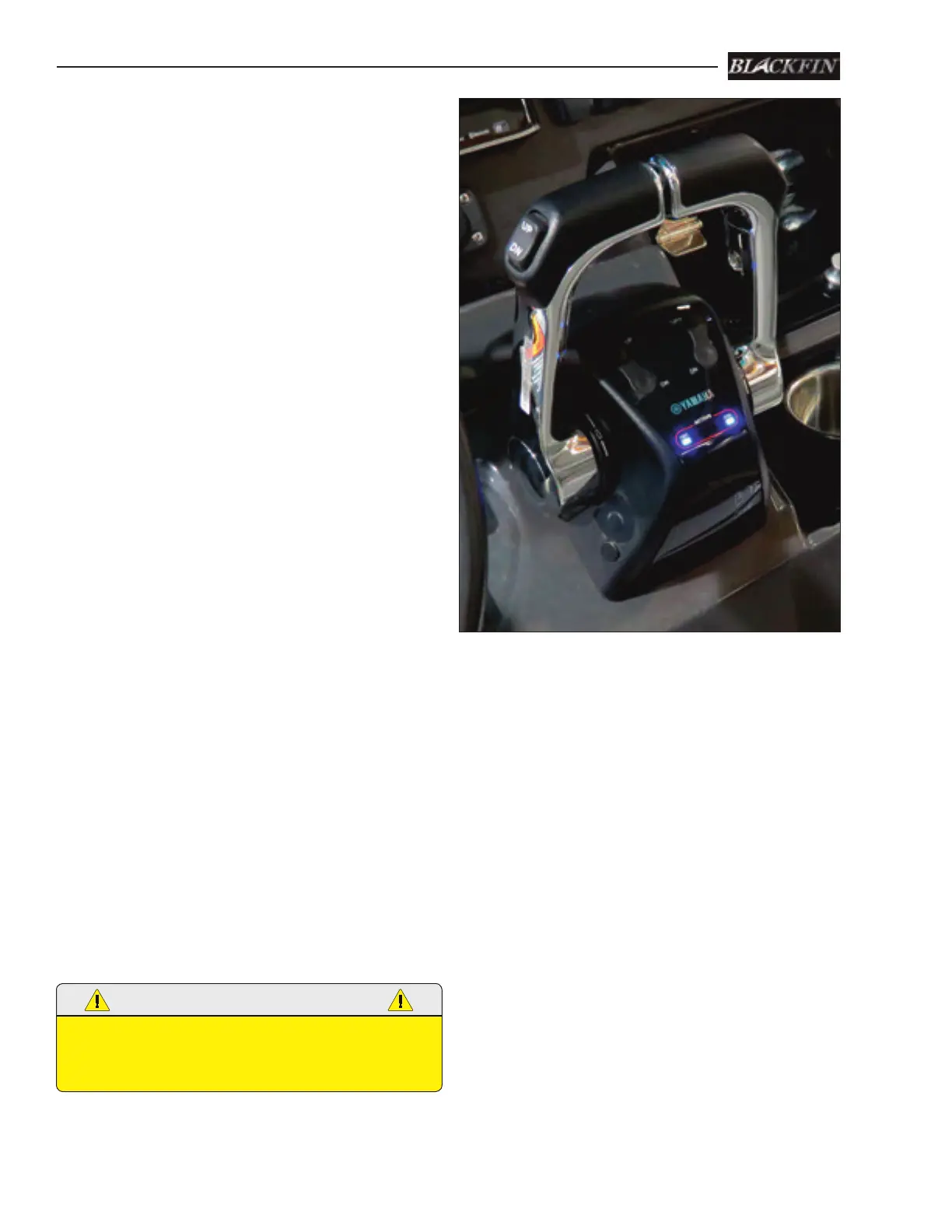
Most engine controls and key pads have integrated
switches and indicator lights which allow the operator
to control all aspects of the boat’s propulsion system.
LED lights on the control pad indicate that the control
is activated and the engines can be started.
The most common features activated or moni-
tored by the keypad are:
• Starter lockout, which prevents the engine from
being started in gear.
• Gear lockout, which allows the engine RPM to be
advanced in neutral safely.
• Battery voltage warning indicator that warns the
operator of high or low voltage supplied to the
system (audible alarm)
• An engine synchronization feature that
automatically keeps both engines at the
same RPM while cruising. Refer to Engine
Synchronizing in this section and the control
systems owner’s manual for more information
regarding engine synchronization.
• Trolling feature that allows the operator to
increase the engine speed in 50 RPM increments
while operating at trolling speeds between 600
- 1000 RPM.
• Station transfer that allows the operator to
transfer control from one station to another with
the push of a button on boats with two helm
stations. Each station must be selected before
the controls will operate from that station.
These features and others not mentioned require
specic procedures to activate and operate them
properly. Some of the procedures and features are
unique to the engines and other options installed on
your boat. It is essential that you read the owner’s
manual for the controls and be completely familiar
with their operation before using your boat.
ALWAYS RETURN THE ENGINE THROTTLE LEVER TO THE
EXTREME LOW SPEED POSITION BEFORE SHIFTING. NEVER
SHIFT THE UNIT WHILE ENGINE SPEED IS ABOVE IDLE RPM.
Engine Synchronizer
During most operations of a twin engine boat, it is
advantageous for both engines to be operated at
the same RPM. This reduces noise and vibration
and can increase engine eciency. Setting the
throttles so that the engines are running the same
RPM (synchronized) can be done by listening to the
engine sounds at low RPM and with the automatic
synchronizer feature built into the electronic engine
controls when the engines are operating above
1000 RPM. Attempting to synchronize the engines
solely by using the tachometer readings or control
lever placement generally will not work. When the
engines are in proper synchronization, the throttle
levers may not necessarily be even.
Refer to the engine or control owner’s manuals for
more information on the engine synchronizer and
other features for the electronic controls installed
on your boat.
Yamaha Electronic Controls


 To Next Page