101-B00 Page 5/16
OPERATION
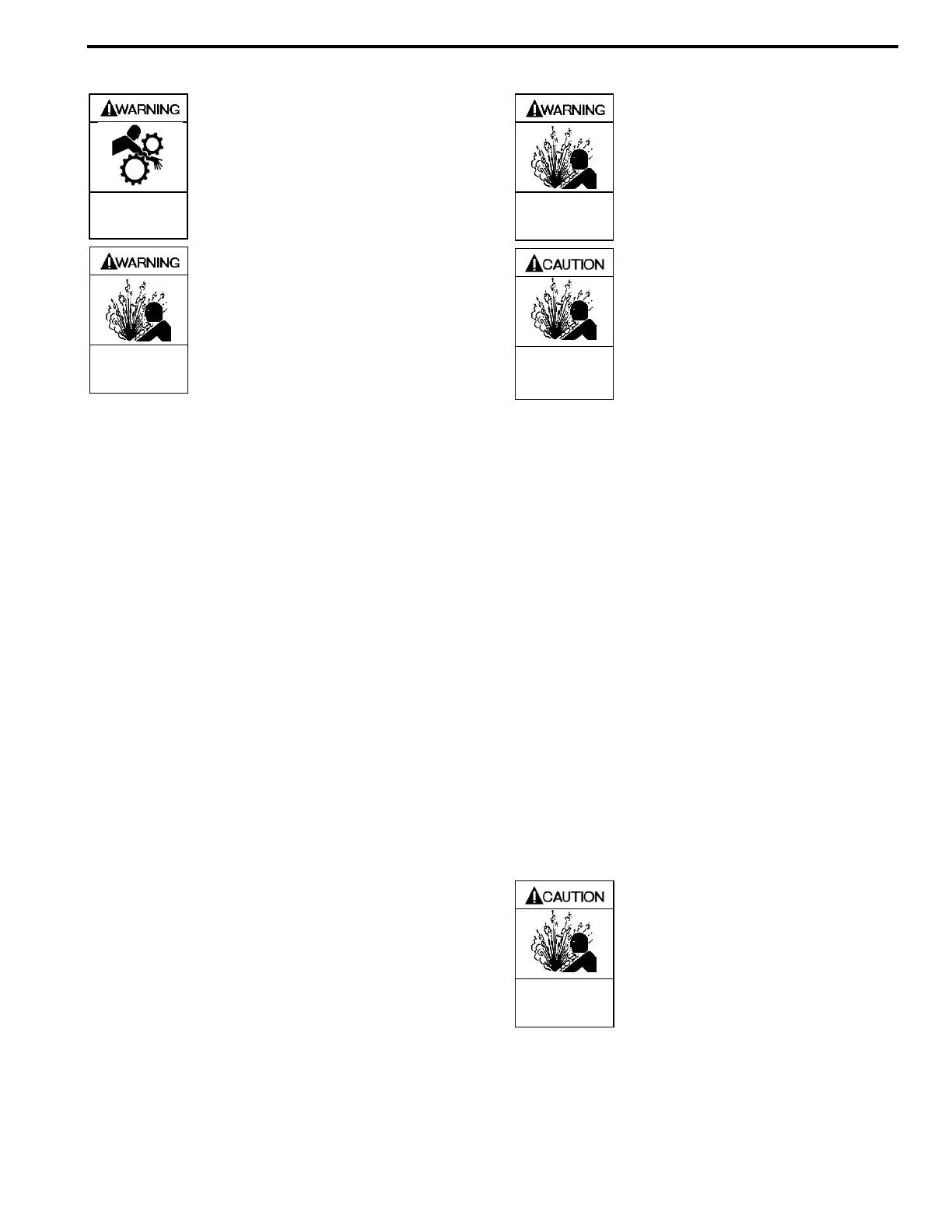
Operation without guards in place can
cause serious personal injury, major
property damage, or death.
Do not operate
without guard
in place
Disconnecting fluid or pressure
containment components during pump
operation can cause serious personal
injury, death or major property damage
Hazardous pressure
can cause personal
injury or property
damage
Failure to relieve system pressure prior
to performing pump service or
maintenance can cause personal injury
or property damage.
Hazardous pressure
can cause personal
injury or property
damage
Pumps operating against a closed valve
can cause system failure, personal
injury and property damage
Hazardous pressure
can cause personal
injury or property
damage
PRE-START UP CHECK LIST
1. Check the alignment of the pipes to the pump. Pipes
should be supported so that they do not spring away or
drop down when pump flanges or union joints are
disconnected.
2. Verify proper coupling alignment.
3. On GX models, check the oil level in the gear reducer.
Refer to ‘Lubrication’ in the ‘Gear Reducer Maintenance’
section of this manual.
NOTICE:
Blackmer gear reducers are not lubricated at the factory.
Oil MUST be added before initial pump start-up
4. On GX models shipped without the gear reducer
attached, the inboard bearings are NOT greased at
the factory. The inboard bearing MUST be greased
after installation of the gear reducer and prior to
initial pump start up. See “Pump Lubrication” in the
Maintenance section of this manual.
5. Check the entire pumping system to verify that the proper
inlet and discharge valves are fully open, and that the
drain valves and other auxiliary valves are closed.
6. Install vacuum and pressure gauges on the pump in the
1/4” NPT connections provided to check suction and
discharge conditions after pump start-up.
7. Check the wiring of the motor, and briefly turn on the
power to make sure that the pump rotates in the direction
of the rotation arrow.
START UP PROCEDURES
NOTICE:
Consult the "General Pump Troubleshooting" section of
this manual if difficulties during start up are
experienced.
1. Start the motor. Priming should occur within one minute.
2. Check the suction and discharge pressure to see if the
pump is operating within the expected conditions.
Record pressures in the ‘Initial Start Up Information’
section.
3. Check for leakage from the piping and equipment.
4. Check for overheating, excessive noise or vibration of the
pump, reducer, and motor.
5. Check the flow rate to ensure the pump is operating
within the expected parameters. Record flow rate in the
‘Initial Start Up Information’ section.
6. Check the pressure setting of the relief valve by briefly
closing a valve in the discharge line and reading the
pressure gauge. This pressure should be 20 psi (1.4 bar)
higher than the maximum operating pressure.
Do not run the pump for more than 15 seconds with
the discharge valve completely closed.
If adjustments need to be made, refer to "Relief Valve
Setting & Adjustment."
Incorrect settings of the pressure relief
valve can cause pump component
failure, personal injury, and property
damage.
Hazardous pressure
can cause personal
injury or property
damage



 To Next Page