14
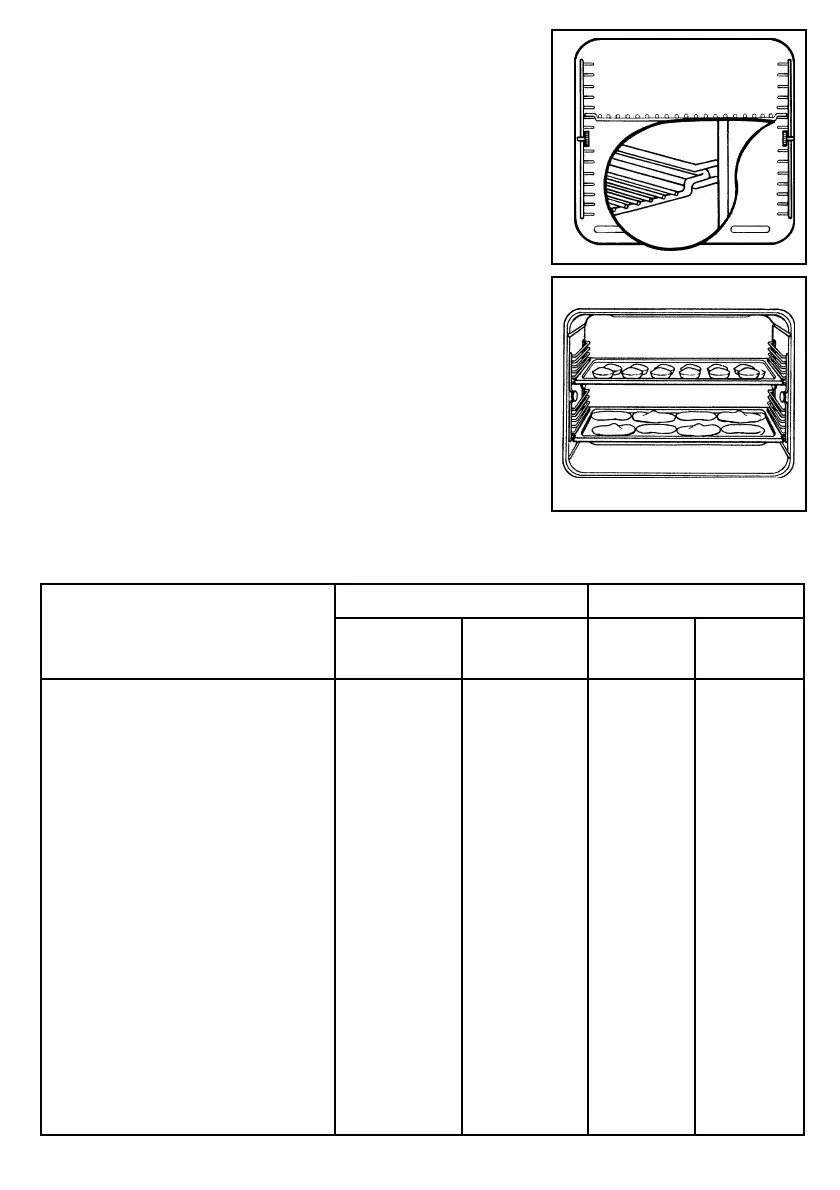
FO 2079
Fig. 5
The effects of dishes on cooking results
Dishes and tins vary in their thickness,
conductivity, colour, etc. which affects the
way they transmit heat to the food inside
them:
A Aluminium, earthenware, oven glassware
and bright shiny utensils reduce cooking
and underneath browning.
B Enamelled cast iron, anodized
aluminium, aluminium with non-stick
interior and coloured exterior and dark,
heavy utensils increase cooking and
underneath browning.
FO 2078
Fig. 4
Cooking Chart - Fan and
Conventional Oven
The oven temperatures are intended as a
guide only. It may be necessary to increase
or decrease the temperatures by 10 °C to
suit individual preferences and requirements.
NOTE: Shelf positions are counted from
bottom of the oven.
Food
Biscuits 180-190 6 - 8 180-190
Bread 210-220 5 210-220
Casseroles 130-140 3 - 5 150-180
Cakes: Small and queen 160-170 170-180
Sponges 160-170 5 - 7 180-190
Madeira 140-150 5 160-170
Rich Fruit 130-140 5 150-160
Christmas 130-140 130-140
Meringues 90-100 6 100-110
Fish 170-190 5 - 9 170-190
Fruit Pies and Crumbles 190-200 6 190-200
Milk Puddings 130-140 5 130-140
Pastry: Choux 6 160-170
Shortcrust
Flaky 190-200 5 190-200
Puff
Plate Tarts 180 5 - 7 190-200
Quiches/Flans 170-180 4 - 6 190-200
Scones 210-220 7 - 8 230
Roasting: Meat & Poultry 160-180 6 180-200
Fan Oven
Conventional Oven
Shelf
positions
are not
critical but
ensure that
oven
shelves are
evenly
spaced
when more
than one is
used.
}
Shelf
Position
Cooking
Temp (°C)
Cooking
Temp (°C)
Shelf
Position



 To Next Page