EasyManua.ls Logo

Boeing F4B-1 - Page 10

Boeing F4B-1
90 pages
Print Icon
To Next Page IconTo Next Page
To Previous Page IconTo Previous Page
Loading...
z~f..
---~.~-
~
'
~
<(
U)
0::
(.!)
N
<(
t-
-IN
Cl
N
IJJ
(.!)
<(
...J
IJJ
Cl)
:::)
-IN
LL
ff)
I
00
+
ci
u:
-IN
N
N
t-
0
(t)
+
-IN
!Q
t
12
10.
LINE-UP
(Reference
Fig.
7):
a.
There
are
three
leveling
positions
which
can
be
used.
These
are
as
follows:
A-B.
Laterally
on
lugs
on
lower
longer_ons.
B-C.
Longitudinally
on
lugs
on
lower
nght
longeron.
D.
Laterally
across
the
top
longerons,
near
sta.
8.
For
ordinary
alignment
the
points
A, B
and
C
are
the
only
ones
used.
A
leveling
board
approximately
20
inches
long
will
be
necessary
in
checking
the
longitudinal
level.
. .
b.
In
handling
the
fuselage
care
must
be
taken
to
lift
and
support
it
only
at
strut
points.
Always
secure
the
fuselage
so
that
it
can
not
fall
from
its
supports.
11.
TESTING
ALIGNMENT
(Reference
Fig.
7
and
8):
a.
The
construction
of
the
fuselage
is
such
that
no
adjustment
necessary
(
or
possible)
except
in
lower
bays
Sta.
1-2
and
2-3.
If
fo_r
any
reason
the
fu~elage
_is_
thought
_to
be
out
of line,
level
it
at
A-B
and
B-C
(Fig.
7),
place
a
level
m posit10n D
(Fig.
7)
and
drop
a
plumb-bob
from
the
~op
of
the
tail
post.
This_
will
indicate
any
serious
misalign-
ment
in
the
rear
port10n of
the
fuselage.
The
alignment
should
be
checked
further
by
attaching
a
center
line
from
front
to
rear
and
taking
measurements
as
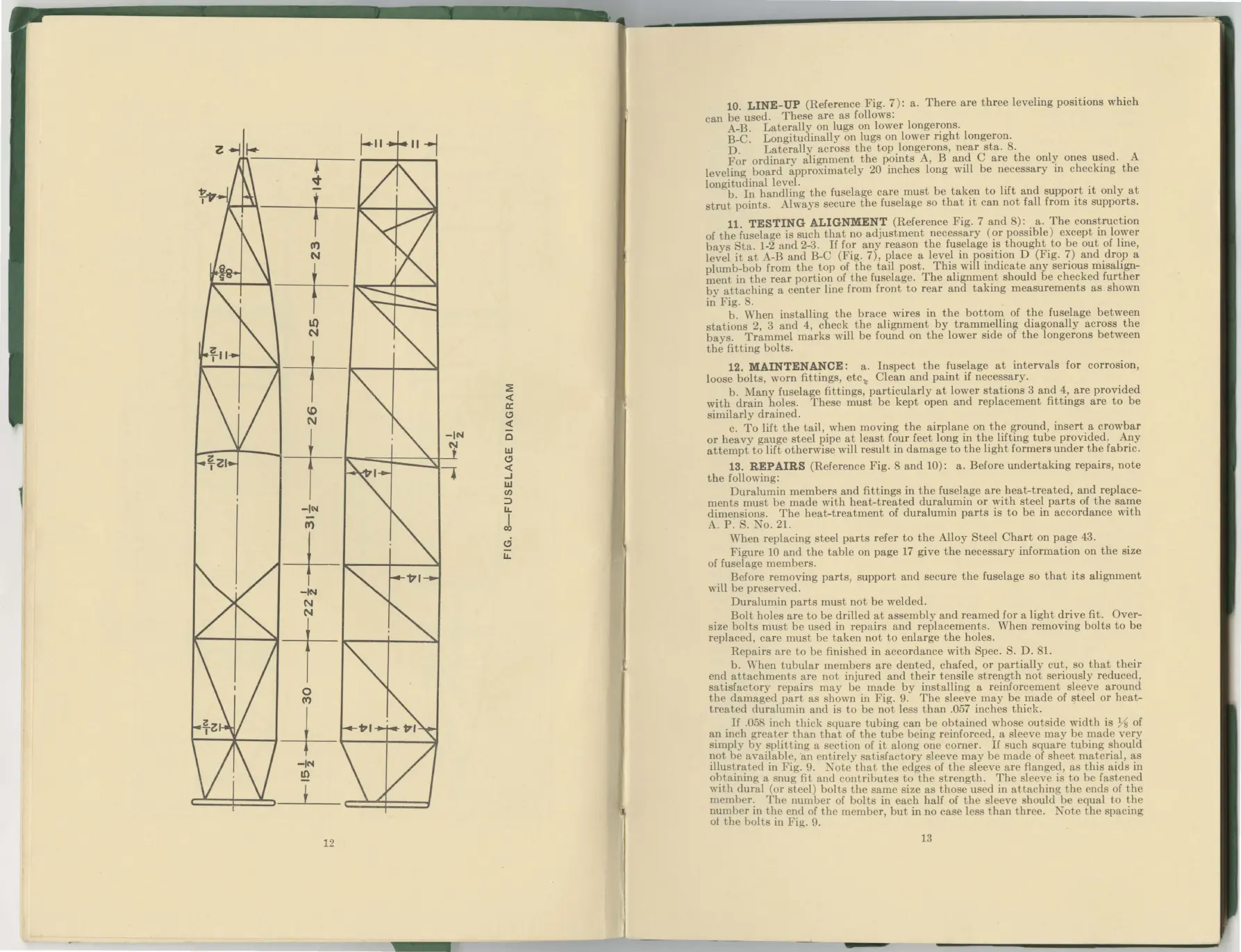
shown
in
Fig.
8.
b.
When
installing
the
brace
wires
in
the
bottom
of
the
fuselage
between
stations
2, 3
and
4,
check
the
alignment
by
trammelling
diagonally
across
the
bays.
Trammel
marks
will
be
found
on
the
lower
side
of
the
longerons
between
the
fitting
bolts.
12. MAINTENANCE:
a.
Inspect
the
fuselage
at
intervals
for
corrosion,
loose
bolts,
worn
fittings,
etc.
Clean
and
paint
if
necessary.
b.
Many
fuselage
fittings,
particularly
at
lower
stations
3
and
4,
are
provided
with
drain
holes.
These
must
be
kept
open
and
replacement
fittings
are
to
be
similarly
drained.
c.
To
lift
the
tail,
when
moving
the
airplane
on
the
ground,
insert
a
crowbar
or
heavy
gauge
steel
pipe
at
least
four
feet
long
in
the
lifting
tube
provided.
Any
attempt
to
lift
otherwise
will
result
in
damage
to
the
light
formers
under
the
fabric.
13.
REPAIRS
(Reference
Fig
. 8
and
10):
a.
Before
undertaking
repairs,
note
the
following:
Duralumin
members
and
fittings
in
the
fuselage
are
heat-treated,
and
replace-
ments
must
be
made
with
heat-treated
duralumin
or
with
steel
parts
of
the
same
dimensions.
The
heat-treatment
of
duralumin
parts
is
to
be
in
accordance
with
A. P.
S.
No.
21.
When
replacing
steel
parts
refer
to
the
Alloy
Steel
Chart
on
page
43.
Figure
10
and
the
table
on
page
17
give
the
necessary
information
on
the
size
of
fuselage
members.
Before
removing
parts
,
support
and
secure
the
fuselage so
that
its
alignment
will
be
preserved.
Duralumin
parts
must
not
be
welded.
Bolt
holes
are
to
be
drilled
at
assembly
and
reamed
for
a
light
drive
fit.
Over-
size
bolts
must
be
used
in
repairs
and
replacements.
When
removing
bolts
to
be
replaced,
care
must
be
taken
not
to
enlarge
the
holes.
Repairs
are
to
be
finished
in
accordance
with
Spec. S.
D.
81.
b.
When
tubular
members
are
dented,
chafed,
or
partially
cut,
so
that
their
end
attachments
are
not
injured
and
their
tensile
strength
not
seriously
reduced,
satisfactory
repairs
may
be
made
by
installing
a
reinforcement
sleeve
around
the
damaged
part
as
shown
in
Fig.
9.
The
sleeve
may
be
made
of
steel
or
heat-
treated
duralumin
and
is
to
be
not
less
than
.057
inches
thick.
·
.
If
.058
inch
thick
square
tubing
can
be
obtained
whose
outside
width
is
½ of
a!1
mch
great~r
~han
that
_of
the
_tube
being
reinforced,
a
sleeve
may
be
made
very
simply
by
_splittmg a
section
of
it
along
one
corner.
If
such
square
tubing
should
~10t
be
avai!abl~,
·
an
entirely
satisfactory
sleeve
may
be
made
of
sheet
material,
as
illus~r~ted m
Fig.
9.
Note
that
the
edges
of
the
sleeve
are
flanged,
as
this
aids
in
o~tammg
a
snug
fit
and
contributes
to
the
strength.
The
sleeve
is
to
be
fastened
with
dural
(or
steel)
bolts
the
same
size
as
those
used
in
attaching
the
ends
of
the
member:
The
number
of
bolts
in
each
half
of
the
sleeve
should
be
equal
to
the
number
m
the
end
of
the
member,
but
in
no
case
less
than
three.
Note
the
spacing
of
the
bolts
in
Fig.
9.
13

Related product manuals