Need help?
Do you have a question about the Boeing ForeFlight Sentry and is the answer not in the manual?
Proper placement of the Sentry device for optimal signal reception and stability.
Steps to establish a wireless connection between your iOS device and the Sentry receiver.
Enabling iOS Local Network permission for ForeFlight to connect to external devices like Sentry.
Procedure for updating the Sentry device's firmware through the ForeFlight application.
An overview of the key functionalities and capabilities of the Sentry device.
How to power the Sentry device on and off using its physical button.
Interpretation of the different LED lights on the Sentry for status and battery indication.
Detailed steps for connecting Sentry to your iOS device's Wi-Fi network.
Information on the default Sentry Wi-Fi network name and how to customize it.
How to assign and manage a WPA2 passcode for secure Sentry Wi-Fi connection.
Details on Sentry's rechargeable battery, charging, and checking battery percentage.
Overview of the specific features and capabilities of the Sentry Mini device.
Instructions on how to power on the Sentry Mini using a USB-C connection.
Understanding the LED indicators for ADS-B and GPS status on the Sentry Mini.
Steps to connect your iOS device to the Sentry Mini's wireless network.
Details on the Sentry Mini's default network name and lack of passcode option.
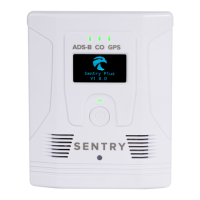
Comprehensive list of advanced features and capabilities of the Sentry Plus.
Operation of the power button on the Sentry Plus device for turning it on and off.
Understanding the meaning of the LEDs for ADS-B, CO, GPS, and power status.
Explanation of the OLED display, its splash screen, and various status messages.
Description of the four different real-time information views available on the OLED display.
Information on the Sentry Plus battery capacity, charging methods, and LED indicators.
Details on using USB-C chargers and their compatibility with the Sentry Plus.
How to enable and use the Auto Power option for automatic device power management.
How Sentry Plus creates a wireless network and connects to multiple devices.
How to change the default Sentry Plus Wi-Fi network name (SSID) and hide broadcast.
Steps to assign a passcode and reset Sentry Plus to factory settings.
Using Sentry Plus to connect to an aircraft's wireless network for data sharing.
How Sentry Plus provides data alongside aircraft Wi-Fi networks.
Information on the accelerometer function for measuring g-loads during flight.
How to display and analyze g-Load data within Sentry Plus flight track logs.
How the Sentry Plus automatically records flight data for analysis.
Step-by-step guide to importing recorded flight logs into ForeFlight.
How imported track logs sync across devices via the ForeFlight account.
Settings and conditions for automatically importing flight logs from Sentry Plus.
Configuring automatic import settings and deleting track logs from Sentry Plus.
How deleting logs in ForeFlight affects Sentry Plus and vice-versa.
Procedure for performing a factory reset to clear all stored track logs.
Using Sentry Plus for FLARM collision avoidance and traffic awareness.
Understanding the different symbols and colors used for traffic targets in ForeFlight.
Setting up visual and audio alerts for nearby traffic targets.
How ADS-B traffic is depicted within the Synthetic Vision display.
Enabling the setting to filter out distant traffic targets from the map view.
Explanation of TIS-B data, its broadcast, and inclusion criteria for aircraft.
How TIS-B traffic is received and differentiated from ADS-B traffic.
Key differences in information displayed for ADS-B and TIS-B traffic targets.
How ForeFlight identifies your aircraft as the ownship for map display purposes.
Reasons for false traffic alerts and how to resolve them, including ownship issues.
Information on FIS-B ground-based towers and their data transmission capabilities.
How to enable and view the location of ADS-B towers on the ForeFlight map.
Understanding how tower tiers affect the range and type of weather data available.
A table detailing weather product availability based on tower tier and broadcast range.
How Sentry stores weather data for playback and access up to 30 minutes.
How to choose and display various ADS-B weather products on the map.
Downloading charts, weather, and NOTAMs for offline access during flight.
How packing interacts with Sentry data for viewing weather products.
Displaying precipitation radar data, including CONUS and Regional NEXRAD.
Using the animate feature to view sequences of NEXRAD radar data.
Viewing NWS forecast cloud tops and filtering by altitude.
Displaying NWS forecast icing severity and super-cooled droplets (SLD).
Viewing NWS forecast turbulence intensity (EDR) based on Eddy Dissipation Rate.
Graphical representation of freezing levels across North America with altitude filtering.
Combining and filtering AIRMETs, SIGMETs, and Center Weather Advisories.
Viewing pilot reports (PIREPs) broadcast over ADS-B on the map.
Showing observed cloud-to-ground lightning strike density and polarity.
Viewing METARs for airports via ADS-B, including data from low altitude towers.
Viewing TAFs broadcast via FIS-B, similar to internet-based TAFs.
Displaying textual NOTAMs for SUA status, including Alert Areas and Restricted Areas.
Viewing FDC and domestic NOTAMs broadcast over FIS-B, limited to 30 days.
Displaying TFRs graphically on the map when the TFRs layer is active.
Viewing wind and temperature data broadcast over FIS-B for flight planning.
How Sentry's internal processor determines and displays GPS accuracy.
Understanding the color-coded LED for Sentry's GPS accuracy status.
Displaying Sentry's reported GPS accuracy on the ForeFlight instrument panel.
Steps to resolve poor GPS signal or accuracy problems with Sentry.
Selecting the correct mounting position for accurate pitch and roll data.
General process for calibrating the Attitude and Heading Reference System.
Using the Auto Zero Pitch & Bank feature for automatic AHRS calibration.
Step-by-step guide for manually adjusting pitch and roll for AHRS calibration.
Understanding the middle LED's color changes for CO concentration levels.
How ForeFlight provides visual and audible alerts for elevated CO levels.
Actions taken when dangerous CO levels are detected, including LED and audible alarms.
How to test the built-in carbon monoxide alarm functionality.
How to add and view pressure altitude data on the ForeFlight instrument panel.
How to show cabin pressure for pressurized and non-pressurized aircraft.

 To Next Page
 General