Need help?
Do you have a question about the Bosch BAT 155 and is the answer not in the manual?
Evaluates the vehicle's cranking voltage to diagnose starter performance. Interprets results like NORMAL, LOW, or NOT DETECTED.
Tests alternator performance at idle and under accessory load. Analyzes voltage output and ripple for system health.
Steps for using the amp meter function, including zeroing the probe and clamping it around a wire for measurement.
Procedure for using the volt meter function, including plugging in the probe and touching test points, with a 60V limit.
Configure display brightness and select the user interface language.
Set the tester's clock and view system details like version and test counts.
Guidelines for packing and shipping returned goods, emphasizing prevention of shipping damage and proper labeling.
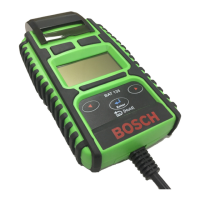
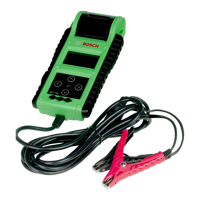
The BAT 155 Battery Tester is a diagnostic tool designed for testing 6 and 12-volt batteries, as well as 12 and 24-volt charging systems. It is particularly useful for automotive service and maintenance, providing insights into battery health and charging system performance. The device is intended for operation within an ambient temperature range of 0 to 50 degrees Celsius (32 to 122 degrees Fahrenheit).
The primary function of the BAT 155 is to assess the condition of vehicle batteries and charging systems. It offers several testing modes to provide a comprehensive diagnostic picture.
Battery Testing: This mode allows for the evaluation of individual 6-volt and 12-volt batteries. It determines the battery's State of Health (SOH), State of Charge (SOC), and voltage, providing results such as "GOOD & PASS," "GOOD & RECHARGE," "BAD & REPLACE," and "MARGINAL." These results guide users on whether a battery is capable of holding a charge, needs recharging, requires immediate replacement, or is serviceable but with decreased capacity. For battery pack testing, it specifically supports 12-volt systems.
Multiple Battery Testing (in a Vehicle): When a vehicle has multiple batteries, the BAT 155 can test them as a pack. If an issue is detected within the pack, the tester will indicate this, prompting the user to perform individual battery tests after disconnecting the cables. This ensures a thorough diagnosis of each battery in a multi-battery setup.
System Test: This comprehensive test evaluates the vehicle's charging system. It includes checks for cranking volts, idle voltage, and ripple voltage.
Amp/Volt Meter Testing: The device can function as an amp/volt meter when connected to the vehicle battery and equipped with the appropriate probes.
The BAT 155 is designed for ease of use with a clear display screen and intuitive controls.
User Interface: The device features a display screen (Home Screen) that presents test results and navigation options. Arrow keys allow users to scroll through menus and select different test modes or settings. An "Enter Key" confirms selections and advances through test procedures. A "Left Arrow Key" often serves as a back or cancel button.
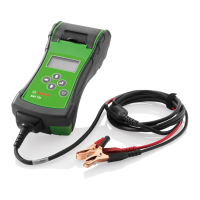
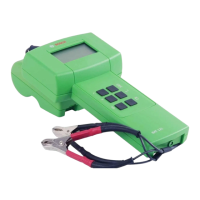
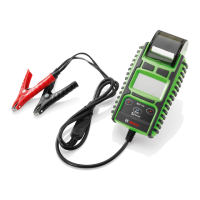
Connectivity: The tester connects to vehicle batteries using red and black load leads with clamps. The red clamp connects to the positive terminal, and the black clamp to the negative terminal. It also includes a USB port for potential data transfer or software updates (though not explicitly detailed in the provided excerpt, USB ports typically serve these functions).
Integrated Printer: A built-in thermal printer allows for immediate printouts of test results. This is a significant convenience for documenting diagnostic findings for customers or record-keeping. The printer uses 2 1/4 inch wide thermal paper rolls, with a maximum length of 98 feet.
Cable Verification: Upon connection to a vehicle battery, the tester performs a quick cable verification to ensure proper connection through the output cables and sensors in the clamp jaws. This helps prevent inaccurate readings due to poor connections.
Power Source: The BAT 155 is powered by 6 AA alkaline 1.5V batteries, which are installed in a chamber on the back of the unit. The device will display "POWER LOW" when these batteries are weak, indicating they need replacement. The tester's display will only become active once it's connected to a vehicle battery.
Settings Menu: A dedicated "Settings" menu allows users to customize various aspects of the device. Options typically include:
Safety Warnings: The manual emphasizes critical safety precautions, including working in well-ventilated areas, wearing safety glasses and protective clothing, and avoiding sparks or flames near batteries. It also warns against dropping metal tools onto batteries and advises removing personal metal items when working with lead-acid batteries to prevent short circuits and burns.
The BAT 155 requires minimal maintenance, primarily focusing on ensuring proper operation and longevity.
Battery Replacement: The internal 6 AA alkaline batteries need to be replaced when the "POWER LOW" message appears on the screen. It's recommended to replace all 6 batteries at the same time.
Paper Loading/Replacement: The integrated printer requires thermal paper rolls. Users can easily load new rolls by pulling up the cover lifter, inserting the roll, and ensuring the leading edge comes out correctly before closing the cover. The tester will not print if the cover is not properly snapped in place.
Terminal Cleaning: Before testing, it is crucial to ensure battery terminals are clean. The manual recommends using a wire brush if necessary to remove corrosion, being careful to prevent contact with eyes.
Battery Acid Level Check: For non-sealed, maintenance-free batteries, users are advised to add distilled water to each cell until the acid reaches the manufacturer's specified level. This helps purge excessive gas from cells and should be done carefully to avoid overfilling.
Physical Inspection: Users should regularly inspect the battery for cracked or broken cases or covers. If a battery is damaged, the tester should not be used on it.
Warranty and Return Goods: The device comes with a one-year warranty covering defects in material or workmanship. Warranty claims require dated proof of purchase and units must be shipped pre-paid. For returns, proper over-packing is essential to prevent damage during shipment, and "RETURN GOODS" should be indicated on all shipping documents to avoid extra charges.
The BAT 155 Battery Tester is a robust and user-friendly tool designed to provide accurate and reliable diagnostics for vehicle batteries and charging systems, supported by clear instructions and essential safety guidelines.
 General
| System Voltage | 12 V |
|---|---|
| Display | LCD |
| Width | 110 mm |
| Terminal Type | Clamp |
| Test Range | 100-2000 CCA |
| Supported Standards | EN, DIN, SAE, JIS, IEC |

 To Next Page