Donotintentionallyengagetilelockingmechanism
andattempttolift theentiredumbbellviatilegrip.
Thedumbbellshouldonlybeliftedbyusingthelift
handlesmoldedintothebaseassembly.
If thedumbbelllockingmechanismfailstoperform
in accordancewiththetestprocedureabove,
dotilefollowingthings:
1.Discontinueuseoftileproductimmediately
untilproperservicecanbeprovided.
2.ContactyourBowflexretailerorcontact
Bowflexdirectlybyphone
at1-800-605-3369forservice.
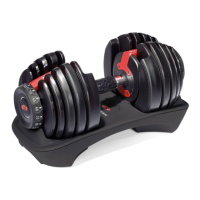
Offset weight selection
As indicated above, proper selection for a given weight
is accomplished by selecting that weight number on both
ends of the dumbbell. For example: to select 20 lbs, one
must dial both adjustment knobs on the dumbbell to tile
number 20. By selecting the same number on both sides of
the dumbbell, you will replicate a common dumbbell, this
is to say, a balanced dumbbell with equal weight on both
sides. While this is tile most common form of weight selec-
tion and will be used in tile vast majority of workouts, tile
Bowflex SelectTech wMDumbbell offers a useful and unique
workout alternative known as offset weight selection. Offset
weight selection involves using a different weight setting
on one side of the dumbbell relative to the other. Doing so
can be a powerful muscle development tool during certain
workouts, such as the biceps curl. The SelectTech Dumbbell
functions exactly the same way whether you have selected
balanced or offset weights. The only exception is that when
you are using offset weights, you must return the dumbbell
to the base in the same orientation that you removed it.
When you have offset weight selection the combination of
weight plates selected will not be the same on both sides of
the dumbbell. You must therefore make certain to return the
dumbbell to the base in the same orientation in which itwas
removed, in order for the weight plates to settle back into
the corresponding vacant slots in the dumbbell base.
Example of offset weight selection workout
Performed traditionally, dumbbell curls strengthen the
biceps, but do little for the forearm muscles that assist
in supination and pronation of the wrist. Supination and
pronation are terms describing a rotating motion of the
wrist. For example, turning a doorknob and turning your
key in your car's ignition are examples of supination and
pronation. Turning a doorknob clockwise would be the
supination direction, while counter-clockwise would be the
pronation direction. Whether you are training for a specific
sport, or just training to become stronger and improve activ-
ities of daily living, training your forearm muscles that are
involved in supination and pronation can be beneficial.
These dumbbells allow you to train differently than
traditional dumbbells. By using diflerent weight settings on
either side of the dumbbells, you can use those supination/
pronation muscles during your curls. Using more weight
on the thumb side of the dumbbell will improve pronation
strength, while more weight on the little finger side will
improve supination strength. Not only will you be strength-
ening your biceps, but also you can become stronger in
activities involving rotation of the wrist!
The following example of a Biceps Curl using offset weight
is a good demonstration of the superior muscle development
provided by the SelectTech Dumbbell.
Side 1 Side 2 Total dumbbell weight
Weight settings selected 201bs 30 Ibs 25 Ibs
Weight Difference A 10 Ibs
Weight Distribution 10 Ibs 15 Ibs 25 Ibs
Weight offset + 5 Ibs
im



 To Next Page