- 2 -
EN
Instructions for use
Contents
Cystofix®/Cystofix® Paed
Drainage catheter preassembled in its puncture
cannula, protective tubing (for Cystofix® Puncture
Set), stopper for balloon catheter only (doesn’t
apply for Cystofix® Paed), drainage bags (2L) with
drain tap and protective cap (for the Cystofix®
Puncture Set with bags).
Cystofix® Minipaed
Soft, coated mandril wire mounted in the drainage
catheter, adapter, puncture needle, splittable
introducer with safety sheath, guide wire (for
Cystofix® Minipaed Exchange sets).
Indications
Catheterisation of the bladder after surgery, in
case of bladder dysfunction, urinary retention, for
diagnostic purposes, for urine assessment.
Contraindications
Carcinoma of the bladder, anticoagulation and
antiplatelet treatment, abdominal wall sepsis,
presence of a subcutaneous vascular bypass in
the suprapubic region.
Side effects
In case where, despite the special design and
material of the catheter, a deposition of urinary
components on the catheter material occurs,
consider pH of urine, concentration of urine and/or
possible urinary infection. Occasionally, strangury
due to foreign body irritation may occur.
Recommendations
n Mandatory: the insertion of a suprapubic
percutaneous catheter and management of
the patient with the SPC must be undertaken
only by staff who has acquired appropriate
medical competencies.
n Please take into account current guidelines
and recommendations.
n Cystofix® products are not intented to be
used for long term implantation.
n Cystofix® polyurethane catheter is indicated
to be used for short term catheterisation.
n Cystofix® silicone balloon catheter is indi-
cated to be used for long term suprapubic
catheterisation.
n Do not introduce the catheter beyond the last
catheter mark.
D
Re-use of single-use devices creates a risk for
the patient or user. The device can be contami-
nated and/or its functional capacity impaired.
Contamination and/or limited functionality of
the device may lead to injury, sepsis or death
of the patient.
Urine bags contain DEHP. Animal experiments
have shown DEHP to be potentially toxic to
reproduction. Given the current state of scien-
tific knowledge, a risk (in case of long-term
use) especially for premature male babies can-
not be completely excluded. As a precaution,
the use of medical products containing DEHP
should be restricted to short-term use for pre-
gnant women, breastfeeding mothers, infants,
and children.
n Do not puncture in cases of: insufficiently filled
bladder.
n Do not puncture at distance of the median
line of the body : risk of bleeding!
n Do not withdraw the catheter from the can-
nula if the catheter tip protrudes beyond the
cannula tip (without the protective sheath in
place), catheter tip may be cut off!
n Separate cannula halves cautiously. Edges
of splitted cannula are sharp and may cut if
handled inappropriately!
n When exchanging the catheter, do not insert
the guidewire with the stiff tip first.
n Check the catheter function regularly; the
physician will decide how often and which
method should be used for this check.
n Do not use if the packaging is damaged.
n For the balloon catheters : do not inflate more
than indicated on the funnel.
Other indications: None
Interactions: None
Application
First puncture
Cystofix® Puncture Set, Cystofix® Paed
n Open the blister pack then prepare the set
component on a sterile area.
n Then, bladder must be filled according current
guidelines and recommendations and it must
be possible to localize it.
n Evaluate whether local anaesthesia is advi-
sable according current guidelines, then per-
form it all along the puncture track until the
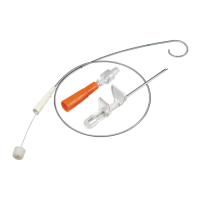
Puncture set, exchange set or dilation exchange set for suprapubic percutaneous
catheter insertion.


 To Next Page
 Loading...