EasyManua.ls Logo

Bridge Technologies VB440 - User Manual

Bridge Technologies VB440
60 pages
Print Icon
To Next Page IconTo Next Page
Loading...
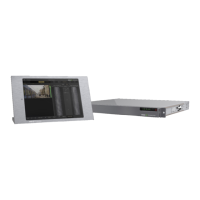
VB440 Studio Probe
User’s Manual
Applies to software release v6.0
November 2020
Current documents are always found in the log-in area of the www.bridgetech.tv site.
Refer to section 1.2 of this document for more information.
Question and Answer IconNeed help?

Do you have a question about the Bridge Technologies VB440 and is the answer not in the manual?

Overview

The Bridge Technologies VB440 Studio Probe is a real-time monitoring and analytics device designed for high-bitrate streams typically found in studio environments. It supports RTP streams carrying SMPTE 2022-6 and 2110 streams, with optional protection by SMPTE 2022-7. The probe's primary function is to enable operators to inspect individual streams and verify their compliance with relevant standards.

Function Description:

The VB440 Studio Probe acts as a comprehensive monitoring solution for professional media over IP networks. It features dual 100Gbps network ports, ensuring future-proof connectivity for high-bandwidth applications. The device operates as an HTTP server, allowing users to access its client interface via a standard web browser, eliminating the need for custom software installations on client computers.

The user interface is divided into several key views:

  • Status View: This is the landing page and provides a generalized overview of the probe's health and activity. It includes four main sections:

    • Network Status: Displays key information about each network interface, including connection status, physical link speed, received bitrate (with a bar indicating traffic load relative to max link speed), neighbor name and port (via LLDP), PTP state (Slave, Uncalibrated, Listening, Faulty, Disabled), and the current date and time of the PTP clock on the interface. A detailed view provides transceiver and extended LLDP information for troubleshooting and device identification.
    • PTP Clocks: Offers an overview of all PTP clocks announcing themselves on the network. It lists domain, preference, grand master, clock identity, vendor, time delta, time source, clock class, accuracy, priority2, and the network interface receiving announce messages. The VB440 itself always acts as a slave clock.
    • Video Engine Statistics (BETA): Provides an overview of active video engines, showing the engine number, video stream name, video format (resolution, scan format, frame rate), bitrate, throughput (frames per second), and maximum processing delay per video frame.
    • Video Streaming Statistics (BETA): Identifies client devices playing video flows. For each client, it displays the IP address, browser type, operating system, bitrate, queue length, and Round-Trip Time (RTT). Detailed client performance graphs for RTT, transmit rate, transmit queue length, and retransmission of packets are available.
  • Flow View: Accessible via a signal symbol, this view lists all monitored flows. Each entry shows an icon indicating flow type (video camera for video, headphones for audio, speech bubble for ancillary), flow name, signal persistence duration, transport stream standard, metadata (resolution, channels), and IP address. A search box facilitates locating specific flows. Clicking a flow opens a new window displaying an IAT (Inter-Arrival Time) graph. The bottom of the page summarizes configured, monitored, video, audio, and ancillary flows.

  • Service View: Accessed via a TV screen icon, this view lists all configured services and their associated flows. Users can click on a service for a detailed view or select from a list at the bottom. A search box is also available here.

  • Network View: Within the detailed service status, the Network view offers three tabs:

    • Flows: Provides extensive information about individual flows, including two IAT graphs and detailed measurements.
    • Capture: Used for troubleshooting by capturing packets for analysis. Users can set time limits, video frame limits, and packet limits. Rolling captures continuously capture streams until manually stopped. Captured files can be downloaded in Pcap format.
    • Timing: Features trend graphs for Path Delay, RTP Align Offset, First Packet Time (FPT), FPT Margin, Virtual Receive Buffer (VRX), and Network Burstiness (C). These graphs help visualize the timing model and identify potential issues related to packet arrival, buffer performance, and network congestion.
  • Video View: Displays the color scope of the video flow across three tabs:

    • Waveform: Shows luminance (Y), color difference (CbCr), combined YCbCr, and RGB components.
    • Vectorscope: Visualizes colorimetry, with options for Rec. 601, Rec. 709, and Rec. 2020 color spaces. Contrast can be adjusted.
    • Diamond: Illustrates RGB interaction to identify gamut errors, with blacks in the middle, whites at the top/bottom, blue/red on the right, and green on the left.
  • Audio View: Presents audio flows for a specific service using RMS meters, a Goniometer, and a LUFS radar. RMS meters show audio levels for individual channels. The Goniometer plots signals on L/R and M/S axes to visualize stereo imaging and phase. The LUFS radar displays Loudness Units Full Scale (LUFS) based on EBU R128 recommendations, with momentary, short-term, and integrated measurements, and selectable time intervals (15s, 30s, 3m, 1m, 5m).

  • Ancillary View: Offers two tabs for ancillary data:

    • Overview: Displays information associated with the ancillary flow, including line number, DID, SDID, specification, application, number of packets per frame, and total User Data Words.
    • SCTE 104: Provides an overview of transmitted SCTE 104 messages, including time, event ID, duration, and info.

Important Technical Specifications:

  • Supported Streams: RTP streams carrying SMPTE 2022-6 and 2110 streams.
  • Protection: Optional SMPTE 2022-7 protection.
  • Network Ports: Dual 100Gbps network ports for data.
  • Management Ports: 1 or 2 RJ45 1 Gbps Ethernet ports for management.
  • QSFP28 Connectors: Supported for data ports, or a QSFP cage + supported SFP module.
  • Supported QSFP28 Protocols: 100GBASE-CR4, 100GBASE-KR4, 100GBASE-SR4, 56GBASE-R4, 50G Ethernet Consortium, 40GBASE-CR4, 40GBASE-SR4, 40GBASEL-R4, 40GBASE-ER4, 25GBASE-CR/CR-S, 25GBASE-SR, 25GBASE-LR, 25G Ethernet Consortium, 10GBASE-SR, 10GBASE-LR, 10GBASE-ER, 10GBASE-CX4, SGMII, 1000BASE-X.
  • PTP Clock Accuracy: RTP clock ticks at 90kHz, providing a resolution of 11.111us.
  • Power: Requires two power cables for redundant PSU.
  • Operating Temperature: Maximum ambient temperature of 45 degrees Celsius to prevent overheating.
  • Safety: CE-marked (LVC 73/23/EEC, EMC 89/336/EEC), compliant with US and Canada requirements, designed for CSA approval. SFP modules are certified Laser Class 1.

Usage Features:

  • Web-based GUI: Accessible via any web browser (Chrome recommended), eliminating the need for dedicated software.
  • Intuitive Navigation: A navigation menu with distinct icons (Services, Flow, Status, Expert) allows for easy switching between views.
  • Flow Configuration: Users can define flow names, group names, IP addresses, ports, and apply class labels (e.g., Primary, Secondary, Amber, Blue) to bundle related flows into services.
  • Multicast/Unicast Support: Both multicast and unicast addresses can be configured and monitored.
  • SSM (Source-Specific Multicast) Support: Allows specification of additional SSM source addresses for backup solutions.
  • Uncompressed Stream Content Definition: Users can specify the type of content in the stream (e.g., 2022-6 SDI, 2110-30/AES67, 2110-40 Ancillary) or use auto-detection.
  • TR Offset Configuration: Allows setting a TR offset value for 2110-21 measurements, based on signal type or a specified value.
  • Packet Capture: On-demand packet capture with configurable limits and rolling capture functionality for post-event analysis.
  • PTP and BMCA Configuration: Detailed settings for PTP client and Best Master Clock Algorithm (BMCA), including mode, domain number, priority1, sync interval, announce interval, and announce receipt timeout.
  • Audio Monitoring: RMS meters, Goniometer for stereo imaging, and LUFS radar for loudness monitoring with various time scales and EBU modes.
  • Video Scope Analysis: Waveform, Vectorscope, and Diamond displays for detailed video signal analysis, including colorimetry adjustments.
  • Ancillary Data Monitoring: Overview and SCTE 104 message displays for ancillary data analysis.
  • System Administration Interface: Accessed via /admin URL, providing access to software activation, system health monitoring, networking settings, accounts, diagnostic reports, software updates, and a terminal.
  • User Accounts: Management of user accounts with different access rights (full or read-only).
  • Firewall Configuration: Allows defining zones, assigning interfaces, and configuring allowed services and IP ranges.
  • VLAN Support: Creation and configuration of VLANs for network segmentation.

Maintenance Features:

  • Diagnostic Reports: Generation of diagnostic reports for support teams to debug potential issues.
  • Software Updates: Automatic checking for and installation of software updates, including security fixes and probe software. Users can choose to install all updates or security updates only.
  • Update History: Logs past updates with date, time, and number of packages.
  • Configuration Export/Import: Full or partial configuration can be exported as XML documents for backup and restoration. License and software maintenance keys can also be exported/imported.
  • Eii (External Integration Interface): Allows export of XML files containing data for integration with 3rd party NMS systems.
  • System Logs: Displays system logs, including errors, warnings, and notices, with filtering options for debugging.
  • Counters and Alarms: Clear all button to reset all counters, graphs, and alarm history.

Bridge Technologies VB440 Specifications

General IconGeneral
BrandBridge Technologies
ModelVB440
CategoryMeasuring Instruments
LanguageEnglish