
 Need help?
Do you have a question about the BRIGHT BlueEye Ex-D and is the answer not in the manual?
Instructions for safe handling, modification prohibition, and spare parts.
Explanation of DANGER, WARNING, CAUTION, and NOTICE symbols.
Description of the MEMS-based gas quality measurement device.
List of reported values, units, reference conditions, and standards.
Accuracy, repeatability, and dynamics of the device.
Specifies the permissible gas composition ranges for the device.
Hazards associated with installation, maintenance, and repair activities.
Defines Zone classifications (0, 1, 2, 20, 21, 22) for hazardous areas.
Explains the meaning of symbols and codes in the ATEX marking.
Properties of specifically designed gas connectors with sintered metal flame arrestors.
Provides the external physical dimensions of the BlueEye™ Ex-D.
Lists and describes the components shown in the P&ID diagram.
Two methods for communicating with the device: RS485 and USB package.
Options for selecting output parameters and their default ranges.
Procedure for formatting the microSD card for data logging.
List of recommended checks for pressure, flow rate, and sensor contamination.
Conditions under which the factory calibration values are determined.
Details on supply voltage and power consumption.
Specifies inlet, overload, and outlet pressure parameters.
Defines ambient, gas, and maximum surface temperature ranges.
Information on the types of gases the device can measure.
Link to the Modbus communication protocol documentation.
Information regarding ATEX and IECEx certificates of conformity.
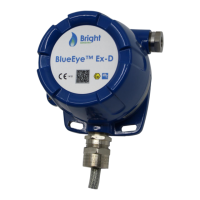
The BlueEye™ Ex-D is a MEMS-based gas quality analyzer designed for continuous measurement of combustible gases in hazardous areas. It correlates measurements to various gas composition parameters, including Gross Calorific Value (Hs), Net Calorific Value (Hi), Gross Wobbe Index (WIs), Net Wobbe Index (Wli), Density (ρ), Relative Density (ρ rel.), Compression factor (Z), Air-Fuel ratio (AFR), Stoichiometric Air-Fuel Ratio (s-ARF), Methane Number (MN), Carbon dioxide mol% (CO2 mol%), and Hydrogen mol% (H2 mol%). The device is certified for use in Zone 1 and Zone 2 hazardous areas, adhering to ATEX and IECEx standards.
The BlueEye™ Ex-D utilizes micro-electromechanical systems (MEMS) for gas quality measurement. It incorporates Bright Sensors' patented dynamic viscosity measurement principle, combined with other MEMS-based measurement techniques like thermal conductivity and Integrated Infrared (INIR) for CO2 sensing. The gas combustion properties are calculated by inductive standards through correlative models. These models are temperature and pressure compensated within a defined range to ensure accurate measurement results. The device operates automatically upon power connection, activating data communication via RS485 Modbus RTU and providing a signal through its 4-20 mA current loop after approximately 3 minutes.
The BlueEye™ Ex-D is designed for ease of use and integration into existing systems. It can be connected to a gas supply, with recommendations for a dry, filtered gas supply line, a 10µm filter, and a pressure reducer if the main pipeline pressure exceeds 1100 mbar absolute. The device should be mounted upright with gas connectors in a horizontal position and the cable gland perpendicular to the ground. For optimal measurement performance, it is recommended to install a purge bypass and avoid long gas lines to achieve low latency results. The device is calibrated for an absolute pressure range between 960 and 1100 mbar, and stable pressure within this range is crucial for accurate measurements.
Communication with the BlueEye™ Ex-D can be established in two ways: via RS485 Modbus RTU, requiring connection to the user's own Modbus system, or by using Bright Sensors' Modbus USB Windows Interface Package. The latter offers additional functionalities such as charting, storing output parameters in CSV format, switching reference conditions and units, and applying moving averages. The device continuously reports one selected parameter via the 4-20mA current loop, with default output ranges that can be customized via Modbus registers.
The BlueEye™ Ex-D includes a dedicated microSD card slot for continuous logging of measurement and system data. The device logs measurement data with 1-second granularity to a .csv file, compressing and saving it once the file reaches 10 MB. It can store up to 200 compressed data log files, equivalent to approximately 6 months of data, before deleting the oldest files. System data is also logged in real-time to a text file for debugging purposes, storing up to 5 system data log files (approximately 1 week of data). To activate data logging, a microSD card must be formatted to FAT32 and inserted into the device's PCB slot after powering down and removing the top lid.
The BlueEye™ Ex-D is designed with minimal maintenance requirements due to the absence of moving parts, combustion of the medium, or chemical reactions with the medium. However, an inspection interval of every 12 months is recommended. This inspection should verify correct pressure and flow rate, ensure no contamination of the flame arrestors or sensor unit, and confirm that the accuracy of reported values is within specifications.
The device is factory calibrated, and a calibration report is provided upon purchase. To validate if drift is within the required accuracy, the BlueEye™ Ex-D should be tested under the same conditions as during calibration. If the average 10-minute values deviate by more than 0.25%, recalibration or replacement of the sensor unit is recommended. For devices with an integrated CO2 sensor, a "zeroing" procedure is recommended every 6 months to reset the baseline, as these sensors are more prone to drift.
The 4-20 mA current loop is factory calibrated but can be re-calibrated by the user to match specific current loop systems. This can be done via Modbus or using the Bright Sensors' Modbus USB Windows Interface Package by following a specific procedure involving passcode entry, setting override values, adjusting input integers for 4 mA and 20 mA, and then restarting standard current loop operation.
For cleaning, the device should only be cleaned with a slightly damp cloth to prevent damage to components. It is crucial not to insert any items into the openings to avoid mechanical stress, liquids, or dirt that could damage or destroy the sensor. Any repairs or alterations not described in the operating manual must not be carried out without prior consultation with Bright Sensors SA to maintain warranty validity and ensure safe operation. In hazardous areas, special care must be taken with electrical connections, and an ATEX-approved junction box must be connected to the outer end of the cable if it is installed within the ATEX zone.
 General
| Type | Laser Distance Meter |
|---|---|
| Accuracy | ± 1.5 mm |
| Laser Class | Class 2 |
| Laser Type | 635 nm, <1mW |
| Operating Temperature | -10°C to +50°C |
| Protection Class/Rating | IP65 |
| Resolution | 1 mm |
| Response Time | < 0.5 s |
| Battery Type | Li-Ion Rechargeable |

 To Next Page