The Brooks Sho-Rate™ "50" Model 1350E and Sho-Rate™ "150" Model 1355E are variable area, glass tube flow rate indicating meters designed for a wide range of gas and liquid low-flow applications. These devices are manufactured to meet national and international standards, ensuring reliable performance when properly installed, operated, and maintained.
Function Description:
The core function of these flowmeters is to provide a visual indication of flow rate. They operate on the variable area principle, where a tapered glass metering tube and a metering float are the basic elements. As fluid flows through the tube, the float rises to a position where the upward force of the fluid equals the downward force of gravity. The height of the float, read against a scale on the tube or an adjacent scale plate, directly corresponds to the flow rate. The design allows for quick and simple removal or installation of the tube and float while the meter remains in the process piping, facilitating maintenance and calibration.
Important Technical Specifications:
- Models: Sho-Rate™ "50" Model 1350E and Sho-Rate™ "150" Model 1355E.
- Sizes: Available in sizes 2-6.
- Capacities:
- 1350 Series: Refer to Tables 1-1 or 1-2, or 1-3 and 1-4 for detailed capacities based on tube type (rib-guided or plain tapered) and float material (glass, sapphire, stainless steel, Carboloy®, tantalum).
- 1355 Series: Refer to Tables 1-3 and 1-4, or 1-5 for detailed capacities based on tube type (rib-guided) and float material.
- Flow rates are maximum values, with air flows specified at 14.7 PSIA and 70°F.
- Accuracy:
- 1350 Series Standard: ±10% of full scale.
- 1355 Series Standard: ±5% of full scale.
- Repeatability: 0.5% full scale.
- Pressure/Temperature: Rated for 200 psig at temperatures from 33°F to 250°F.
- Pressure Equipment Directive (PED): Equipment falls under Sound Engineering Practice (SEP) according to directive 97/23/EC. Meters larger than 25mm or 1" (inch) are in compliance with PED category I, II or III. All Brooks Instrument Flowmeters fall under fluid group 1.
- European Electromagnetic Compatibility (EMC): CE marked, tested to regulations of 2004/108/EC (EMC directive 89/336/EEC). Requires shielded signal cables and metal connectors for optimal performance.
- Scales:
- 1350 Series: 65 mm nominal length. Graduations: R-65mm or R-100 linear reference scale with air or water calibration table.
- 1355 Series: 150mm nominal length. Graduations: R-150 mm or R-100 linear reference scale with air or water calibration table. Optional direct reading scales (65 mm or 150 mm) with ceramic ink fused on glass tube or metal scale plate mounted beside the tube. Standard type: Ceramic ink fused on meter tube with contrasting yellow background.
- Materials of Construction:
- Metering Tubes: Borosilicate glass.
- Floats: Glass, 316 stainless steel, sapphire, Carboloy®, tantalum.
- Structural Members: End fittings (chrome plated brass, black anodized aluminum, 316 stainless steel), Side plates (black anodized aluminum, optional 316 stainless steel).
- Window: Clear polycarbonate; Back Window: Milk white polycarbonate.
- Float Stops: Standard Teflon®, optional 316 Stainless Steel.
- Tube Packing: Standard Buna-N (Brass and aluminum meters), Viton-A® fluoroelastomers (316 stainless steel meters). Optional Teflon®, EPM (also known as EPR).
- O-rings: Standard Buna-N (Brass and aluminum meters), Viton-A fluoroelastomers (316 stainless steel meters). Optional Teflon (not available with needle valves), EPM, Kalrez®.
- Connections: Standard horizontal female 1/8" NPT threaded adapters with locknuts for front of panel mounting. Multi-tube meters offer individual 1/8" NPT horizontal inlet and outlet; manifold connection 1/8" NPT on inlet with individual outlet or manifold outlet with individual inlet connections.
- Optional Equipment:
- Standard Needle Valve: Can be integrally mounted to the inlet or outlet for fine flow control. Excessive tightening should be avoided to prevent damage to the valve seat. For tight shut-off, a separate shut-off valve upstream is recommended.
- Flow Controllers: Can be integrally mounted to the inlet or outlet.
Usage Features:
- Installation: Flowmeters should be mounted within 6° of true vertical. The inlet connection is at the bottom end fitting, and connections are typically horizontal, female NPT. Adequate piping support is crucial to prevent undue strain on the meter.
- Operation: After installation, flow should be initiated slowly to prevent sudden excessive pressure or flow surges. The flow indication is read using the center of the spherical float as the reference point.
- Safety Warnings:
- Do not operate beyond specified pressure and temperature limits to avoid serious personal injury or equipment damage.
- Glass metering tubes are brittle; breakage can occur even within operating conditions. Do not use with toxic fluids or fluids that chemically react with glass (e.g., water above 140°F, steam, alkalis, fluorine, hydrofluoric acid, molten metal).
- If inlet and outlet valves are closed for any reason, the flowmeter must be completely drained to prevent rupture due to thermal expansion of liquids.
- Protective devices (flow controllers, pressure regulators, snubbers, rupture discs) should be installed upstream to prevent surges.
- ESD (Electrostatic Discharge) Precautions: The instrument contains electronic components susceptible to static damage. Personnel must be grounded, and circuit boards handled in conductive containers.
Maintenance Features:
- Disassembly and Cleaning: The user should periodically inspect and clean the tube and float to prevent inaccuracy and sticking caused by dirt or foreign materials. Borosilicate glass and related parts can be cleaned with any solvent that does not attack glass.
- Seal Compatibility: Users are responsible for selecting materials compatible with their process and conditions, as incompatible materials can lead to leaks, personal injury, or death. Regular checks for leaks are recommended, as metal and elastomeric seals, gaskets, O-rings, and valve seats can change with age, exposure to process fluid, temperature, and pressure.
- Storage: For intermediate or long-term storage, equipment should be kept in its original shipping container in a warm, dry heated warehouse at ambient temperatures of 70°F nominal (110°F max/45°F min) and relative humidity of 45% nominal (60% max/25% min). After prolonged storage (over two years or in adverse conditions), all pressure boundary seals should be replaced, and the device subjected to a hydrostatic/pneumatic pressure test to 150% of rated pressure.
- Return Shipment: A Return Materials Report is required for any returns, available from District Sales Offices or the Product Service Department.
- Service and Support: Brooks Instrument offers repair facilities, start-up service, in-situ calibration, customer seminars, and training. Technical assistance is available via phone for Americas, Europe, and Asia.

 Need help?
 General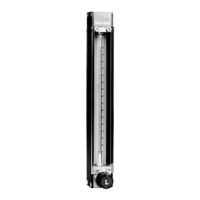

 To Next Page